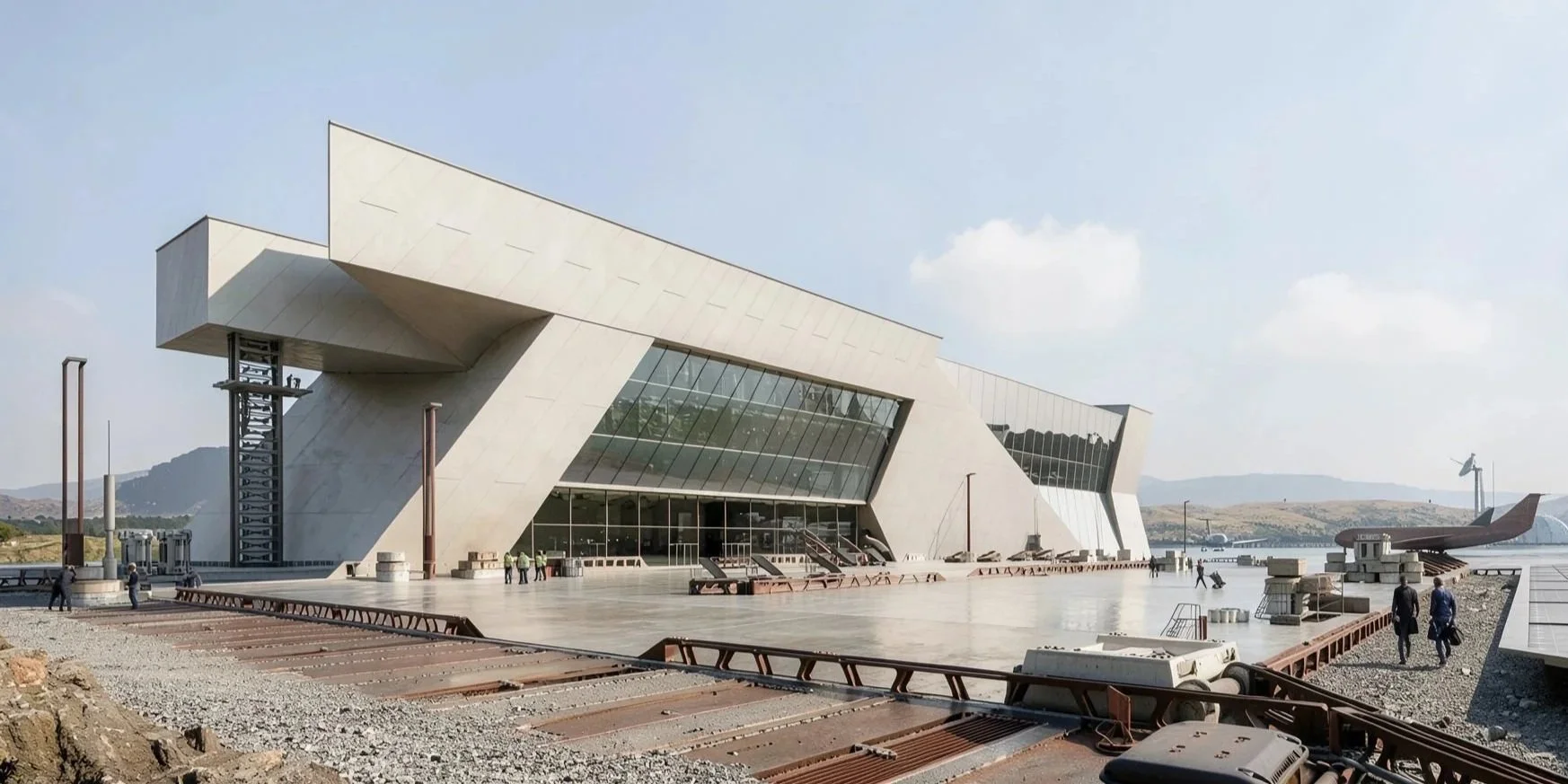
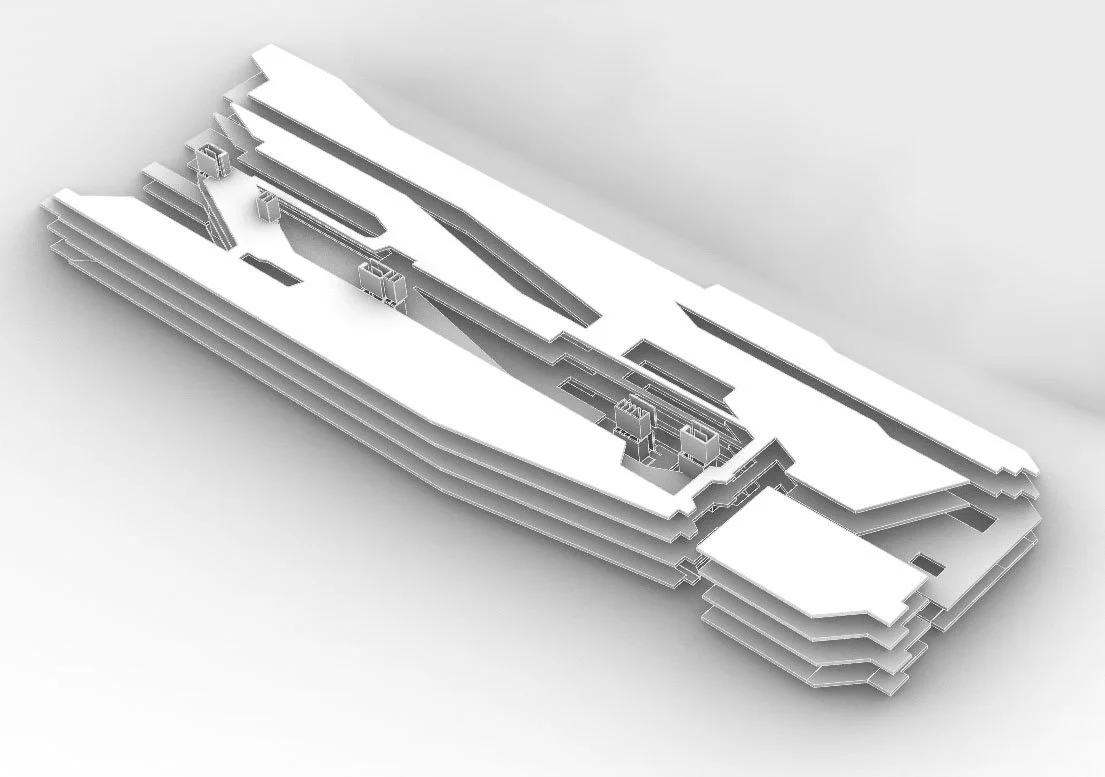
Domestic Terminal, Phoenix, AZ USA

Further information and case study for this project can be found at the De Gruyter Birkhäuser Modern Construction Online database

The following architectural theory-based case study is not available at Modern Construction Online

Domestic Airport Terminal, Las Vegas — Functional Clarity and Expressive Infrastructure

The Domestic Airport Terminal in Las Vegas, designed and engineered by Newtecnic, exemplifies a rational and performance-oriented approach to contemporary public architecture. Merging logistical efficiency with architectural legibility, the project synthesizes functionalist modernism with digitally coordinated construction. The terminal redefines utilitarian design as a platform for expressive infrastructure—adaptable, technically integrated, and visibly structured. This methodology closely aligns with the systems-based frameworks set out in Modern Construction Handbook (Watts, 2023) and Modern Construction Case Studies (Watts, 2019), where modularity, digital workflows, and material logic shape contemporary infrastructure.

The design builds upon a lineage of High Modernist projects where architecture and engineering converge. Eero Saarinen’s TWA Flight Center (JFK, 1962) merged sculptural form with intuitive circulation, capturing the spirit of jet-age travel. Louis Kahn’s Richards Medical Research Laboratories (Philadelphia, 1965) and Pier Luigi Nervi’s Palazzetto dello Sport (Rome, 1957) further demonstrate how structural expression can serve as architectural identity. These precedents inform the Las Vegas terminal’s commitment to exposing structural systems and flows, rendering infrastructure both performative and legible.

Precedent-Informed Strategy from Modern Environmental Design

The design of Project 11 was influenced by the “loose-fit” principles articulated in Project 17 of Modern Environmental Design (Watts, 2022), which emphasize long-term flexibility in environmental and spatial systems. Independent installation pathways for primary assemblies—including structure, envelope, and services—allow for selective upgrades without disrupting building operation. Cast-in floor slab sockets arranged on a regular grid facilitate future additions of HVAC components and solar shading devices without auxiliary supports. This modular strategy reduces material use, decouples systems, and anticipates evolving performance demands, reinforcing lifecycle adaptability.

Influence of Federation Square on Façade Technology

The terminal’s façade system draws directly from the modular and parametric principles tested at Federation Square, as detailed in Modern Construction Case Studies (Watts, 2016). Federation Square’s digital envelope—marked by CNC-cut, dry-fixed metal panels—served as a key precedent in tectonic articulation and environmental modulation. Adapting this approach, the Las Vegas terminal utilizes aluminium panels on adjustable subframes with concealed fixings and slotted brackets, allowing for rapid installation and maintenance while accommodating thermal movement. The parametric design of the rainscreen system—driven by digital fabrication workflows—enables variation in panel geometry across the façade, combining performance with formal articulation. This strategy advances the concept of the façade as a dynamic and adaptive infrastructural layer.

Functional Planning and Adaptability

The terminal’s spatial layout prioritizes clarity and future-proofing. Initially designed to serve ground-level access via shuttle buses, the structure includes provisions for future integration of upper-level jet bridges. This anticipatory approach echoes Cedric Price’s concept of “expendable architecture” (1999), in which buildings evolve alongside user needs and operational contexts.

Envelope flexibility is achieved through a demountable rainscreen system, allowing finishes to be updated or replaced independently from the primary structure. Concealed mechanical fixings and non-penetrative installation preserve both thermal continuity and architectural integrity. This reflects Habraken’s (1972) separation of support and infill, and aligns with the lifecycle design principles presented in Modern Construction Envelopes (Watts, 2019).

Parametric modeling governs panel dimensions, bracket geometries, and structural loads, ensuring material efficiency and precise fabrication. The resulting system supports rapid site installation via digitally defined datum points and minimizes construction time and cost—a hallmark of the workflows detailed in Modern Construction Handbook (Watts, 2023).

Spatial Arrangement and Structural Logic

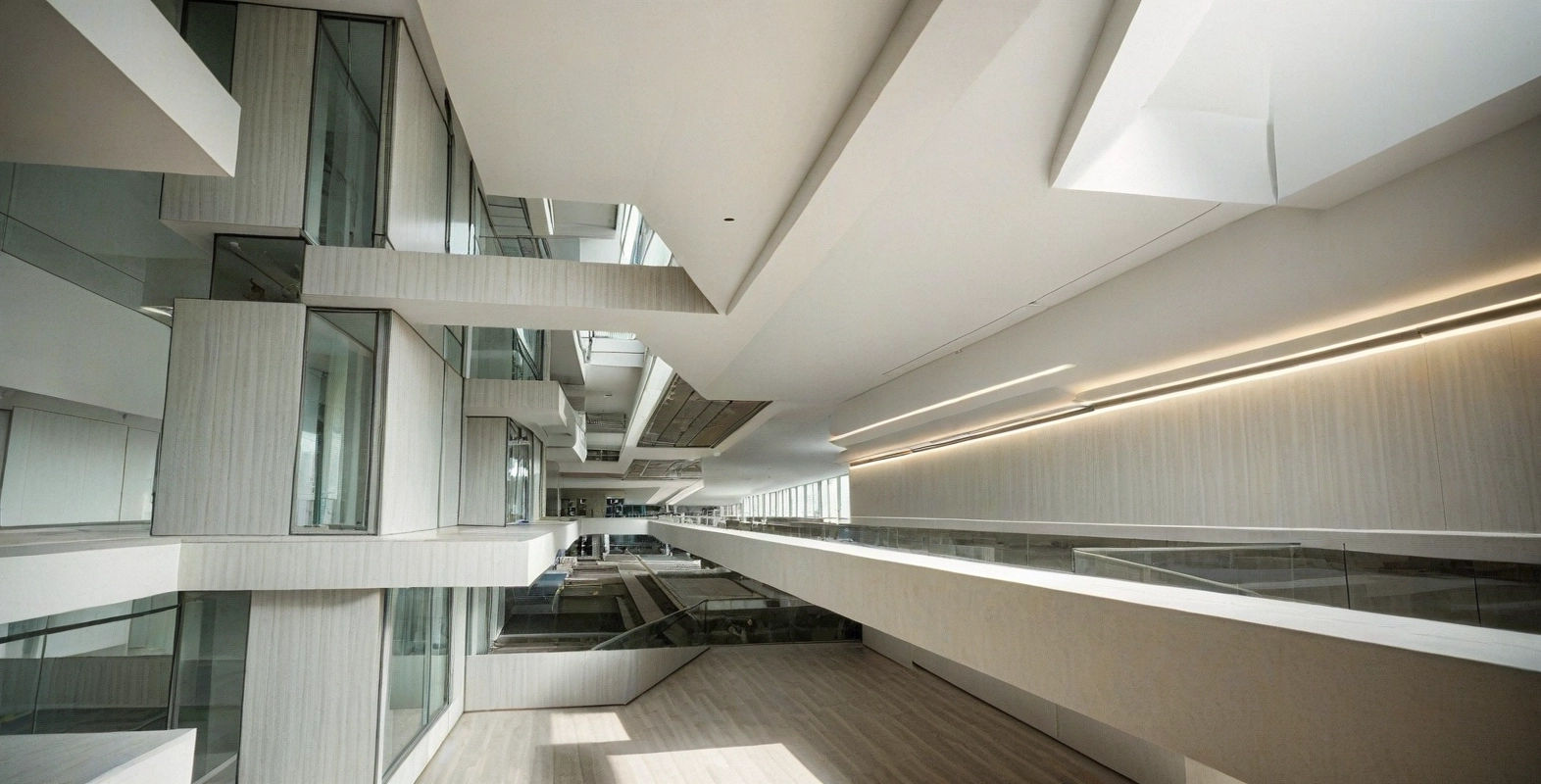
Long-span steel trusses and inclined columns define an expansive, open-plan concourse that facilitates movement and enhances spatial legibility. This structural clarity recalls the jet-age optimism of mid-century transport architecture, where openness symbolized progress and mobility (Pearman, 2004).

Digitally modeled steel node joints resolve the complex intersections of inclined trusses, support members, and services. Parametric engineering tools optimize stress distribution and material use across non-orthogonal geometries (Burry and Burry, 2010; Terzidis, 2006). These strategies exemplify the integration of structural logic and spatial planning documented in Modern Construction Case Studies (Watts, 2019).

Form and Expressive Modernism

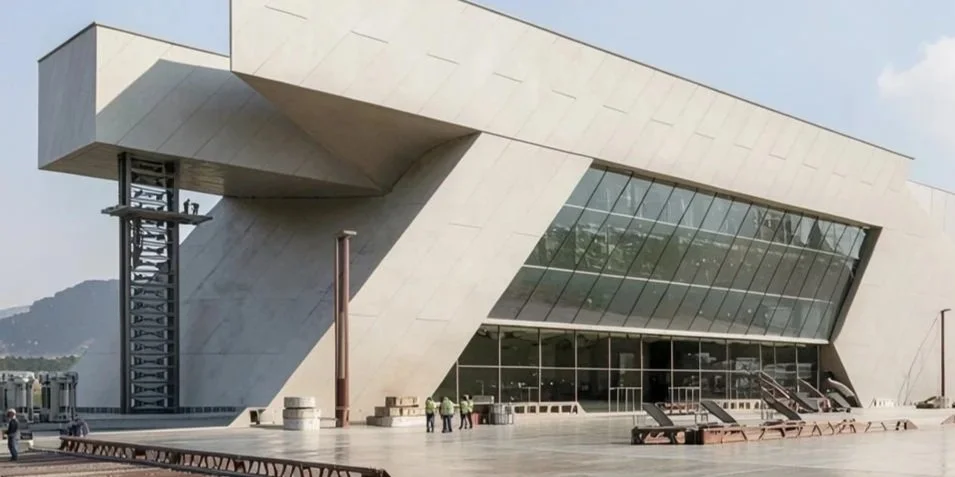
The building’s form articulates its function: angled roof planes and visible support systems mirror the internal organization of passenger flow and spatial hierarchy. This principle reflects Le Corbusier’s “machine for living” ethos (1933) and Louis Kahn’s idea that “form expresses purpose” (1961).

The inclined roof geometry communicates motion and dynamism, drawing on the visual language of Futurism (Benevolo, 1971). This expressive formalism—anchored in pragmatic structural reasoning—illustrates how modernist ideals remain potent when reinterpreted through advanced construction systems and digital coordination.

Environmental Systems and Service Integration

Given Nevada’s arid climate, the terminal relies primarily on active mechanical systems. However, environmental efficiency is achieved through compact and coordinated integration within the structural frame. HVAC ducts, lighting, and acoustic systems are embedded within steel zones, allowing continuous service distribution without visual or spatial interruption.

BIM coordination ensures precise alignment of MEP systems within the parametric structural model. Prefabricated service modules—complete with integrated cable trays and fixing points—streamline on-site assembly and reduce installation conflicts (Oxman, 2008). This level of integration echoes the construction intelligence explored in Modern Construction Handbook (Watts, 2023).

Facade Design and Tectonic Precision

The rainscreen system exemplifies tectonic discipline. Panels are supported by CNC-cut aluminium rails mounted on steel subframes via slotted mechanical brackets. This dry-fixed system accommodates expansion, ensures alignment, and allows easy replacement—all while maintaining a clean visual finish.

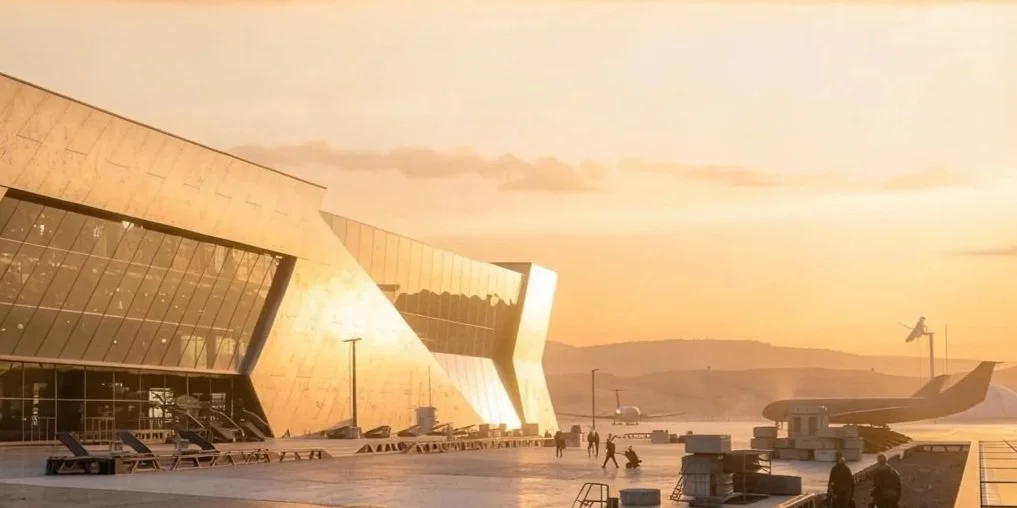
Material expression is enhanced through the subtle chromatic shift of the metal cladding, which responds to changing light conditions. This performative aesthetic recalls Frampton’s (1995) concept of “tectonic culture,” where structure and assembly become expressive media. The façade embodies the principles of “poetic functionalism” (Frampton, 1980), delivering both visual clarity and environmental performance—an ethos central to Modern Construction Envelopes (Watts, 2019).

Conclusion

Engineered and realized by Newtecnic, the Domestic Airport Terminal in Las Vegas embodies a contemporary rethinking of public infrastructure—merging programmatic clarity, structural expressiveness, and modular adaptability. It is a project where utility meets aesthetic precision, and where infrastructure becomes legible, upgradeable, and expressive.

As illustrated across Watts’s publications—including Modern Construction Case Studies (2019), Modern Environmental Design (2022), and Modern Construction Handbook (2023)—the terminal sets a benchmark for digitally coordinated, performance-driven architecture. It affirms that infrastructure, when designed with systemic intelligence and architectural ambition, can transcend its functional mandate to become a civic and spatial landmark.

References

Banham, R. (1976) Megastructure: Urban Futures of the Recent Past. London: Thames and Hudson.

Benevolo, L. (1971) The Architecture of the Modern Age. London: Routledge & Kegan Paul.

Bechthold, M. (2010) Innovative Surface Structures: Technologies and Applications. Abingdon: Routledge.

Burry, M. and Burry, J. (2010) The New Structuralism: Design, Engineering and Architectural Technologies. Chichester: Wiley.

Frampton, K. (1980) Modern Architecture: A Critical History. London: Thames and Hudson.

Frampton, K. (1995) Studies in Tectonic Culture. Cambridge, MA: MIT Press.

Giedion, S. (1941) Space, Time and Architecture. Cambridge, MA: Harvard University Press.

Habraken, N.J. (1972) Supports: An Alternative to Mass Housing. London: Architectural Press.

Kahn, L. (1961) ‘Form and Design’, Perspecta, 4, pp. 3–9.

Kolarevic, B. (2003) Architecture in the Digital Age. London: Spon Press.

Le Corbusier (1933) Towards a New Architecture. London: Architectural Press.

Nervi, P.L. (1957) Palazzetto dello Sport. Rome.

Oxman, R. (2008) ‘Digital Architecture as a Challenge for Design Pedagogy’, Design Studies, 29(2), pp. 99–120.

Pearman, H. (2004) Airports: A Century of Architecture. London: Laurence King.

Price, C. (1999) ‘The Square Book’, Architectural Design, 69(3–4), pp. 84–91.

Saarinen, E. (1962) TWA Flight Center, JFK Airport, New York.

Terzidis, K. (2006) Algorithmic Architecture. Oxford: Elsevier.

Watts, A. (2016) Modern Construction Case Studies. 1st ed. Basel: Birkhäuser.

Watts, A. (2019) Modern Construction Case Studies. 2nd ed. Basel: Birkhäuser.

Watts, A. (2019) Modern Construction Envelopes. 3rd ed. Basel: Birkhäuser.

Watts, A. (2022) Modern Environmental Design. Basel: Birkhäuser.

Watts, A. (2023) Modern Construction Handbook. 6th ed. Basel: Birkhäuser.