
Al Faisaliah Retail Mall, Riyadh, Saudi Arabia
Further information and case study for this project can be found at the De Gruyter Birkhäuser Modern Construction Online database
The following text is not available at Modern Construction Online
The Façade as Environmental Infrastructure
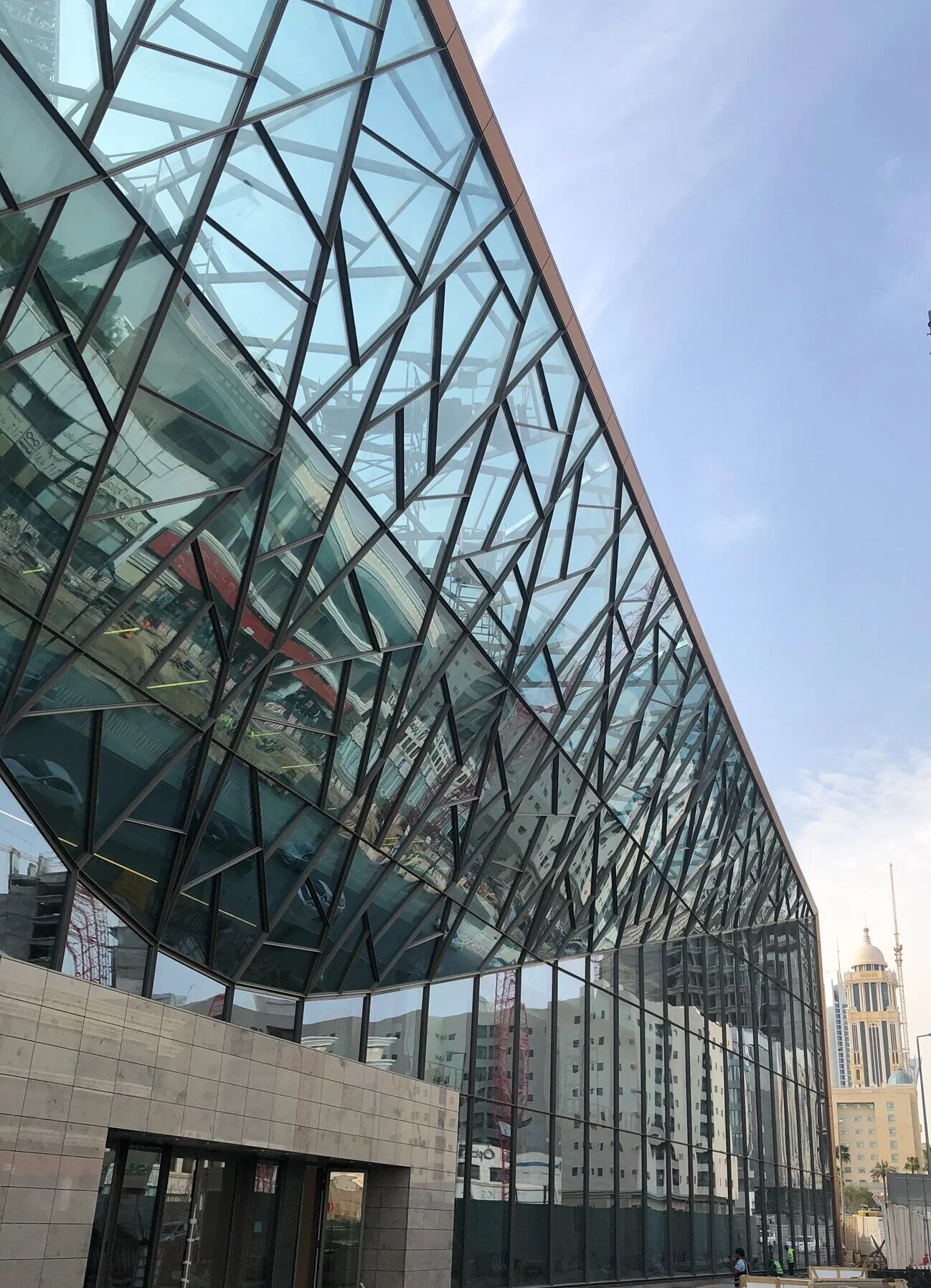
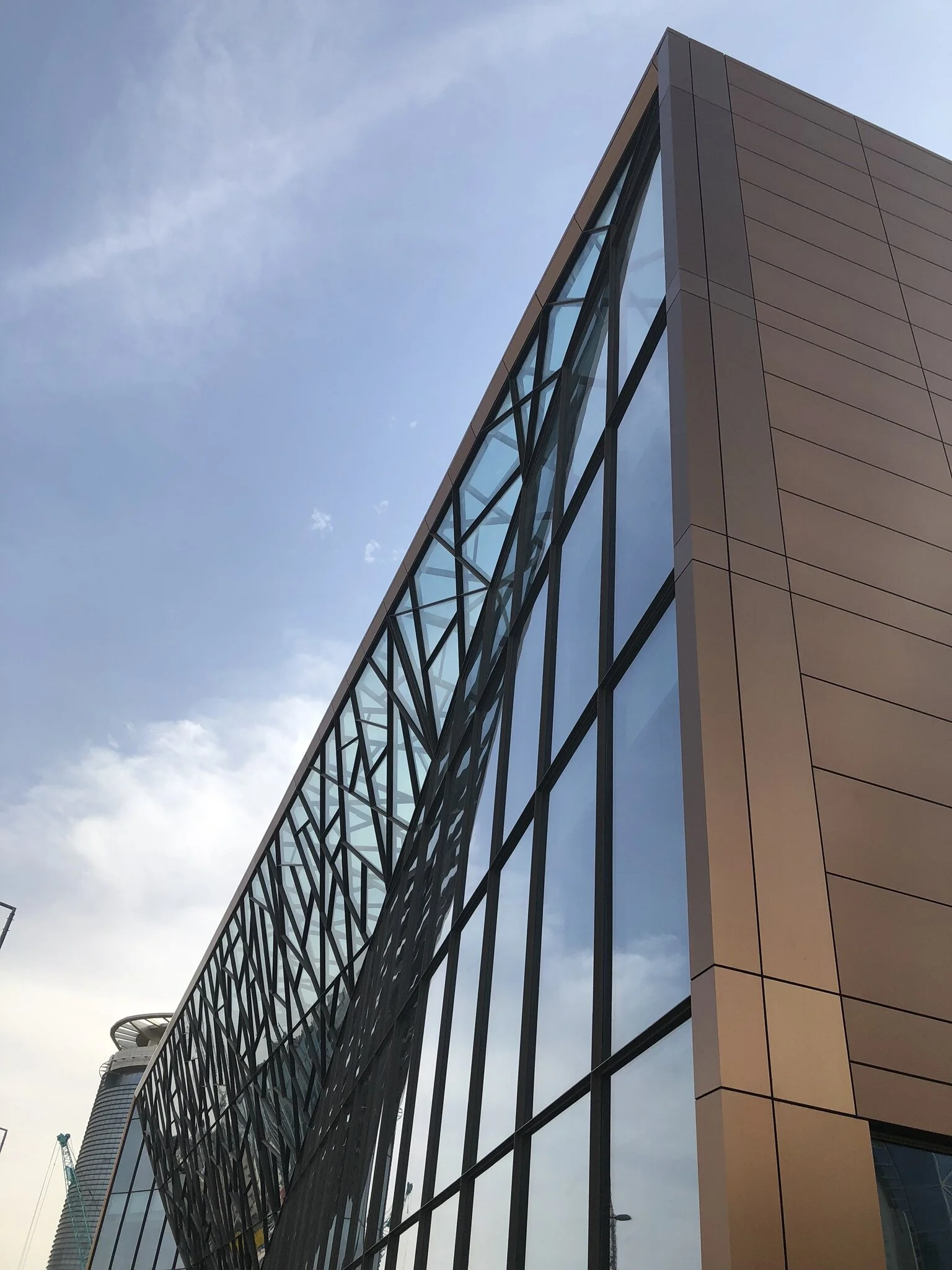
The Al Faisaliah Shopping Mall extension forms part of one of Riyadh's most recognised commercial destinations. Designed by Gensler with façade engineering by Newtecnic, the project extends an established urban landmark while responding to the environmental demands of a hot desert climate and the expectations of contemporary retail architecture.
Newtecnic developed the façade engineering strategy, integrating environmental performance, construction efficiency and architectural expression within a unified building envelope.
The project is significant because it demonstrates a fundamental shift in the understanding of façade design. Rather than functioning solely as an external enclosure, the façade operates as environmental infrastructure. It moderates climate, integrates building services, supports maintenance, contributes to energy performance and establishes architectural identity simultaneously.
In this respect, the project illustrates a broader evolution within contemporary architecture. The façade is no longer simply the outer surface of a building. It becomes an active system through which environmental, operational and architectural objectives are coordinated.
Building in a Desert Climate
Architecture in Riyadh begins with climate.
Extreme solar exposure, high ambient temperatures, intense glare and airborne dust create environmental conditions that place considerable demands upon buildings. Retail environments introduce additional requirements. Large volumes of public space require thermal comfort, visual clarity, controlled daylight and energy efficiency throughout extended operating hours.
These conditions create a fundamental challenge.
Shopping centres seek openness and visibility. Desert climates demand protection and moderation.
The façade therefore becomes the primary mediator between these competing requirements.
Its task is not merely to separate inside from outside but to establish a controlled environmental transition between two radically different climatic conditions.
From Enclosure to Environmental Filter
The architectural strategy treats the façade as a filter rather than a barrier.
Traditional walls often operate through separation. Contemporary environmental envelopes increasingly operate through modulation. Instead of excluding external conditions entirely, they regulate the degree to which light, heat, air and views are permitted to enter the building.
The Al Faisaliah extension embodies this principle.
Shading systems, glazing, ventilated cavities and environmental control elements are organised as layers within a coordinated assembly. Each layer performs a specific function while contributing to the overall performance of the system.
The result is a façade that responds selectively to environmental forces rather than resisting them uniformly.
This approach reflects an important lesson for architectural practice: successful environmental design often depends upon managing forces rather than simply excluding them.
Layering as Environmental Strategy
One of the defining characteristics of the project is its layered construction.
The façade is organised as a sequence of environmental thresholds positioned between the exterior climate and the conditioned interior environment.
External shading devices form the first layer of protection, intercepting solar radiation before it reaches the building enclosure. Recessed glazing provides a second layer of defence by reducing direct exposure to sunlight. Ventilated cavities introduce a third layer, dissipating heat before it can transfer into occupied spaces.
Each layer contributes to performance.
More importantly, the layers operate together.
Environmental effectiveness emerges not from individual components but from the relationships established between them.
This principle of layered performance has become increasingly important within contemporary façade engineering, particularly in regions where climatic conditions place exceptional demands upon buildings.
Learning from Regional Traditions
Although realised through contemporary materials and fabrication methods, the project draws upon principles deeply rooted in regional architectural traditions.
Throughout the Middle East, architecture has long relied upon filtered light, shaded transition spaces and layered environmental boundaries. Courtyards, arcades, screens and recessed openings all perform environmental functions while contributing to social and spatial experience.
The Al Faisaliah façade reinterprets these principles within a contemporary commercial context.
Rather than reproducing historical forms, it adapts underlying environmental strategies. Shading becomes integrated within the building envelope. Layers of screening regulate daylight and glare. Transitional zones moderate environmental conditions between exterior and interior spaces.
This approach demonstrates how architectural continuity can be achieved through the adaptation of principles rather than the replication of forms.
Regional identity emerges through environmental intelligence rather than stylistic imitation.
Environmental Performance and Architectural Expression
A recurring challenge within architecture is the relationship between technical performance and visual expression.
Environmental systems are often treated as separate technical additions attached to completed architectural forms. This separation frequently produces conflicts between performance requirements and architectural intentions.
The Al Faisaliah extension adopts a different approach.
Environmental performance becomes a generator of architectural expression.
The depth of the façade, the rhythm of shading devices, the articulation of openings and the layering of surfaces all emerge from environmental requirements. The architectural character of the building is therefore inseparable from its environmental logic.
This relationship recalls an important modernist principle: architecture achieves coherence when technical requirements contribute directly to form rather than being concealed behind it.
Performance becomes visible.
Integration of Building Services
One of the less visible but equally important aspects of the project is the integration of building services within the façade assembly.
Contemporary façades increasingly accommodate lighting systems, maintenance routes, environmental controls and operational infrastructure. These functions must be incorporated without compromising environmental performance or architectural clarity.
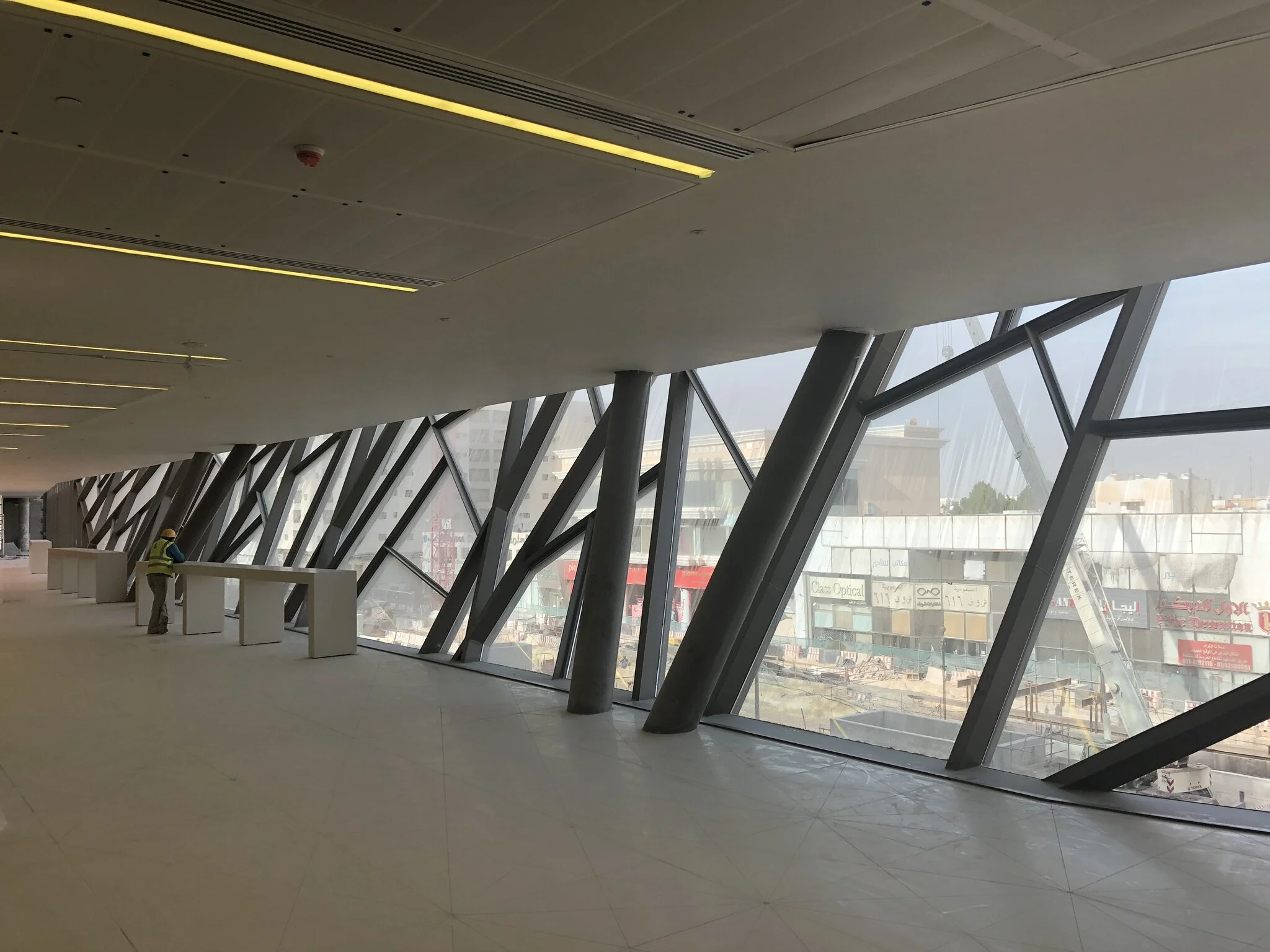
At Al Faisaliah, service systems are integrated within the depth of the façade itself.
Lighting infrastructure, maintenance access and environmental control systems are coordinated within the layered assembly. This reduces visual clutter, simplifies maintenance operations and improves overall system performance.
The façade therefore operates as infrastructure as well as architecture.
This integrated approach reflects broader developments in contemporary construction, where individual systems are increasingly combined within coordinated frameworks rather than developed independently.
Prefabrication and Construction Efficiency
The environmental ambitions of the façade required a construction strategy capable of delivering high levels of precision and consistency.
The envelope was therefore developed using prefabricated aluminium and steel components manufactured under controlled factory conditions.
Prefabrication offers several advantages.
Environmental performance can be verified before installation. Quality control becomes more reliable. Construction programmes can be shortened. Installation risks are reduced.
Most importantly, prefabrication supports the precise coordination required by layered environmental systems.
The success of the façade depends not only upon design decisions but also upon the accuracy with which those decisions are realised during construction.
Environmental performance ultimately becomes a construction issue as much as a design issue.
Material Performance
Material selection was guided primarily by environmental durability.
The climatic conditions of Riyadh expose building materials to intense ultraviolet radiation, airborne dust, significant temperature fluctuations and long-term environmental wear. Materials therefore needed to maintain performance while preserving appearance over extended periods of operation.
Aluminium and steel were selected because of their durability, dimensional stability and compatibility with prefabricated construction.
These choices demonstrate an important aspect of façade engineering.
Material selection is rarely determined by aesthetics alone. Appearance, environmental behaviour, maintenance requirements, fabrication constraints and lifecycle performance must all be considered simultaneously.
The most successful materials are often those capable of satisfying multiple requirements at once.
Day and Night Performance
The façade performs differently across the daily cycle.
During daylight hours it operates primarily as an environmental moderator, reducing solar gain, controlling glare and supporting thermal comfort. After sunset, integrated lighting systems transform the envelope into an urban landmark.
This dual role reflects an increasingly important characteristic of contemporary civic and commercial architecture.
Buildings contribute not only to environmental performance but also to the visual identity of the city. The façade therefore participates in both environmental and cultural systems.
Its function extends beyond enclosure to include communication, orientation and public presence.
The building becomes part of the broader urban environment rather than an isolated object.
The Façade as System
Perhaps the most important lesson offered by the Al Faisaliah extension is the understanding of architecture as system rather than object.
The façade cannot be understood solely in terms of appearance. Its performance depends upon the interaction of climate, materials, construction, services, maintenance and operation.
Environmental performance emerges through coordination.
This perspective represents a significant shift from traditional views of architecture. Buildings are increasingly evaluated according to how effectively they organise relationships between systems rather than how successfully they compose isolated forms.
The façade becomes a point of convergence where environmental, technical and architectural objectives are aligned.
Project Significance
The Al Faisaliah Shopping Mall extension demonstrates how façade design can integrate environmental performance, cultural continuity and commercial identity within a single architectural system.
The project illustrates Newtecnic's approach to façade engineering, where climate, construction and architectural expression are developed together rather than treated as separate concerns.
More broadly, it demonstrates the emergence of the façade as environmental infrastructure. Through the integration of shading, glazing, ventilation, services and construction logic, the envelope becomes an active participant in the operation of the building rather than a passive enclosure.
In doing so, the project offers an important model for architecture in extreme climates. It shows how environmental intelligence can generate architectural quality, transforming technical performance into a source of identity, comfort and civic presence.