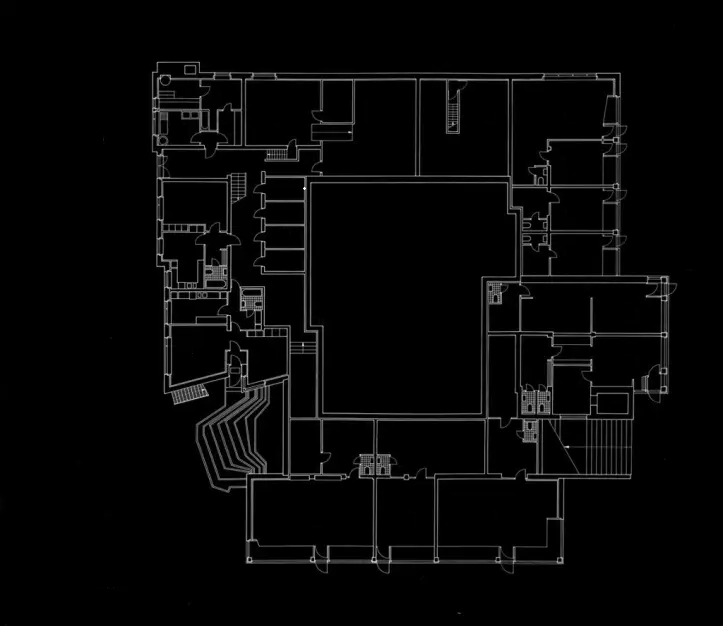
Säynätsalo Town Hall — Alvar Aalto, 1952
Architectural Significance
Säynätsalo Town Hall is widely regarded as one of the most important civic buildings of the twentieth century. Designed by Alvar Aalto for a small Finnish municipality, the project demonstrates how architecture can achieve civic significance through material intelligence, spatial richness and careful attention to human experience rather than through monumentality alone.
Combining council chambers, administrative offices, shops and housing within a single composition, the building establishes a close relationship between public life, landscape and construction. It illustrates how architecture can create a sense of place through the thoughtful organisation of materials, spaces and everyday activities.
Materiality and Construction
One of the building's most important contributions is its use of ordinary materials with extraordinary care. Brick, timber, concrete and copper are employed not as finishes applied to a design concept but as active participants in the architectural experience.
Materials are allowed to express their texture, weight and method of assembly. Variations in brickwork, changes in level and carefully detailed junctions create richness through construction rather than decoration. The project demonstrates that architectural character can emerge directly from the organisation of materials and making.
This understanding of construction as a source of architectural expression remains one of Aalto's most enduring lessons.
Space, Light and Human Experience
The building is organised around an elevated courtyard that acts as the civic heart of the project. Public and administrative functions are arranged around this shared space, creating a clear relationship between institution, community and landscape.
Natural light plays a central role throughout the building. Carefully positioned openings, deep reveals and changes in volume create spaces that respond to the changing seasons and qualities of Nordic daylight. Architecture is experienced not as a static object but as a series of relationships between material, light, occupation and movement.
The project demonstrates how civic architecture can achieve dignity through proportion, atmosphere and spatial organisation rather than through scale alone.
Architecture and Landscape
Säynätsalo Town Hall establishes a particularly close relationship between architecture and site. Buildings, courtyards, paths and planted areas are developed as parts of a unified composition that responds to both climate and topography.
Rather than imposing a formal order upon the landscape, Aalto allows architecture and terrain to work together. The result is an environment that feels both carefully designed and naturally rooted in its setting.
This integration of building and landscape contributes significantly to the project's sense of permanence and belonging.
Continuing Relevance
The continuing relevance of Säynätsalo Town Hall lies in its demonstration that architectural quality can emerge through the careful coordination of material, construction, light and human experience. The project shows that innovation does not depend upon technological complexity and that ordinary materials can achieve extraordinary richness when used with intelligence and care.
More than seventy years after its completion, the building remains an important precedent for civic, educational and residential architecture. Its enduring lesson is that architecture achieves lasting significance when construction, place and human experience are developed together as parts of a coherent whole.
Säynätsalo Town Hall continues to demonstrate that architecture is not simply the organisation of systems and spaces, but the creation of environments in which materials, light, landscape and occupation reinforce one another to enrich everyday life.