
Bergen Airport, Norway
Further information and case study for this project can be found at the De Gruyter Birkhäuser Modern Construction Online database
The following text is not available at Modern Construction Online
Light, Landscape and Public Infrastructure
The expansion of Bergen Airport Terminal 3 transforms a major transport facility into an architecture closely connected to its surrounding landscape. Designed by Nordic Office of Architecture, the project combines extensive glazing, exposed timber structure and carefully controlled daylight to create an environment that reflects the character of western Norway.
Newtecnic provided façade engineering for the development, creating envelope systems that integrate environmental performance, passenger comfort and architectural clarity within a demanding Nordic climate.
The significance of the project lies in its understanding of infrastructure as a public experience rather than simply an operational requirement. The terminal demonstrates how architecture can transform the act of travel through the careful orchestration of light, landscape, materiality and environmental performance.
In doing so, it establishes a model for infrastructure that is simultaneously efficient, humane and deeply connected to place.
Infrastructure and Place
Transport buildings are often designed primarily around movement, efficiency and operational performance.
While these requirements remain essential, Bergen Airport Terminal 3 demonstrates that infrastructure can also contribute meaningfully to civic identity and public experience.
The project is rooted in the landscapes of western Norway. Mountains, fjords, changing weather conditions and seasonal variations in daylight are not treated as background conditions but as active participants in the architectural experience.
The terminal therefore functions not simply as a gateway for travel but as an introduction to place.
From arrival to departure, passengers remain visually connected to the landscape that surrounds the airport.
Architecture of Openness
The architectural strategy is founded upon openness, orientation and visual continuity.
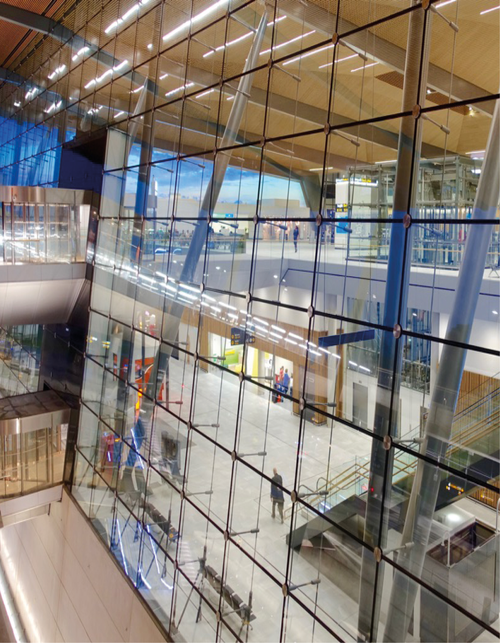
Rather than creating a sealed interior environment disconnected from its surroundings, the building establishes an ongoing relationship between inside and outside. Large glazed surfaces frame views across the airfield while maintaining connections to the distant landscape beyond.
This openness serves practical as well as experiential purposes.
Visual access improves orientation, reduces stress and assists intuitive navigation through the terminal. Passengers are able to understand their location within the building and their relationship to aircraft movement, weather conditions and the surrounding environment.
Architecture becomes a tool for wayfinding.
The building communicates through visibility rather than signage alone.
The Façade as an Instrument of Light
Light is one of the defining characteristics of Nordic architecture.
Seasonal variation, low-angle sunlight and long periods of darkness create environmental conditions in which daylight acquires exceptional importance. Architecture consequently develops not only around enclosure but around the careful management of light itself.
The façade of Bergen Airport Terminal 3 functions as an instrument for capturing, filtering and distributing daylight throughout the building.
Large glazed surfaces introduce natural illumination deep into the terminal while maintaining visual clarity and environmental control. Rather than treating daylight as an incidental by-product of transparency, the design uses it as a primary architectural material.
The changing quality of light throughout the day and across the seasons becomes part of the passenger experience.
Environmental Openness
Many contemporary façade systems are primarily concerned with protection.
They shield occupants from excessive solar gain, extreme temperatures or challenging environmental conditions. While Bergen must also provide environmental protection, its central challenge is different.
The project seeks to maximise openness while maintaining performance.
Transparency, daylight and visual connection are pursued alongside thermal efficiency, weather resistance and occupant comfort. The façade therefore performs a delicate balancing act between environmental exposure and environmental control.
This balance is one of the project's most significant achievements.
The architecture feels open and connected to nature despite operating within a climate that demands high levels of environmental performance.
High-Performance Glazing
Achieving this degree of openness requires sophisticated façade engineering.
The extensive glazed surfaces employ triple-glazed units, thermally broken framing systems and carefully detailed interfaces designed to minimise heat loss. These measures allow the building to maintain comfortable internal conditions despite significant seasonal temperature variations.
Solar control strategies reduce glare while preserving visual transparency. Environmental performance is therefore achieved without sacrificing the qualities of openness and visibility that define the architecture.
The façade demonstrates that transparency and energy efficiency need not be opposing objectives.
Through careful engineering they become mutually reinforcing.
Structure and Materiality
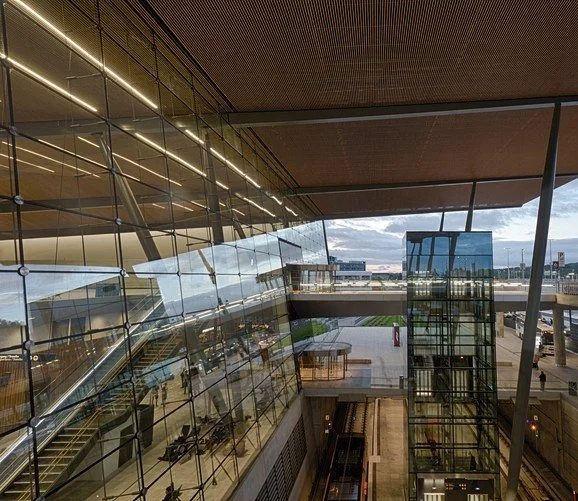
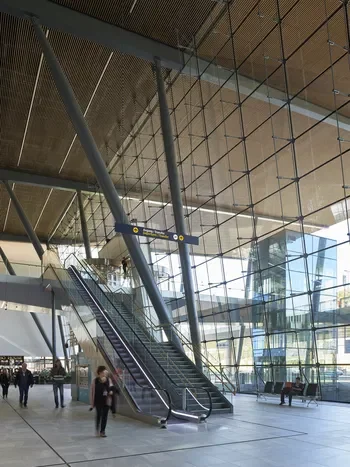
A defining characteristic of the terminal is the relationship between the glazed façade and the exposed timber roof structure.
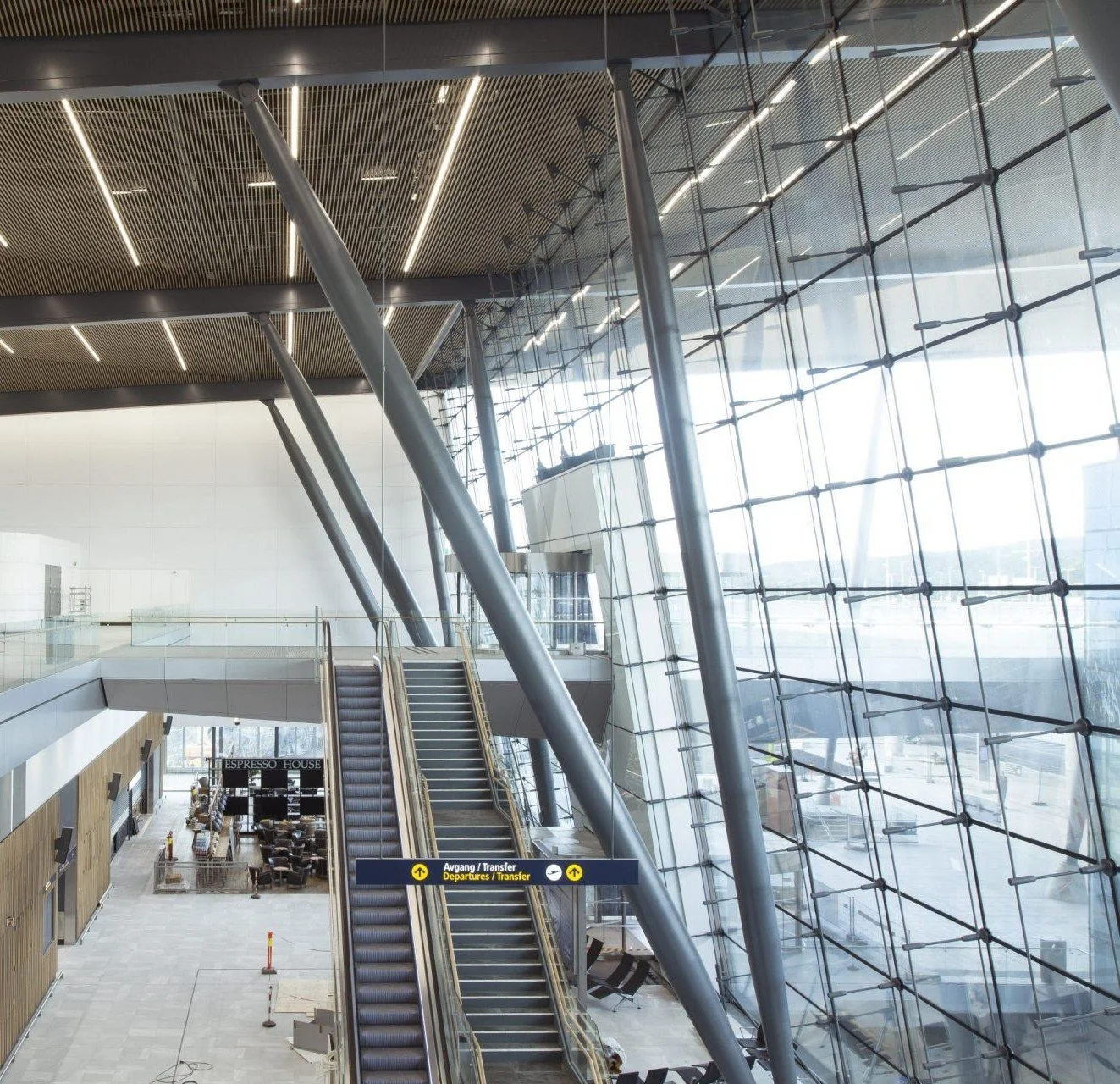
Long-span glulam beams establish the primary spatial order of the building while introducing warmth, texture and human scale into a large infrastructural environment. Their visibility reinforces an architectural tradition in which structure is understood not merely as support but as a contributor to spatial experience.
The combination of timber and glass is particularly significant.
Glass provides openness and visual connection. Timber provides solidity, warmth and tactile character. Together they establish a balance between technological performance and human experience.
The architecture therefore feels both contemporary and deeply rooted in Nordic building culture.
Environmental Honesty
One of the strengths of the project is the clarity with which environmental performance is expressed.
The façade does not rely upon excessive visual complexity or technological display. Its environmental intelligence is embedded within proportion, detailing and material selection.
The architecture communicates its performance through restraint rather than spectacle.
This approach reflects a broader Nordic tradition in which sustainability is often achieved through careful optimisation rather than technological excess. Environmental responsibility emerges through the disciplined coordination of structure, enclosure and materiality.
The result is a building whose performance appears natural rather than forced.
Construction and Delivery
The success of the project depended upon the efficient integration of design and construction.
The façade was developed using prefabricated curtain wall systems that enabled high levels of quality control while reducing disruption to ongoing airport operations. Modular glazing units improved installation efficiency and programme certainty while maintaining the precision required by the architectural concept.
Careful coordination between architecture, structure and façade engineering ensured that environmental performance, maintainability and visual clarity could be developed simultaneously.
The project demonstrates how prefabrication can support architectural quality rather than limiting it.
Construction efficiency and design ambition operate together rather than in opposition.
Weather as Experience
The relationship between architecture and weather is particularly important within the terminal.
Rain, cloud, changing light conditions and seasonal variation all become visible aspects of the passenger experience. The façade allows these environmental conditions to be observed and appreciated without compromising comfort.
Rather than isolating occupants from nature, the building mediates their relationship with it.
Passengers remain aware of changing environmental conditions while benefiting from a carefully controlled interior environment.
This quality contributes significantly to the character of the terminal.
The building acknowledges the realities of its climate rather than attempting to conceal them.
Civic Identity
Although primarily an infrastructure project, the terminal performs an important civic role.
For many visitors, it provides a first encounter with western Norway. For residents, it functions as a familiar point of arrival and departure. The architecture therefore contributes directly to the public identity of the region.
The façade plays a central role in this civic presence.
During daylight hours, reflections of sky, mountains and weather animate the building. During the darker months, the illuminated terminal becomes a welcoming landmark within the airport campus.
The building acts simultaneously as infrastructure, public building and regional gateway.
Project Significance
Bergen Airport Terminal 3 demonstrates how environmental performance and architectural experience can be developed together within a major infrastructure project.
Through the integration of glazing, timber structure and landscape, the project creates a terminal that is efficient, durable and environmentally responsive while remaining deeply connected to its setting.
The project illustrates Newtecnic's approach to façade engineering, where environmental performance, construction methodology and public experience are developed as parts of a single architectural strategy.
More broadly, it demonstrates that infrastructure can be both technically rigorous and emotionally engaging. By treating light, landscape and climate as architectural resources rather than constraints, the project transforms the experience of travel through a carefully balanced relationship between openness and performance.
The result is an architecture that functions not simply as a transport facility but as a meaningful expression of place, environment and public life.