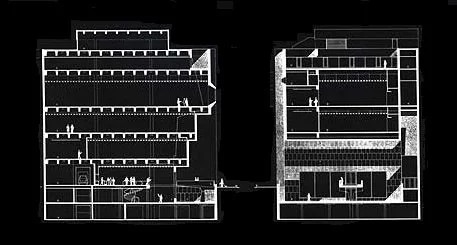
Whitney Museum of American Art — Marcel Breuer, New York, 1966
Architectural Significance
The Whitney Museum of American Art is one of the defining cultural buildings of post-war modernism. Designed by Marcel Breuer for Manhattan's Upper East Side, the building demonstrates how architecture can establish a powerful civic identity while accommodating the changing requirements of a cultural institution.
Its distinctive form, characterised by inclined walls, deeply recessed openings and a monumental presence, gives the museum a strong architectural character without relying on applied decoration. The building derives its identity from the direct expression of structure, material and form, creating an architecture whose permanence is inseparable from its construction.
Permanence and Change
One of the most significant aspects of the Whitney Museum is its demonstration that architecture can provide a durable framework for activities that evolve over time. The building was designed to accommodate changing exhibitions, curatorial approaches and patterns of occupation without sacrificing architectural coherence.
Rather than pursuing flexibility through neutrality, Breuer established a strong organisational order within which change could occur. The relationship between permanence and adaptation is therefore carefully balanced. The architecture remains constant while the activities it supports continue to evolve.
The project demonstrates that robust architectural identity and operational flexibility need not be opposing ambitions.
Urban Presence and Institutional Identity
The Whitney also established an important relationship between building and city. Its sculptural form creates a distinctive civic presence within the urban fabric while carefully choreographing arrival, entry and movement.
The building is not conceived as a neutral container but as an active participant in public life. Its sequence of approach, entry and circulation reinforces the public significance of the institution and contributes to the experience of visiting the museum.
This understanding of architecture as both institutional framework and urban presence remains one of the project's most enduring qualities.
Continuing Relevance
The continuing relevance of the Whitney Museum lies in its demonstration that buildings can remain architecturally specific while accommodating changing patterns of use. The project shows how permanence and adaptability can coexist within a coherent architectural framework.
More than half a century after its completion, the building remains an important precedent for cultural architecture because it recognises that institutions evolve while architecture endures. Its enduring lesson is that strong architectural order can provide continuity through change, allowing buildings to support new forms of occupation without losing their identity.