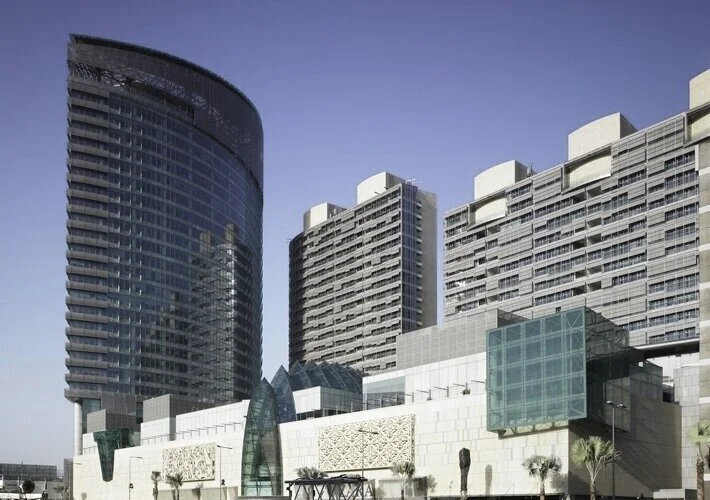
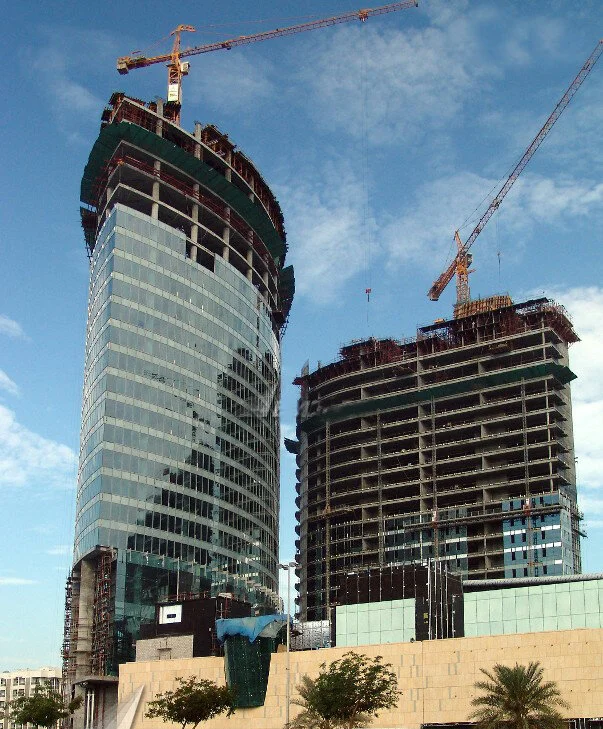
Burjuman Tower, Dubai, UAE

Further information and case study for this project can be found at the De Gruyter Birkhäuser Modern Construction Online database

The following architectural theory-based case study is not available at Modern Construction Online

Facade Design of the Burjuman Office Tower, Dubai – Climate-Responsive Modernism and Prefabricated Logic

Located in the historic Bur Dubai district, the Burjuman Office Tower by Kohn Pedersen Fox Associates (KPF), with contractor-side façade engineering by Andrew Watts of Newtecnic, exemplifies climate-adapted commercial architecture in the Gulf region. The project synthesises High Modernist lineage with site-specific environmental performance, deploying a prefabricated façade system that mediates between formal expression, climatic resilience, and construction efficiency. This case study examines the design’s conceptual heritage, technical realisation, and its broader contribution to regionally responsive high-rise architecture. The façade system developed for this project served as a conceptual and technical precedent for the system implemented in Project 11, featured in the second edition of Modern Construction Case Studies.

High Modernist Lineage and Technical Reinterpretation

The Burjuman façade carries forward the ethos of High Modernism, reframing its rational clarity and structural order within the context of a hot-arid urban environment. Influences from SOM’s John Hancock Center inform the tower’s vertical emphasis and structural legibility, while Norman Foster’s Willis Faber and Dumas building prefigures the integration of solar-responsive glazing as a performative layer.

Other precedents—such as the HSBC Headquarters in Hong Kong, the Pirelli Tower in Milan, and Marcel Breuer’s IBM La Gaude—offered models for modularity, sun control, and orientation-specific design. These precedents, however, are not quoted directly; rather, they serve as a conceptual scaffold, adapted through digital analysis, regional expertise, and fabrication technologies to meet Dubai’s environmental demands.

This approach aligns with the strategies outlined in Modern Construction Envelopes (Watts, 2019), where adaptive reuse of formal precedents is paired with performance-based rationalisation—a hallmark of contemporary high-rise façade practice.

Facade Geometry and Environmental Strategy

The tower adopts a restrained, rectilinear volume—a formal typology consistent with commercial office towers—but renders it expressive through a layered and articulated façade. Vertical aluminium fins, deep-set glazing, and horizontal ledges produce a visual rhythm that corresponds to the building’s solar exposures. This approach not only reinforces architectural clarity but also serves as an environmental filter.

The design integrates three interdependent objectives: optimising daylight and view for occupants, creating a legible urban identity, and passively moderating the harsh desert climate. Glazing is selectively recessed to reduce solar gain, while shading devices are dimensioned and oriented through solar simulation—embodying the performative logic Watts (2023) identifies as essential to hot-climate façade systems.

Prefabricated Curtain Wall and Layered Composition

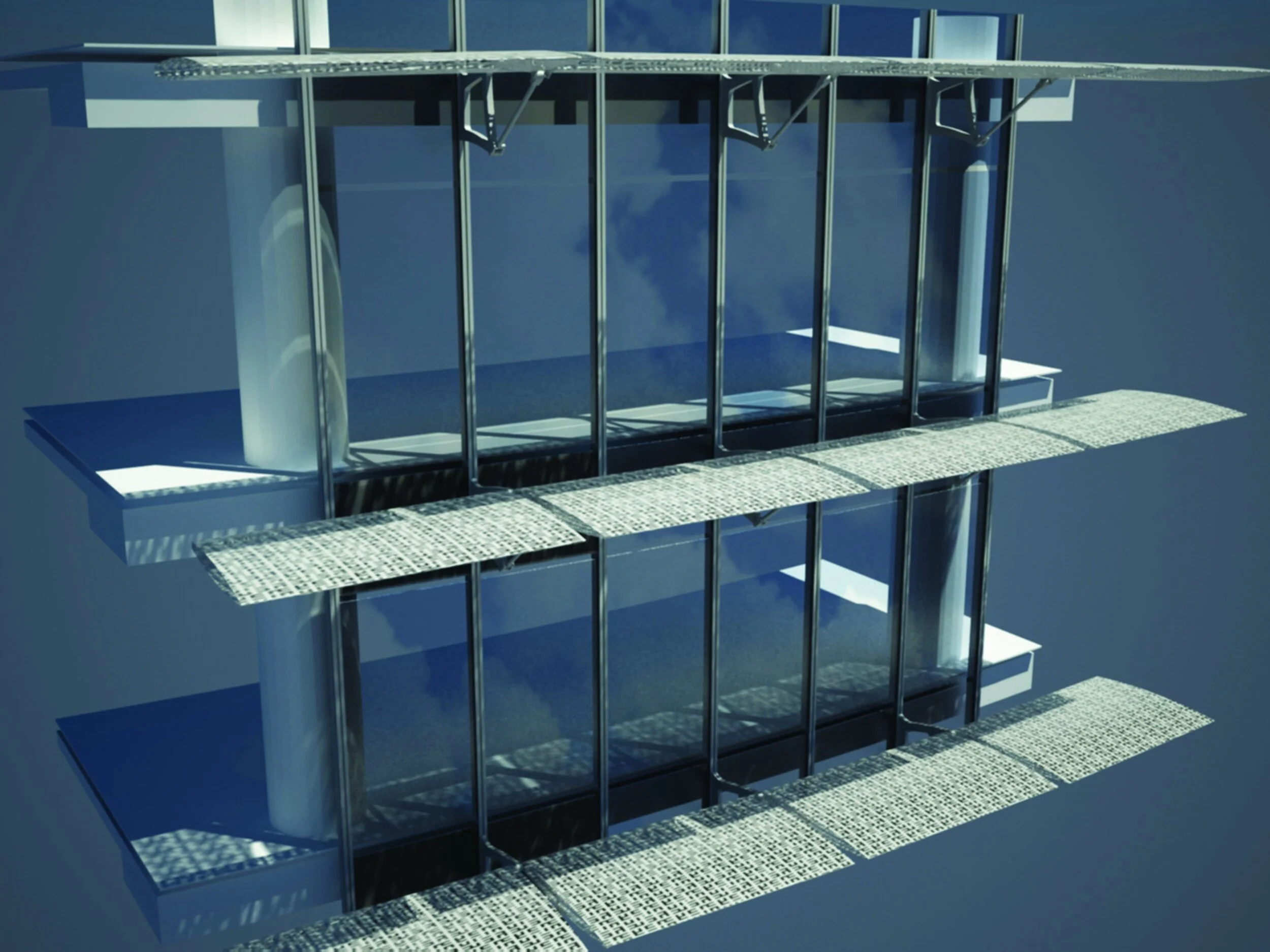
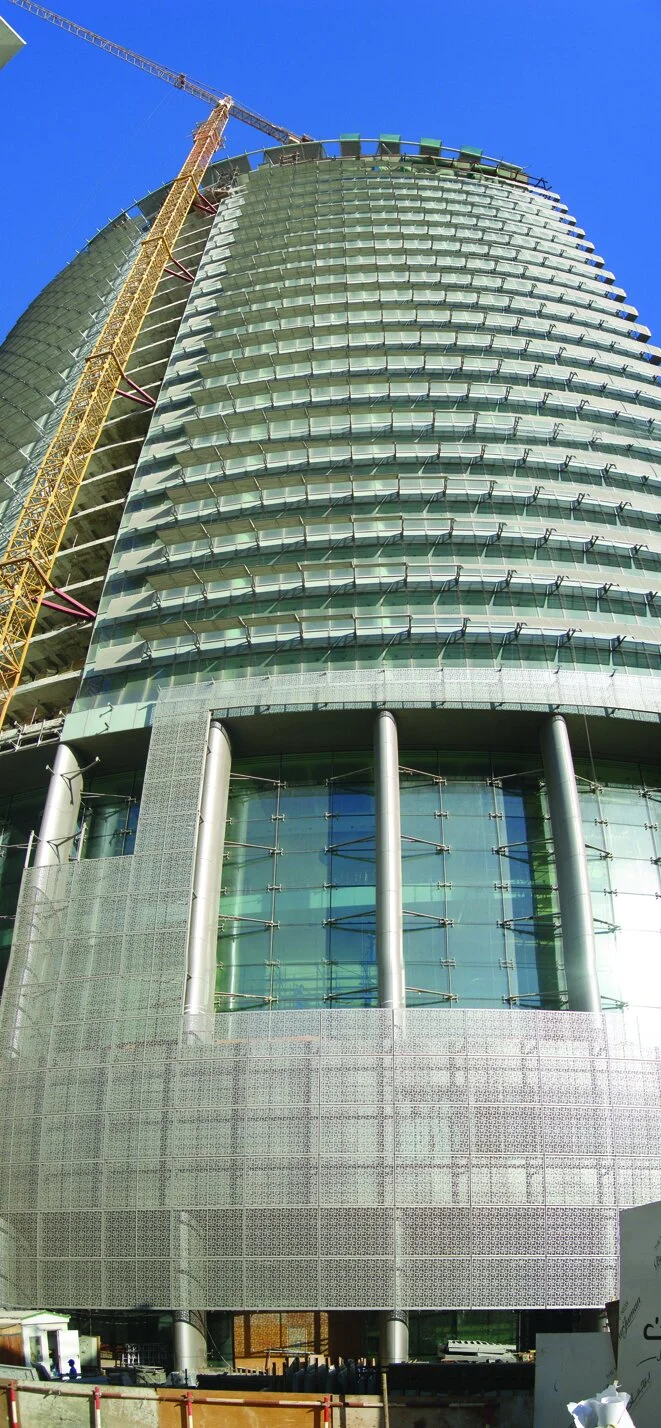
The façade system comprises a unitised curtain wall, prefabricated off-site to ensure dimensional control and accelerate construction sequencing. The primary surface is formed by blue-tinted, low-emissivity double-glazing, supplemented by external shading elements of extruded aluminium. These shading devices—ranging in depth and frequency—respond dynamically to orientation and solar angle, establishing a second layer of climatic filtration.

This layered composition reinforces the building’s dual identity as both technologically advanced and environmentally grounded. As Watts (2019) emphasises, the most effective climate-responsive envelopes integrate shading, insulation, and reflectivity as constituent components of a coherent system—not as applied features.

Spandrel panels—comprising insulated aluminium composite—conceal services and maintain a continuous thermal envelope. The system modulates its language across orientations: northeast elevations are more open to capture diffuse daylight, while the southwest-facing façades deploy deeper projections to counter direct sun exposure.

Material choices reinforce this adaptive logic. Reflective aluminium and low-E glass are selected not merely for aesthetic consistency, but for their thermal properties and resonance with the reflective tones of the desert landscape—a strategy consistent with regionally attuned material thinking described in Modern Construction Case Studies (Watts, 2016).

Passive Moderation and Performance Integration

Performance begins with the glazing specification: double-glazed units with low-emissivity coatings reduce heat gain while preserving interior daylight. This thermal moderation is supplemented by shading devices designed through parametric modelling of incident solar angles. These passive strategies reduce HVAC loads while improving occupant comfort—avoiding reliance on high-cost mechanical compensation.

As Watts (2023) argues, environmental performance in hot climates must be embedded in the primary design moves. Burjuman’s façade accomplishes this by integrating passive responses into its formal and tectonic language. The visible skin is underpinned by a robust thermal envelope of continuous insulation, reinforced by thermally broken joints and sealant systems to minimise air infiltration.

The overall façade thus performs not merely as a weather barrier, but as an active environmental moderator—regulating heat, glare, and light through an orchestration of form, material, and assembly.

Prefabrication and Assembly Logic

The decision to adopt a unitised curtain wall system was driven by performance requirements and construction logistics. Prefabrication allowed for precise quality control, with each panel fabricated under controlled factory conditions, then transported and installed on-site with minimal disruption. Silicone gaskets, anchor brackets, and articulated connections accommodate thermal expansion, seismic tolerance, and structural movement.

As outlined in Modern Construction Handbook (Watts, 2023), unitised systems offer a high degree of adaptability, making them particularly suited to the rapid construction timelines and high technical standards of Gulf megaprojects. The Burjuman system exemplifies this, delivering both speed and performance in a climate that tolerates neither construction delay nor envelope failure.

Ground Plane Integration and Urban Identity

At street level, the façade transitions in materiality and scale. Stone cladding, deeper setbacks, and a pedestrian-focused articulation mark the podium, establishing a tactile and human-scaled base. This contrasts with the high-tech surface above, offering a deliberate duality: high-rise iconography balanced with urban responsiveness.

The façade’s shifting reflectivity and finely tuned shading elements animate the tower throughout the day, creating a dynamic dialogue with sunlight and skyline. This play of light and shadow softens the monolithic form and gives the tower a responsive presence within the urban fabric.

Conclusion

The façade of the Burjuman Office Tower offers a compelling model of climate-responsive modernism—one where rational construction, environmental performance, and formal clarity coalesce. Through the integration of shading, prefabrication, and orientation-specific modulation, the project reinterprets High Modernist ideals in a context of extreme heat and rapid urbanisation.

Far from a generic glass tower, Burjuman demonstrates how the expressive potential of the façade can be reactivated through environmental necessity. It contributes to a broader discourse on Gulf-region architecture, one in which performance is not an afterthought, but a primary generator of architectural form.

References

Banham, R. (2015). The Architecture of the Well-Tempered Environment. Chicago: University of Chicago Press.

Edwards, B. (2011). Sustainable Architecture: European Directives and Building Design. London: Wiley-Blackwell.

Kolarevic, B. (2003). Architecture in the Digital Age: Design and Manufacturing. New York: Spon Press.

Silver, S. (2013). Facade Engineering. London: Wiley-Blackwell.

Watts, A. (2016). Modern Construction Case Studies. Basel: Birkhäuser.

Watts, A. (2019). Modern Construction Envelopes. Basel: Birkhäuser.

Watts, A. (2023). Modern Construction Handbook. 6th ed. Basel: Birkhäuser.

BurJuman Residential Apartments, Dubai — An Integrated Façade for Climatic and Cultural Performance

 Situated in the historic core of Bur Dubai, the BurJuman Residential Apartments form the high-rise residential component of the BurJuman Centre, a mixed-use development commissioned by the Al Ghurair Group. The broader complex includes offices, retail, and hospitality functions, positioning the residential tower as both a functional element and an architectural landmark within one of the city's oldest districts.

Façade engineering was undertaken by Newtecnic, whose design integrates environmental performance and contextual sensitivity with a clear modernist lineage. The envelope responds to Dubai’s desert climate, the cultural logic of transitional spaces, and a high-rise typology common in international cities. Designed in collaboration with Kohn Pedersen Fox (KPF), the building represents a convergence of regional adaptation and global construction strategies.

This case study examines the building’s façade in relation to climate responsiveness, material and spatial logic, and precedents within High Modernist architecture. It draws upon broader construction themes as developed in Modern Construction Handbook (Watts, 2023), Modern Construction Envelopes (Watts, 2019), and Modern Construction Case Studies (Watts, 2016). The façade system developed for this project served as a conceptual and technical precedent for the system implemented in Project 06, featured in the second edition of Modern Construction Case Studies.

Urban Context and Architectural Strategy

The project’s location in Bur Dubai necessitated an approach that could simultaneously integrate with the city’s historic fabric and assert a contemporary architectural identity. The design adopts a podium-tower strategy that grounds the tower within its urban context, while the upper massing remains slender and vertically expressive.

The façade strategy plays a critical role in this integration. Its rhythm and geometry echo the formal restraint of International Style high-rises, while its material palette and recessed forms provide shading, articulation, and cultural relevance. The façade responds directly to solar orientation and material erosion common in desert environments, while avoiding overt ornamentation.

Façade Typology and Environmental Performance

The principal façade system is a unitised curtain wall composed of low-emissivity glazing combined with integrated aluminium shading elements. These include horizontal fins and vertical mullions that reduce solar gain, particularly on the east- and west-facing elevations. The shading components are designed as intrinsic architectural features rather than applied add-ons. This typological clarity exemplifies what Frampton (1995) identifies as environmental tectonics—where the building’s form embodies its environmental logic rather than concealing it.

In addition to the curtain wall, deep-set balconies are introduced as environmental thresholds. These recessed voids provide shade and create intermediate zones between interior and exterior. Their spatial and thermal function is akin to the traditional mashrabiya, offering privacy, solar modulation, and passive cooling. While the design does not replicate the traditional form, it maintains the functional principles, establishing a cultural continuity within a modern construction idiom. This layered approach reflects Watts’ (2023) description of façades as transitional and performative membranes in hot climates.

Material Palette and Visual Identity

The façade employs a deliberately minimalist material vocabulary to maximise environmental durability and formal subtlety. It combines silver-toned aluminium for fins and mullions, low-iron reflective glazing, and ceramic-coated panels for spandrels and soffits. These materials resist sand erosion and reduce solar absorption while providing a light, reflective finish that shifts with the desert sky.

This restrained palette contributes to the tower’s visual blending within the broader urban landscape. It avoids the expressive flourishes of some contemporary towers and instead seeks to embed the building within its climatic and urban context. Watts (2016) identifies this form of climatic camouflage as a key trait of performance-driven envelopes in high-rise typologies.

Vertical Modulation and Urban Scale

The façade responds to its urban condition through varying degrees of articulation. At podium level, the façade is more complex, with varied materials and deeper projections to engage with the public realm. As the tower ascends, the façade becomes increasingly uniform and modular, reflecting the repetitive logic of residential floor plates. This vertical modulation enables the façade to function at multiple scales—human, urban, and skyline—and reinforces the building’s role as a civic and residential landmark.

This hierarchical expression aligns with strategies employed in several KPF projects worldwide and reflects principles discussed in Modern Construction Envelopes (Watts, 2019), where functional layering is used to reconcile the demands of performance, scale, and programme.

High Modernist Precedents in Façade Design

Although realised using contemporary technologies, the BurJuman façade draws extensively from the material and conceptual strategies of High Modernist architecture. One key precedent is SOM’s Sears Tower in Chicago (1973), designed by Bruce Graham and Fazlur Khan, which employed modular curtain wall systems and an expressed vertical logic. Similarly, the John Hancock Center (1969), also by SOM, used structural articulation as a façade element. In both cases, tectonic expression was aligned with climatic and structural performance—an approach echoed at BurJuman.

Lever House (SOM, 1952) and the UN Secretariat (Le Corbusier, Niemeyer, Harrison, 1952) are further precedents, particularly in their east-west orientation, glazing strategies, and the podium-tower massing. These projects prioritised transparency and solar control while achieving formal simplicity.

Habitat 67 by Moshe Safdie (1967) introduced recessed balconies and modular terraces that provided both shade and spatial complexity—concepts that resonate with BurJuman’s deep-set balconies. Meanwhile, Gropiusstadt in Berlin (1962–75) by Walter Gropius and The Architects Collaborative (TAC) illustrated how residential façade systems could leverage repetition, standardisation, and subtle modulation to create identity and liveability.

In Europe, the Pirelli Tower (1956–60) by Gio Ponti and Pier Luigi Nervi offered a precedent for vertical elegance and refined material detailing. Within the Gulf context, SOM’s work during the 1960s and 1970s provides a regional precursor, combining high-rise form with shading strategies suited to desert climates.

Together, these precedents provide the conceptual scaffolding upon which the BurJuman façade is built. Rather than replicating formal motifs, the project abstracts their strategies to create a contemporary, regionally attuned high-rise envelope.

Façade as Systems Integration

The BurJuman façade exemplifies the contemporary façade’s role as a multi-functional system. It simultaneously provides environmental control through optimised glazing and integrated shading, supports construction efficiency through modular, unitised elements, enhances mechanical performance by reducing solar heat gain and HVAC demands, and establishes a visual identity through calibrated rhythm, depth, and material harmony.

This integration of systems reflects the broader architectural trajectory discussed by Watts (2016), where façades serve as mediators between internal conditions and external forces—environmental, cultural, and formal. Watts (2019) further explores how the façade has evolved into an active building element, synthesising structural, environmental, and expressive roles.

Conclusion

The BurJuman Residential Apartments’ façade exemplifies the ongoing evolution of modernist envelope design. It distils High Modernist values of performance, rationality, and abstraction into a climatically attuned, culturally responsive system. Through the collaborative work of Newtecnic and KPF, the project demonstrates how façades can operate as architectural synthesisers—unifying technology, place, and typology into a coherent whole.

Rather than referencing the forms of its precedents, the design reinterprets their logics, aligning the façade with a contemporary construction ethos that privileges integration over image. The result is a building that communicates its function, adapts to its environment, and situates itself with dignity in Dubai’s ever-transforming skyline.

References

Frampton, K., 1995. Studies in Tectonic Culture: The Poetics of Construction in Nineteenth and Twentieth Century Architecture. Cambridge, MA: MIT Press.

Gissen, D., 2002. Big & Green: Toward Sustainable Architecture in the 21st Century. New York: Princeton Architectural Press.

Lechner, N., 2015. Heating, Cooling, Lighting: Sustainable Design Methods for Architects. 4th ed. Hoboken: Wiley.

Ponti, G. and Nervi, P.L., 1960. Pirelli Tower, Milan. [Curtain wall precedent].

Safdie, M., 1967. Habitat 67, Montreal. [Residential adaptation precedent].

Skidmore, Owings & Merrill (SOM), 1969. John Hancock Center, Chicago. [High-rise precedent].

Skidmore, Owings & Merrill (SOM), 1973. Willis Tower (formerly Sears Tower), Chicago. [High-rise precedent].

Gropius, W. and The Architects Collaborative (TAC), 1962–75. Gropiusstadt, Berlin. [Housing façade precedent].

Watts, A., 2016. Modern Construction Case Studies. Basel: Birkhäuser.

Watts, A., 2019. Modern Construction Envelopes. 3rd ed. Basel: Birkhäuser.

Watts, A., 2023. Modern Construction Handbook. 6th ed. Basel: Birkhäuser.