
Changsha Meixihu International Culture and Art Centre, China
Further information and case study for this project can be found at the De Gruyter Birkhäuser Modern Construction Online database
The following text is not available at Modern Construction Online
Constructing Continuity
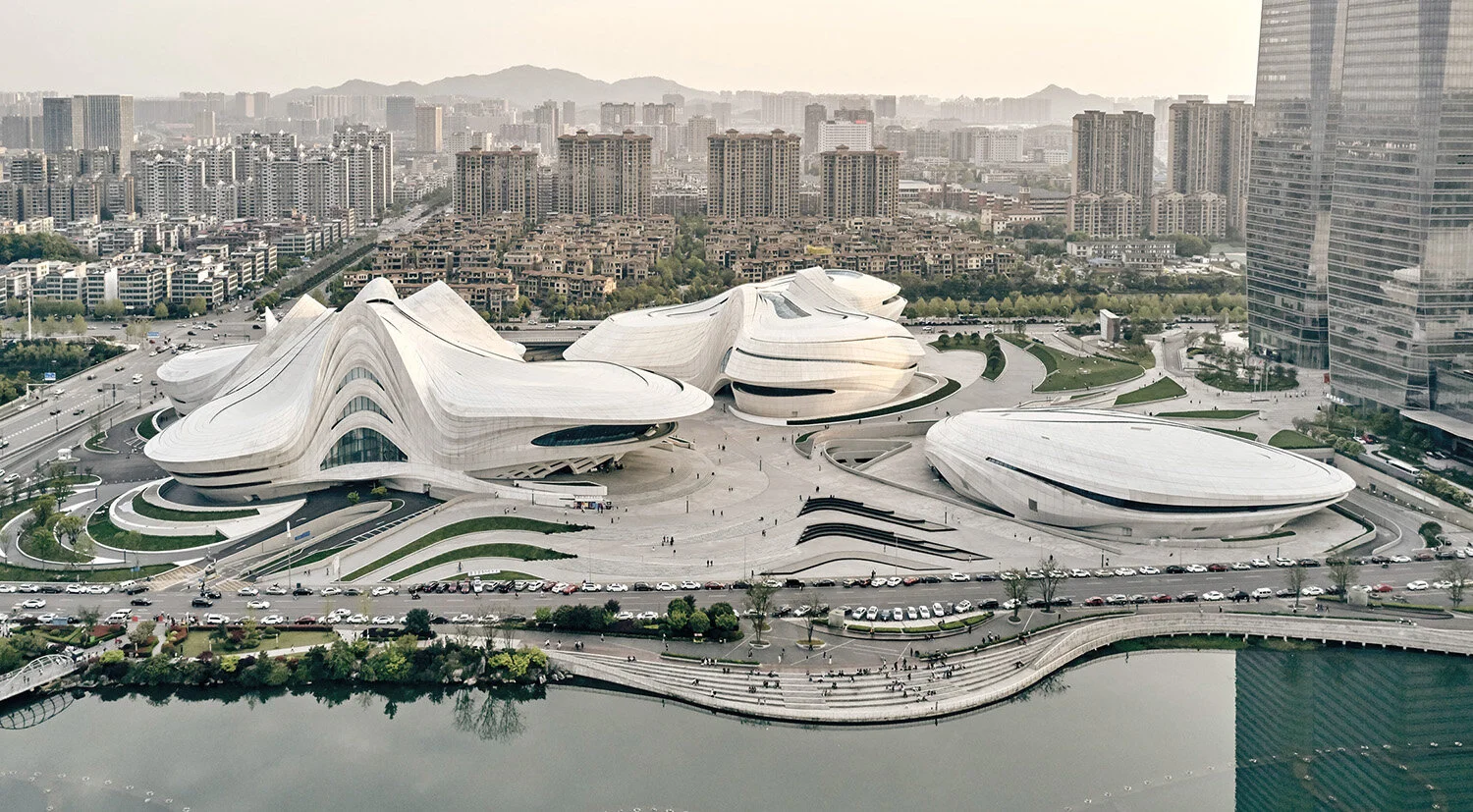
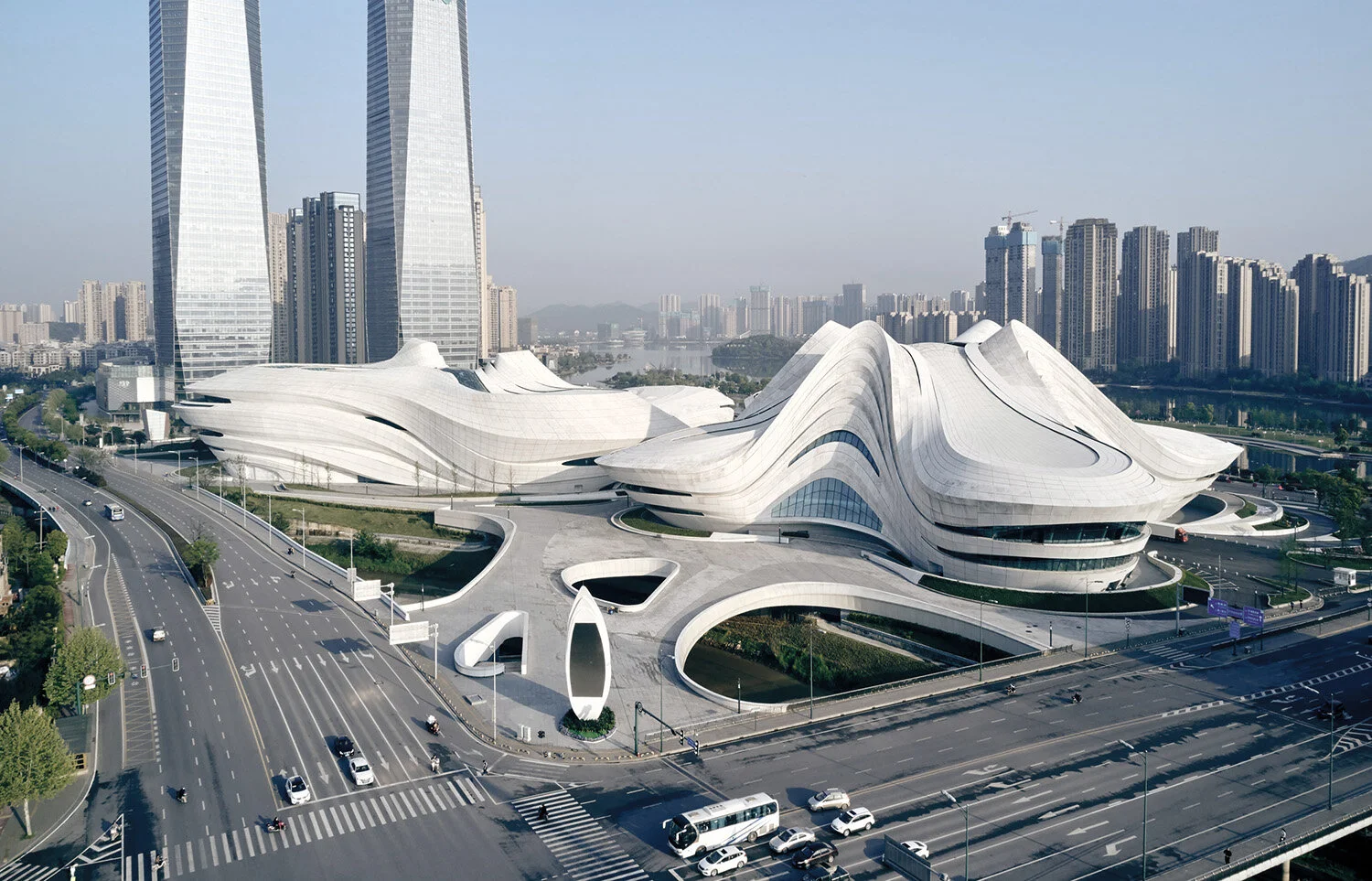
The Changsha Meixihu International Culture & Art Centre is a major cultural complex comprising a theatre, museum and multi-purpose performance venue. Designed by Zaha Hadid Architects, the project is characterised by a continuous architectural form in which walls, roofs and enclosure systems merge into a unified sculptural composition.
Newtecnic provided façade engineering for the project, developing an envelope system capable of translating this complex architectural geometry into a coordinated and buildable construction strategy.
The project demonstrates one of the central challenges of contemporary architecture: how a continuous architectural idea can be realised through the inherently discontinuous processes of manufacturing, transportation and assembly.
Architecture Beyond Separate Elements
Traditional building construction is typically organised around a series of distinct architectural components. Walls, roofs, façades and structure are often designed, fabricated and assembled as separate systems.
At Changsha Meixihu, this distinction is deliberately blurred. The architecture is conceived as a continuous surface that flows across the building, connecting different functions and spaces through a unified formal language.
The resulting form appears seamless and uninterrupted. Yet the construction of such a building requires the opposite condition. Every component must be manufactured, transported, lifted, installed and maintained as an individual element.
The project therefore operates between two apparently contradictory conditions: visual continuity and physical fragmentation.
The façade becomes the mechanism through which these opposing requirements are reconciled.
The Façade as Organising System
Rather than functioning simply as enclosure, the façade acts as the primary organising system for the project.
The envelope establishes the relationship between architectural form, structural support, environmental performance and construction methodology. Every aspect of the building's external expression depends upon the successful coordination of these requirements.
The challenge was not simply to produce complex geometry. It was to create a system capable of managing complexity while remaining practical to manufacture and assemble.
The façade therefore became a process of organisation rather than a process of representation.
Its success depends less upon formal complexity than upon the disciplined coordination of multiple technical systems.
Rationalising Complexity
Complex architectural forms are often misunderstood as collections of unique components. In reality, successful construction depends upon identifying patterns within apparent variation.
At Changsha Meixihu, digital modelling was used to analyse geometry across the entire building and identify opportunities for standardisation. Similar conditions were grouped into repeatable component families, allowing large areas of the façade to be produced using common manufacturing methods and support systems.
This process did not simplify the architecture. Instead, it revealed the underlying order within the geometry.
The project demonstrates how contemporary design tools can transform geometric variation into manageable construction information without compromising architectural intent.
Component Families and Construction Logic
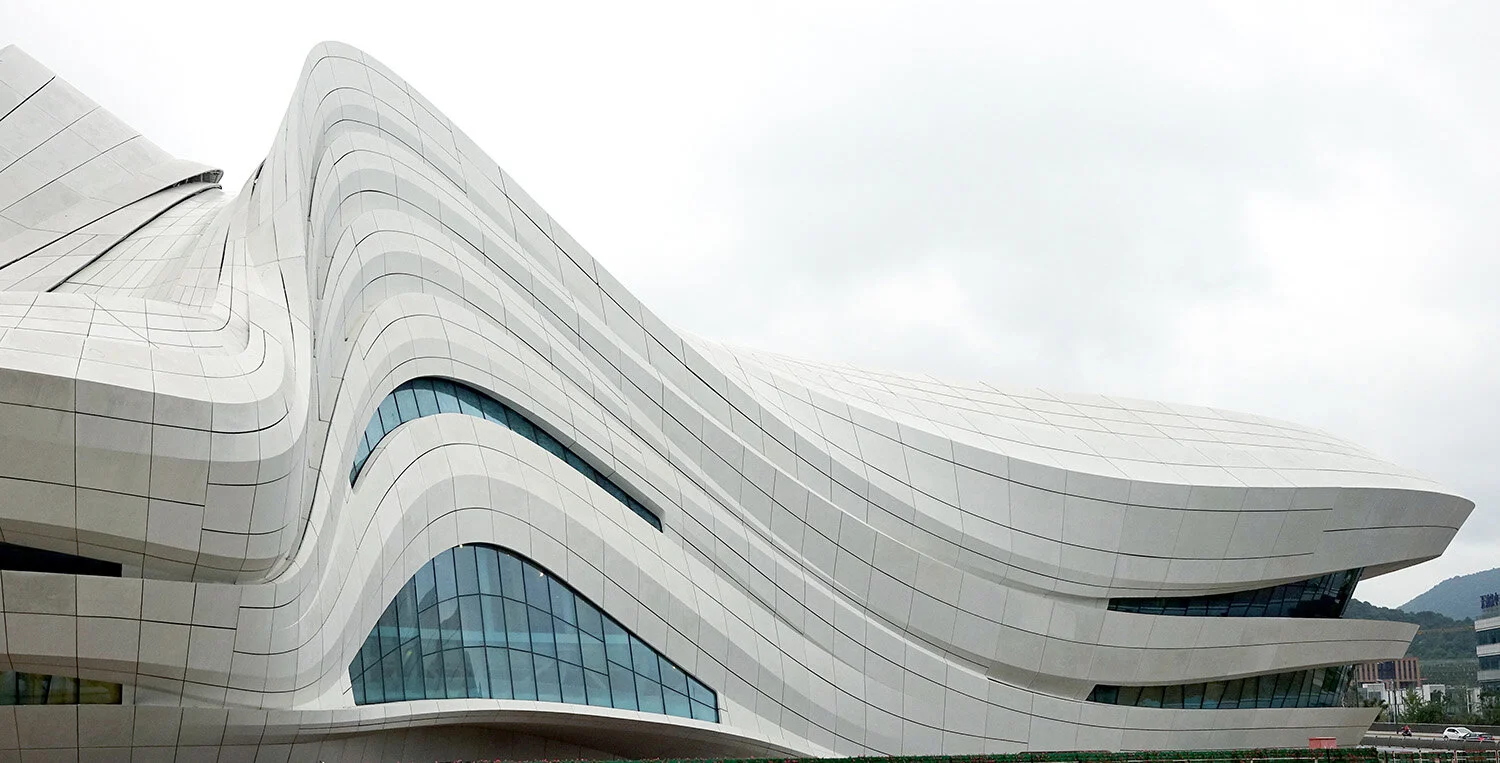
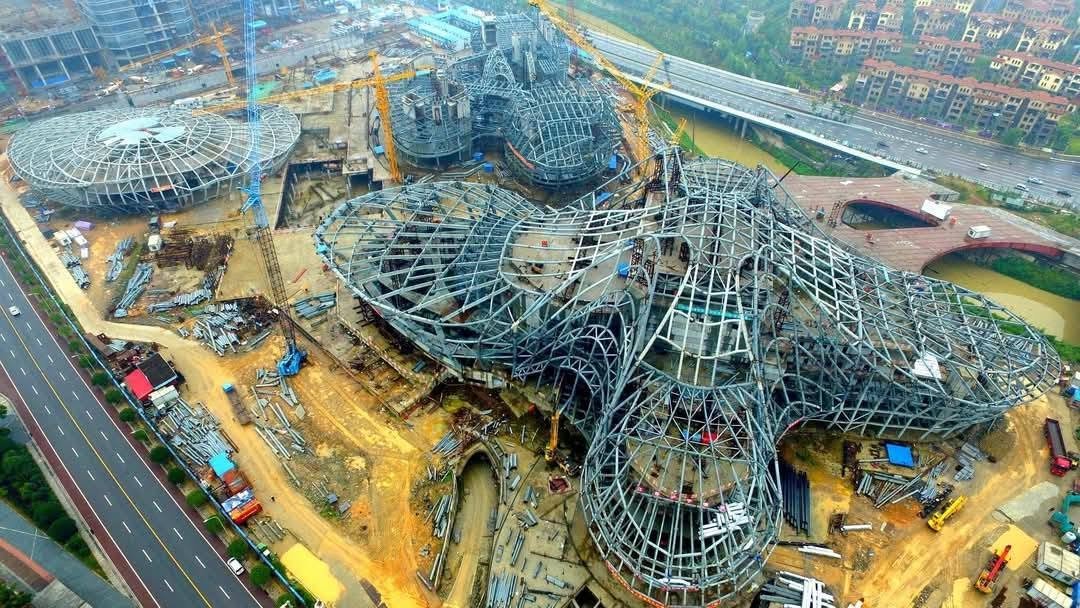
The envelope is formed from glass fibre reinforced concrete (GRC) panels supported by a bespoke steel substructure.
While the completed building appears highly complex, the construction system is organised around a relatively small number of repeatable elements. Panels, brackets, support rails and fixing systems were developed as coordinated families of components capable of accommodating controlled variation across the building.
This approach allowed manufacturing processes to remain efficient while preserving the visual continuity of the architectural form.
The project illustrates an important principle of construction: complexity is often achieved through the intelligent organisation of repetition rather than through the uncontrolled production of unique elements.
Material and Structure
GRC was selected because it combines geometric flexibility with relatively low weight and high durability.
The material allowed the production of large sculptural components while reducing loads on the supporting structure. At the same time, its ability to accommodate complex surface geometries supported the architectural ambition for continuity across walls, roofs and enclosure systems.
The supporting steel substructure was developed in parallel with the cladding system. Rather than acting independently, structure and enclosure were coordinated as a single assembly.
This integration ensured that geometric, structural and fabrication requirements could be resolved simultaneously rather than sequentially.
Digital Design and Physical Construction
One of the most significant aspects of the project is the relationship between digital modelling and physical construction.
Digital tools were used not simply to generate geometry but to coordinate manufacturing information, support locations, installation sequences and construction tolerances. The digital model became a shared source of information connecting design, engineering, fabrication and assembly.
This process reduced uncertainty during construction and enabled problems to be resolved before components reached site.
The project demonstrates how digital workflows become most valuable when they support construction rather than simply generate form.
Prototyping and Verification
Despite the sophistication of digital modelling, physical testing remained essential.
Full-scale mock-ups were produced to verify assembly methods, construction tolerances, weather performance and material quality. These prototypes allowed digital assumptions to be tested against physical reality before full-scale production commenced.
The relationship between simulation and testing is critical within contemporary construction. Digital models can predict performance, but physical prototypes confirm buildability.
The project therefore demonstrates the continuing importance of empirical verification within technologically advanced design processes.
Prefabrication and Assembly
The façade was manufactured through an industrialised process of off-site prefabrication.
Panels, support systems and connection components were produced under factory-controlled conditions before being transported to site for assembly. This improved dimensional accuracy, enhanced quality control and reduced installation risk.
Prefabrication also allowed complex geometry to be managed through a predictable construction sequence. Components arrived on site already coordinated with the supporting structure and installation methodology.
The completed building therefore appears fluid and continuous, yet its construction depends upon a highly disciplined process of sequencing and assembly.
Project Significance
The Changsha Meixihu International Culture & Art Centre demonstrates how complex architectural geometry can be translated into a practical and buildable construction system. The project is significant not because it produces unusual forms, but because it establishes a method for transforming architectural continuity into construction reality.
Through the integration of digital modelling, component rationalisation, prefabrication and physical testing, the façade becomes a framework through which architectural ambition, fabrication logic and construction methodology are brought together.
More broadly, the project illustrates a fundamental principle of contemporary architecture: complexity is not achieved through the abandonment of order, but through the careful organisation of information, materials and construction processes. The resulting building demonstrates how expressive architectural form can emerge from disciplined constructive intelligence rather than from geometry alone.