
Federation Square, Melbourne, Australia
Further information and case study for this project can be found at the De Gruyter Birkhäuser Modern Construction Online database
The following text is not available at Modern Construction Online
From Digital Geometry to Digital Construction
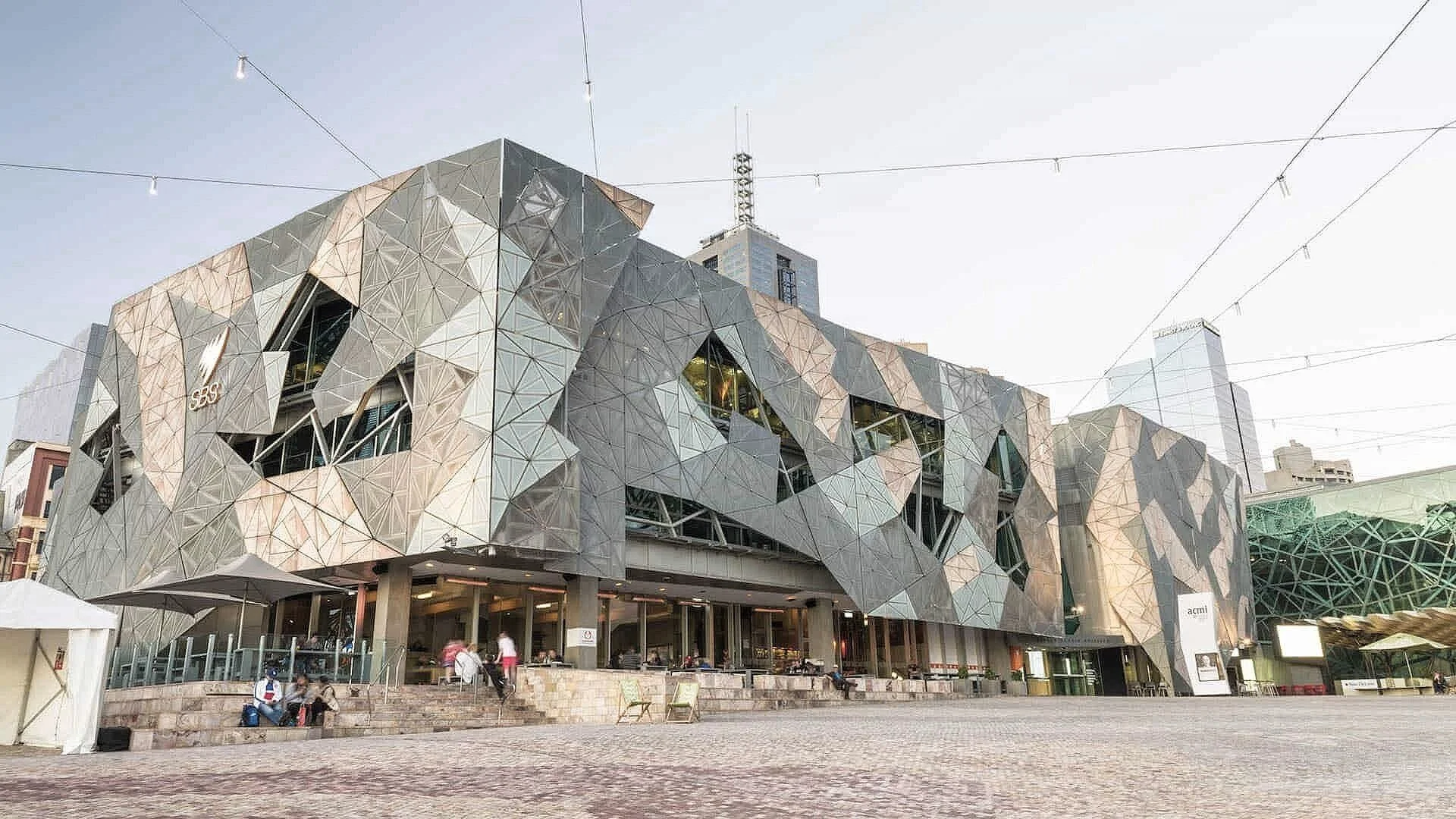
Federation Square occupies a unique position within contemporary architectural history. Located at the heart of Melbourne, the project combines cultural, commercial and public functions within a dense urban site that connects the city centre with the Yarra River and the surrounding civic precinct.
Designed by Lab Architecture Studio and Bates Smart, the project challenged conventional assumptions about architecture, urban space and construction. Rather than conceiving buildings as isolated objects placed within a public setting, Federation Square proposed a continuous civic landscape in which buildings, circulation routes, plazas, roofs and façades operate as parts of a single spatial system.
Newtecnic provided façade engineering for the project, developing envelope systems that enabled this ambitious architectural vision to be translated into a practical and durable construction solution.
The significance of Federation Square extends well beyond Melbourne. The project represents one of the earliest large-scale demonstrations of how digital design, fabrication and construction could operate as an integrated process. In doing so, it helped establish many of the methods that have since become standard practice within contemporary architecture.
Architecture as Civic Landscape
Traditional architecture often relies upon clear distinctions.
Walls are separated from roofs. Buildings are separated from landscapes. Public space exists between architectural objects.
Federation Square deliberately challenged these assumptions.
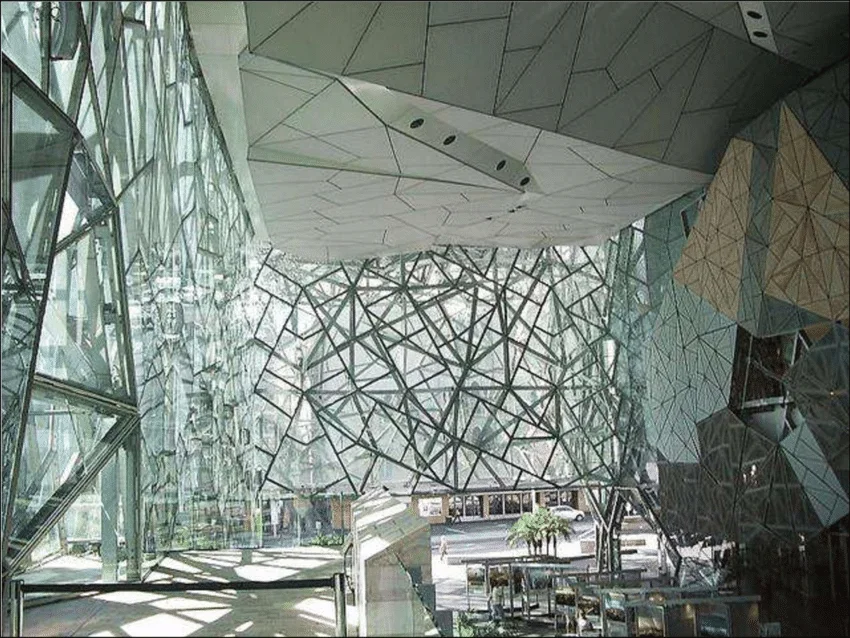
The project was conceived as a continuous civic terrain in which surfaces change their role as they move through the site. A roof becomes a wall. A wall becomes a public surface. Architectural elements extend into the landscape and the landscape becomes architecture.
This approach required a different way of thinking about construction.
If architecture is understood as a continuous field rather than a collection of separate objects, the systems used to construct it must also operate continuously across changing conditions.
The façade therefore became more than an enclosure system. It became part of the organisational framework of the entire project.
The Geometry of Continuity
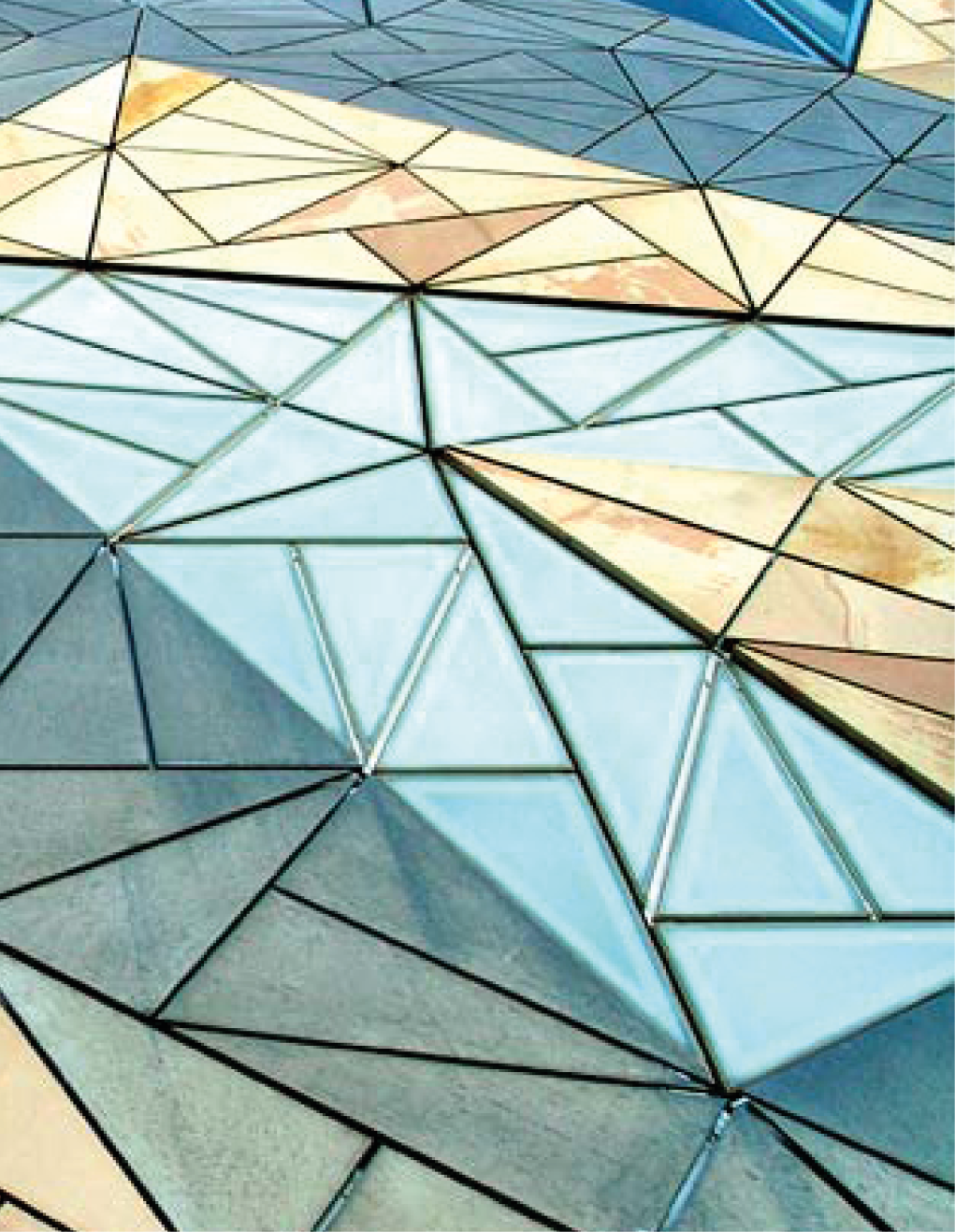
The project's distinctive visual identity is defined by its triangulated surface geometry.
At first glance the pattern appears highly irregular. In reality it is governed by a disciplined geometric framework that allows complex forms to be organised through a coherent set of relationships.
This distinction is important.
Complexity does not emerge from randomness. It emerges from organisation.
The triangulated system provided a geometric language capable of operating across walls, roofs, soffits and transitional surfaces. Rather than developing separate construction systems for each condition, the geometry established a common framework through which different architectural elements could be coordinated.
The result is a project in which continuity is achieved not through uniformity but through shared organisational logic.
Beyond the Rectangular Grid
For much of the twentieth century architectural construction was dominated by rectangular systems.
Curtain walls, cladding systems and structural grids were generally organised through orthogonal relationships because these simplified fabrication and assembly.
Federation Square explored an alternative possibility.
The triangulated framework demonstrated that complex geometries could be constructed efficiently if appropriate methods of rationalisation were developed. The project therefore expanded the range of geometries that could be considered practical for large-scale construction.
This achievement should not be understood primarily as a formal innovation.
Its real significance lies in the way geometry became linked directly to fabrication and assembly.
The project showed that non-orthogonal architecture could be systematic rather than exceptional.
Material Diversity Within a Common System
One of the most remarkable aspects of Federation Square is the range of materials incorporated within a single geometric framework.
Zinc, sandstone, metal panels and glazing all operate within the same triangulated language. Although each material possesses different physical properties, fabrication requirements and environmental behaviours, they are coordinated through a shared organisational structure.
This approach demonstrates an important principle of integrated design.
Coordination does not require uniformity.
Different systems can maintain their individual characteristics while participating in a larger framework of relationships.
The façade therefore becomes an exercise in integration rather than simplification.
Complexity is managed through organisation rather than reduction.
Digital Design as Construction Logic
Federation Square emerged during a period when digital modelling was beginning to transform architectural practice.
Many early digital projects focused primarily upon form generation. Computers allowed architects to create geometries that would have been difficult to draw or visualise using traditional methods.
Federation Square moved beyond this stage.
Digital modelling was used not only to define geometry but also to coordinate structure, fabrication, assembly and construction sequencing.
This represents a fundamental shift.
Digital technology ceased to be merely a design tool and became a construction tool.
The project therefore marks an important transition from digital representation to digital realisation.
Its importance lies not in the complexity of the geometry itself but in the integration of geometry with the processes required to build it.
Rationalising Complexity
The challenge facing the design team was not creating complexity but controlling it.
Without rationalisation, complex geometry rapidly becomes difficult to fabricate, coordinate and assemble. Costs increase. Construction programmes become uncertain. Quality becomes difficult to maintain.
The solution developed for Federation Square was based upon the principle of rational complexity.
The triangulated geometry was organised into repeatable component families that could be manufactured efficiently while still accommodating local variation.
This approach remains highly relevant today.
Many contemporary projects continue to rely upon the same principle: maximise repetition where possible while allowing controlled variation where necessary.
The objective is not simplification but intelligent organisation.
The Development of a Construction System
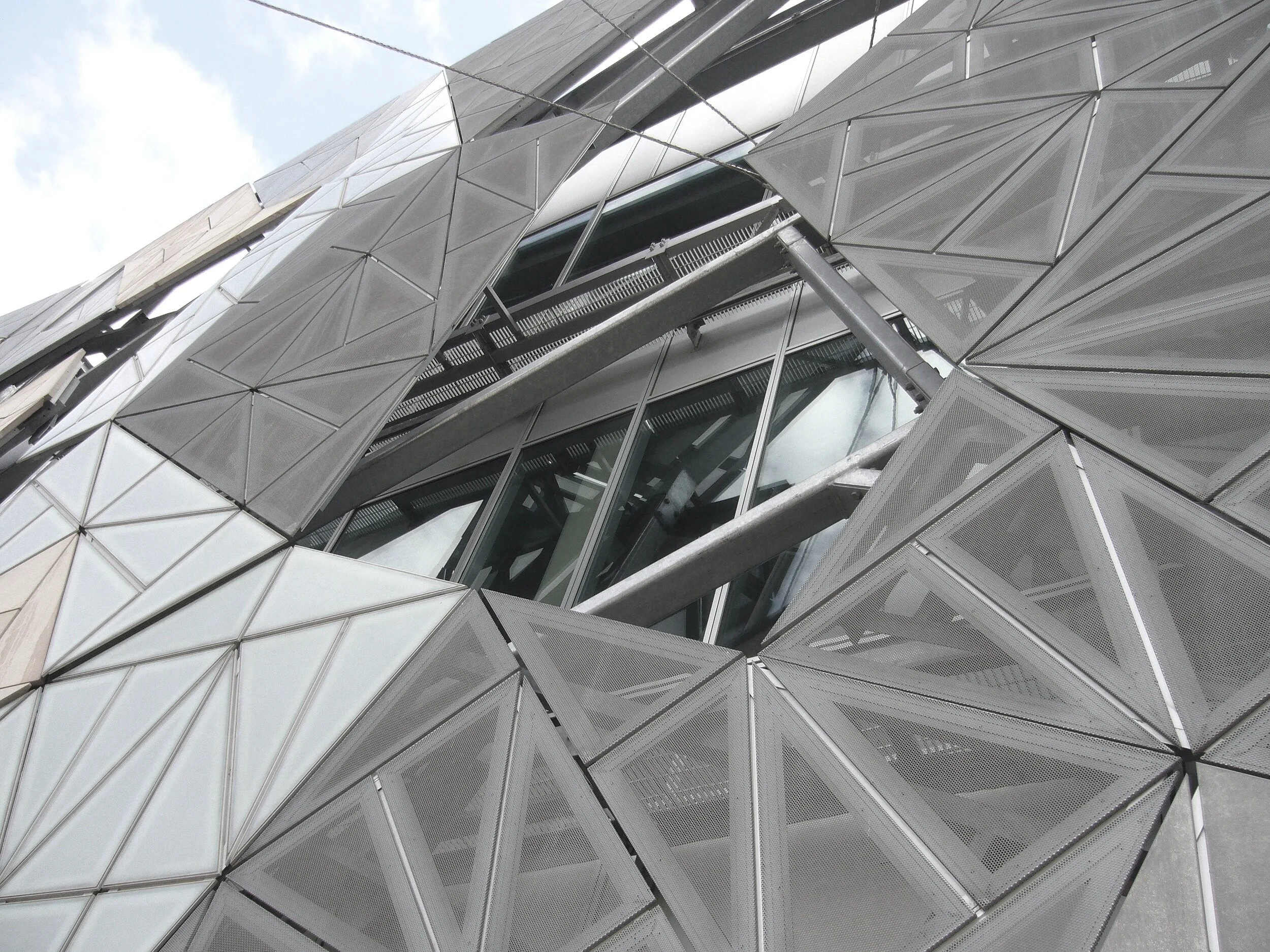
The façade system was developed as an integrated assembly in which structure, cladding, weather protection and environmental performance were considered together.
Rather than treating these requirements independently, the project sought alignment between them.
This integrated approach required extensive coordination between architects, engineers, fabricators and contractors. Digital models provided a shared environment within which information could be exchanged, verified and refined.
The project therefore illustrates a broader transformation within contemporary practice.
Architecture increasingly emerges through collaboration between disciplines rather than through sequential stages of isolated design development.
The façade becomes a point of convergence where multiple forms of expertise meet.
Adjustable Systems and Constructive Reality
No construction process is perfectly precise.
Materials vary. Structures move. Fabrication introduces tolerances. Site conditions differ from assumptions made during design.
Federation Square addressed these realities through adjustable support systems and flexible fixing strategies.
These elements are rarely visible to the public yet are fundamental to the success of the architecture.
The project demonstrates an important lesson for students: architectural quality depends not only upon conceptual clarity but also upon the capacity of systems to accommodate real-world conditions.
Constructive intelligence emerges through the reconciliation of ideal geometry and practical reality.
The success of the project lies in its ability to maintain architectural coherence while accepting the inevitability of variation.
Environmental Integration
Although often discussed primarily in terms of geometry, Federation Square is equally important as an environmental project.
Material selection, surface orientation, glazing distribution and cladding configuration all contribute to environmental performance. The façade operates not simply as a visual system but as a climatic mediator between interior and exterior conditions.
This reflects a broader shift within contemporary architecture.
Environmental performance is no longer treated as a secondary technical problem. Instead, it becomes integrated within the fundamental organisation of the building.
The project therefore anticipates later developments in performance-led design by demonstrating how environmental requirements can be embedded within architectural form from the outset.
A New Construction Paradigm
Federation Square helped establish a new understanding of architectural production.
Traditional workflows often separated design, engineering and construction into distinct stages. Federation Square demonstrated the advantages of a more integrated approach in which design decisions are informed by fabrication and construction considerations from the earliest stages.
This shift has had lasting consequences.
Many of the processes now associated with contemporary digital practice—including parametric coordination, prefabrication, digital fabrication and integrated modelling—were explored here at a significant civic scale.
The project therefore occupies an important place within the evolution of modern construction.
Project Significance
Federation Square represents a pivotal moment in the development of contemporary architecture. It demonstrated that digital design could become digital construction, linking geometry, fabrication and assembly within a single coordinated process.
The project illustrates Newtecnic's approach to façade engineering, where architectural expression, construction logic and environmental performance are developed together rather than treated as separate concerns.
More broadly, Federation Square established a model for the realisation of complex architecture through disciplined organisation rather than uncontrolled complexity. Its enduring significance lies not simply in its distinctive appearance but in the methods through which it was realised.
By transforming geometric ambition into buildable reality, the project helped define a new relationship between architecture and construction—one that continues to shape contemporary practice today.