Galaxy SOHO, Beijing, China

Further information and case study for this project can be found at the De Gruyter Birkhäuser Modern Construction Online database
The following text is not available at Modern Construction Online
Continuity Through Systems
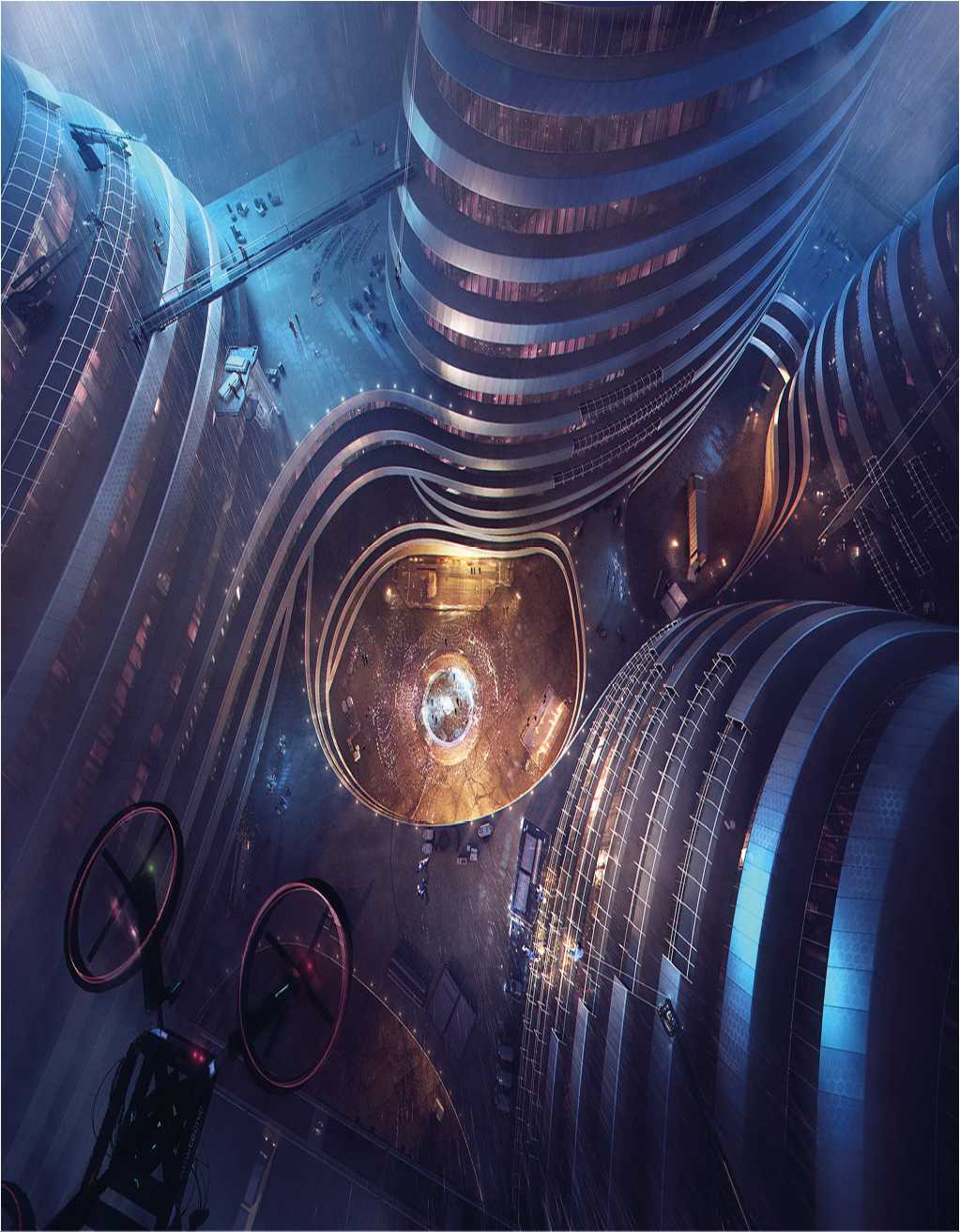
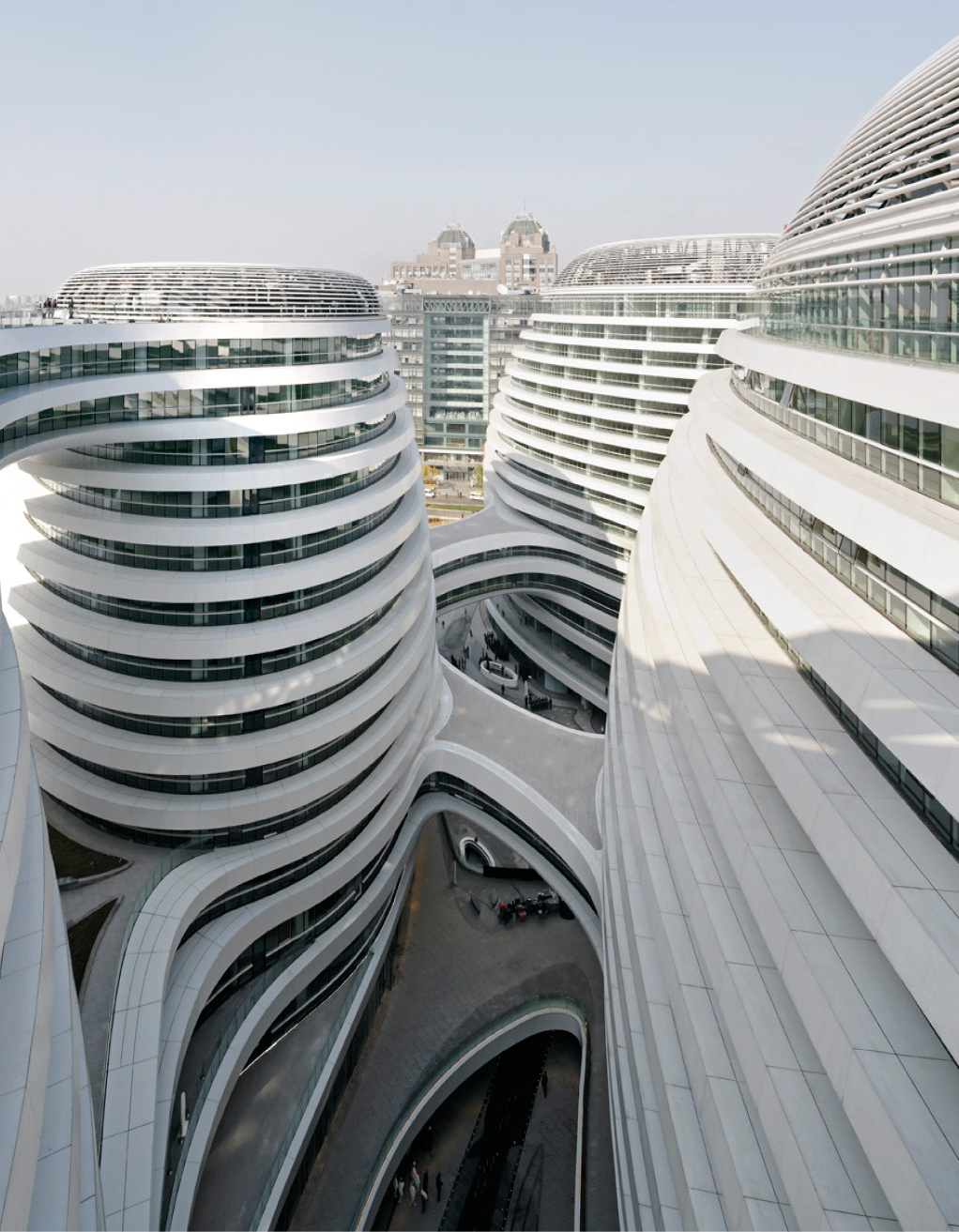
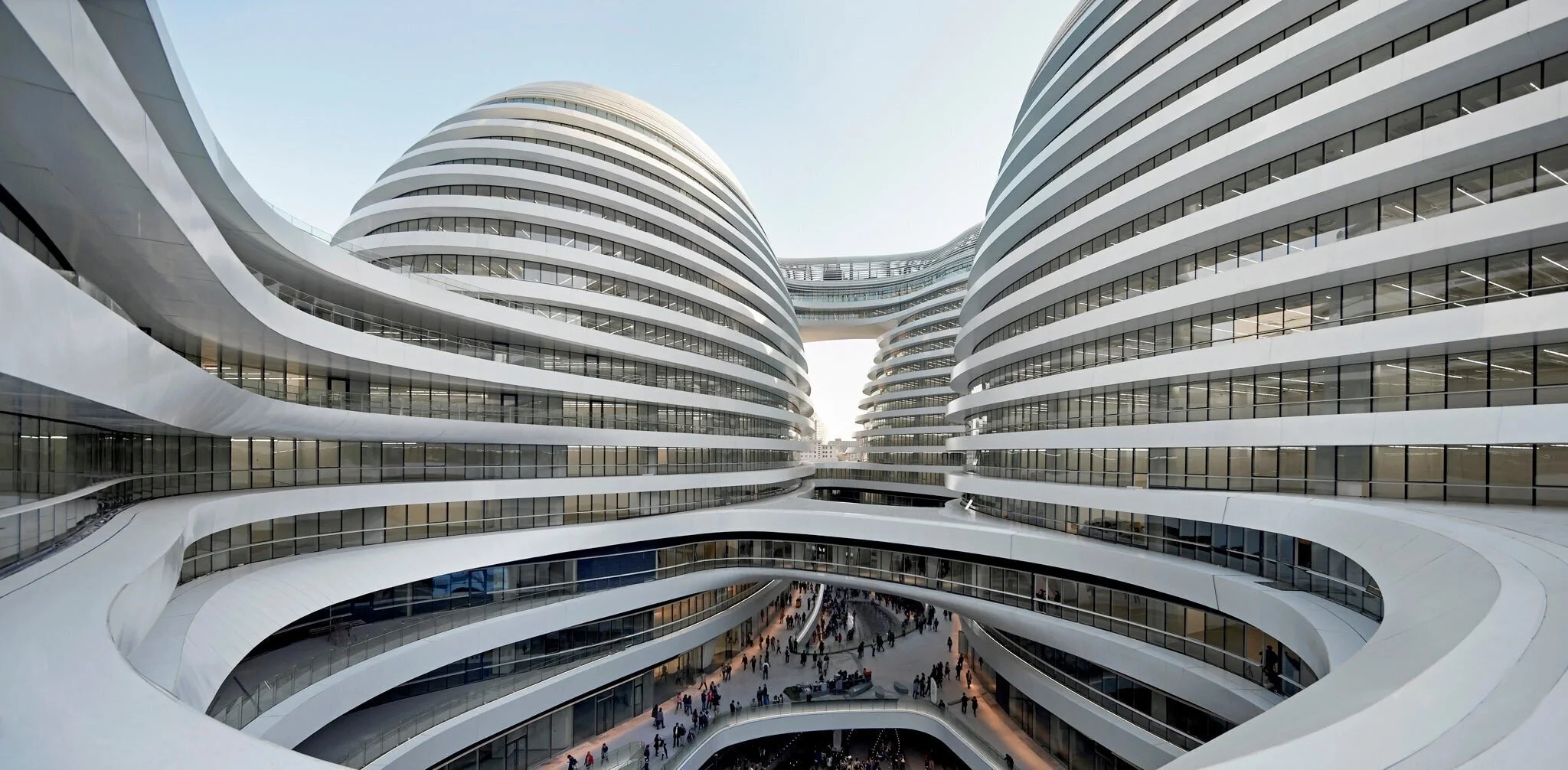
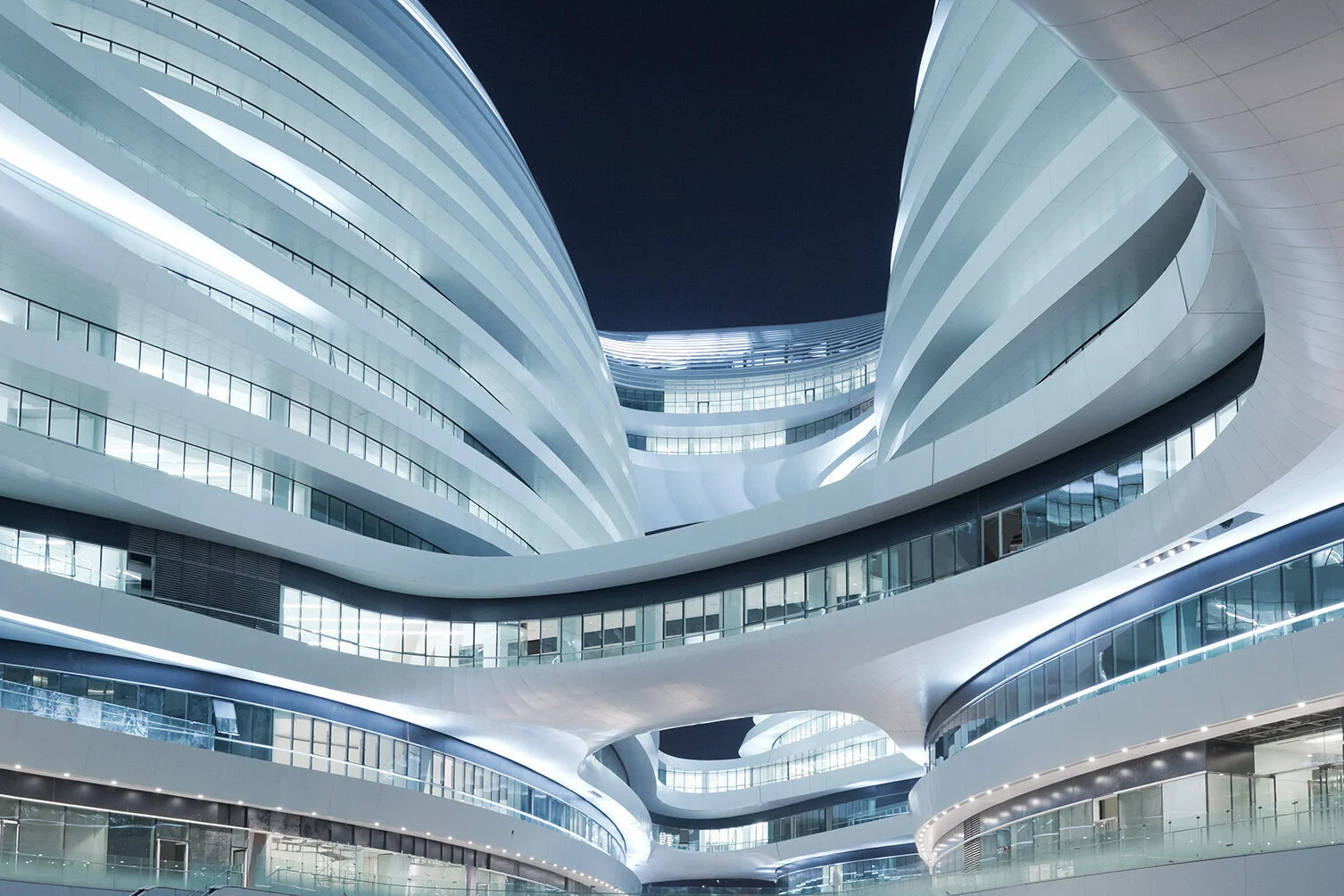
Galaxy SOHO is a major mixed-use development located in Beijing. Designed by Zaha Hadid Architects, the project comprises four interconnected building volumes linked by bridges, terraces and shared public spaces. Together these elements form a continuous urban composition that accommodates commercial, office and retail functions within a unified architectural framework.
Newtecnic provided façade engineering for the project, developing envelope systems capable of translating the architectural concept into an efficient and buildable construction solution.
The significance of Galaxy SOHO lies in its exploration of continuity. The project demonstrates that architectural continuity is not simply a matter of form. It emerges through the coordination of systems. Structure, enclosure, circulation, fabrication and maintenance must all operate together if continuity is to be realised in practice.
This lesson extends beyond the project itself. Galaxy SOHO illustrates how contemporary architecture increasingly depends upon relationships between systems rather than the design of individual objects.
The Idea of Continuity
Continuity is one of the most persistent themes within architecture.
Architects have long sought ways of creating coherent experiences that connect spaces, structures and landscapes. Yet continuity is often misunderstood as a purely visual condition. Smooth surfaces, flowing forms and curved geometries are frequently assumed to create continuity automatically.
Galaxy SOHO challenges this assumption.
The project's visual character is certainly defined by fluid geometry, but its coherence depends upon something deeper. Continuity emerges because multiple systems are organised according to common principles.
The architecture works because structure, façade, circulation and construction all participate in the same organisational logic.
The lesson is simple but important.
Continuity is not drawn. It is constructed.
From Object to Environment
Many commercial developments are composed as collections of individual buildings arranged around external spaces.
Galaxy SOHO adopts a different approach.
The four principal volumes remain identifiable, yet they are linked physically and visually through bridges, terraces and continuous circulation routes. Public space flows between buildings rather than existing separately from them.
This transforms the project from a collection of objects into an architectural environment.
The distinction matters.
An object can be understood independently. An environment depends upon relationships.
The project therefore shifts attention away from individual buildings towards the systems that connect them. Architecture becomes an exercise in organising continuity across multiple scales simultaneously.
A Family of Connected Forms
The individual volumes differ in size, orientation and programme, yet all share a common architectural language.
Curved slab edges establish continuity between buildings. Bridges extend movement across the development. Shared material palettes and façade systems reinforce visual coherence.
Importantly, the buildings do not seek uniformity.
Each responds to local conditions and programme requirements while remaining part of a larger organisational framework.
This balance between individuality and collective order is one of the project's principal achievements.
The development demonstrates that coherence can emerge through relationships rather than repetition.
The whole becomes greater than the sum of its parts.
The Façade as Organising System
The façade plays a critical role in establishing continuity across the development.
Rather than functioning simply as enclosure, it provides a framework through which multiple architectural systems are coordinated. Horizontal floor plates, curved slab edges, glazing systems and balustrades all contribute to a shared visual and technical language.
The façade therefore becomes an organising system.
Its significance lies not only in appearance but in its capacity to connect different parts of the project into a coherent whole.
This reflects an increasingly important characteristic of contemporary envelope design.
Façades are no longer understood solely as boundaries between inside and outside. They become interfaces through which structural, environmental and architectural relationships are organised.
Geometry and Rationalisation
At first glance the geometry of Galaxy SOHO appears highly complex.
The smooth transitions between buildings, curved surfaces and flowing circulation routes suggest extensive customisation. Yet the project depends upon a disciplined process of rationalisation.
Complex geometry was translated into repeatable construction systems capable of efficient fabrication and installation.
This process is fundamental to contemporary construction.
Architecture cannot remain at the level of geometry alone. Every curve must ultimately become a component. Every surface must become a system of manufacture, transport and assembly.
The challenge lies in preserving architectural intent while introducing the discipline necessary for construction.
Galaxy SOHO demonstrates how this balance can be achieved.
Curved Forms and Flat Components
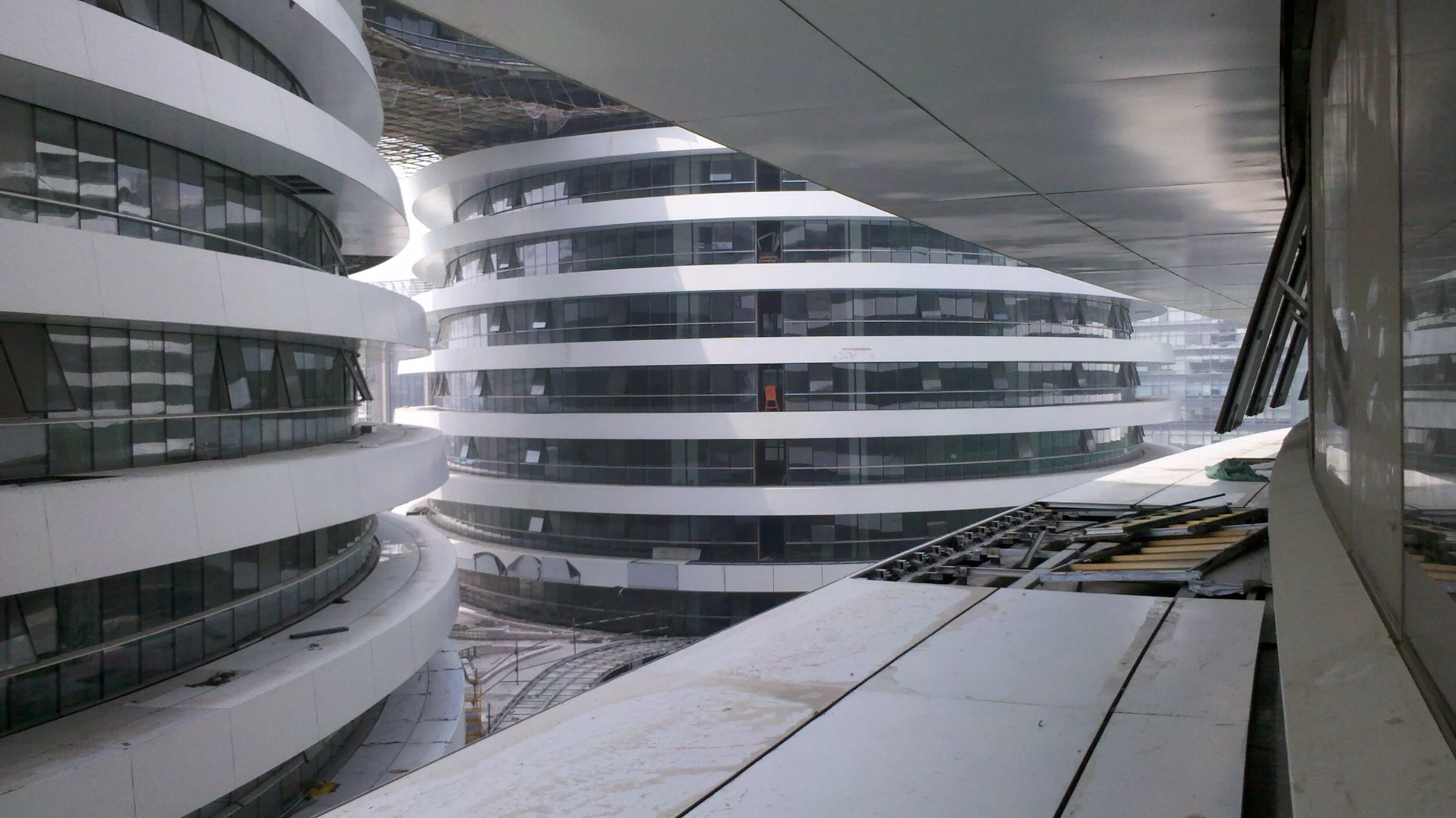
One of the most important strategies employed within the project is the use of planar glazing within a curvilinear architectural framework.
Curved slab edges establish the fluid character of the architecture. Behind these edges, flat glazing panels provide economy, performance and construction efficiency.
This combination illustrates an important principle.
Architectural continuity does not necessarily require continuous materials.
Visual continuity can emerge through the careful coordination of different systems, each responding to its own technical requirements.
The project therefore demonstrates how construction intelligence can support architectural ambition.
Rather than pursuing complexity for its own sake, the design identifies where complexity contributes value and where simplification improves performance.
Integration of Functions
A recurring theme throughout Galaxy SOHO is the integration of multiple functions within single architectural elements.
The balustrade system provides a clear example.
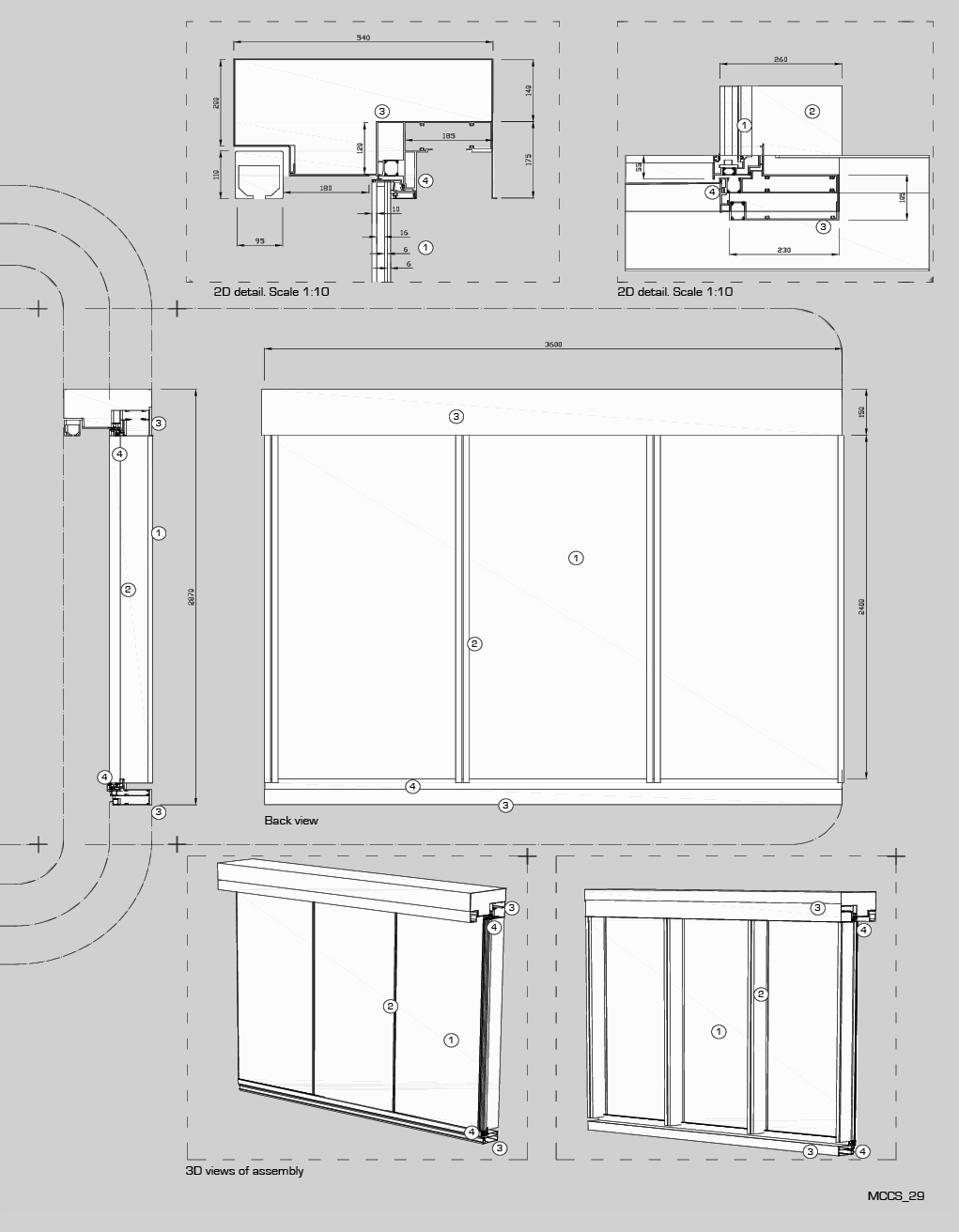
Visually, the balustrades extend the geometry of the slab edges and reinforce the continuity of the architecture. Technically, they provide fall protection, maintenance access and environmental enclosure.
Several requirements are therefore resolved through one coordinated component.
This strategy reflects a broader principle of integrated design.
Architectural quality often increases when elements perform multiple roles simultaneously. Reducing the number of separate systems can improve both visual clarity and construction efficiency.
The project demonstrates how integration becomes a source of coherence.
Digital Coordination and System Thinking
The realisation of Galaxy SOHO depended upon extensive digital coordination.
Digital models were used not simply to describe geometry but to manage relationships between structure, façade systems, circulation routes and construction processes.
This distinction is important.
The true value of digital technology lies less in its ability to generate complex forms than in its capacity to coordinate complex information.
In Galaxy SOHO, digital tools enabled the project to be understood as a system rather than a collection of independent parts.
Geometry became connected to fabrication. Fabrication became connected to installation. Installation became connected to long-term operation.
The project therefore illustrates a mature approach to digital design in which technology supports integration rather than novelty.
Constructability and Continuity
Architectural continuity is often difficult to maintain during construction.
Different trades, fabrication tolerances, structural movement and programme constraints can introduce discontinuities that undermine design intentions.
Galaxy SOHO addressed these challenges through prefabricated façade elements, adjustable support systems and coordinated assembly strategies.
These measures allowed visual continuity to be maintained while accommodating the realities of construction.
This highlights an important lesson for students.
Architectural ideas survive only when they are supported by appropriate construction systems.
Continuity is not protected by geometry alone. It depends upon coordination, tolerance and assembly.
Construction is therefore not separate from architectural design. It is one of the means through which architecture becomes possible.
The Urban Dimension
The significance of Galaxy SOHO extends beyond the individual buildings.
The project establishes a continuous urban environment that encourages movement, interaction and visual connection. Bridges, terraces and public spaces create a network of relationships extending throughout the development.
This approach reflects a broader shift within contemporary urban design.
Rather than treating public space as residual territory between buildings, projects increasingly seek to integrate architecture and urbanism within shared systems of organisation.
Galaxy SOHO demonstrates how continuity can operate simultaneously at the scale of the component, the building and the city.
The project therefore becomes an exercise in multi-scalar coordination.
Architecture as Relationship
Perhaps the most valuable lesson offered by Galaxy SOHO is that architecture is fundamentally relational.
Buildings are connected to structures. Structures are connected to façades. Façades are connected to environmental systems. Public spaces are connected to circulation networks.
The success of the project lies in the alignment of these relationships.
Its flowing forms are merely the visible expression of a deeper organisational coherence.
This understanding is increasingly important within contemporary practice. As projects grow in complexity, architectural quality depends less upon individual forms and more upon the coordination of systems.
Continuity emerges through relationships.
Project Significance
Galaxy SOHO demonstrates how large-scale architectural continuity can be achieved through the integration of design, engineering and construction. The project transforms formal complexity into a coherent system of components, assemblies and relationships that can be fabricated, installed and maintained efficiently.
The project illustrates Newtecnic's approach to façade engineering, where architectural expression, construction logic and environmental performance are developed together within a coordinated framework.
More broadly, Galaxy SOHO demonstrates that continuity is not a geometric condition alone. It is a systemic condition. The project succeeds because multiple systems—structural, environmental, architectural and constructive—operate together according to shared principles.
The result is an architecture that appears fluid and continuous while remaining grounded in practical construction realities. In doing so, Galaxy SOHO provides an important model for contemporary practice, showing how complex urban environments can be organised through relationships rather than isolated forms.
It is a project that transforms continuity from an aesthetic ambition into a constructive methodology.