
Grand Egyptian Museum, Giza, Egypt
Further information and case study for this project can be found at the De Gruyter Birkhäuser Modern Construction Online database
The following text is not available at Modern Construction Online
Permanence Through Adaptation
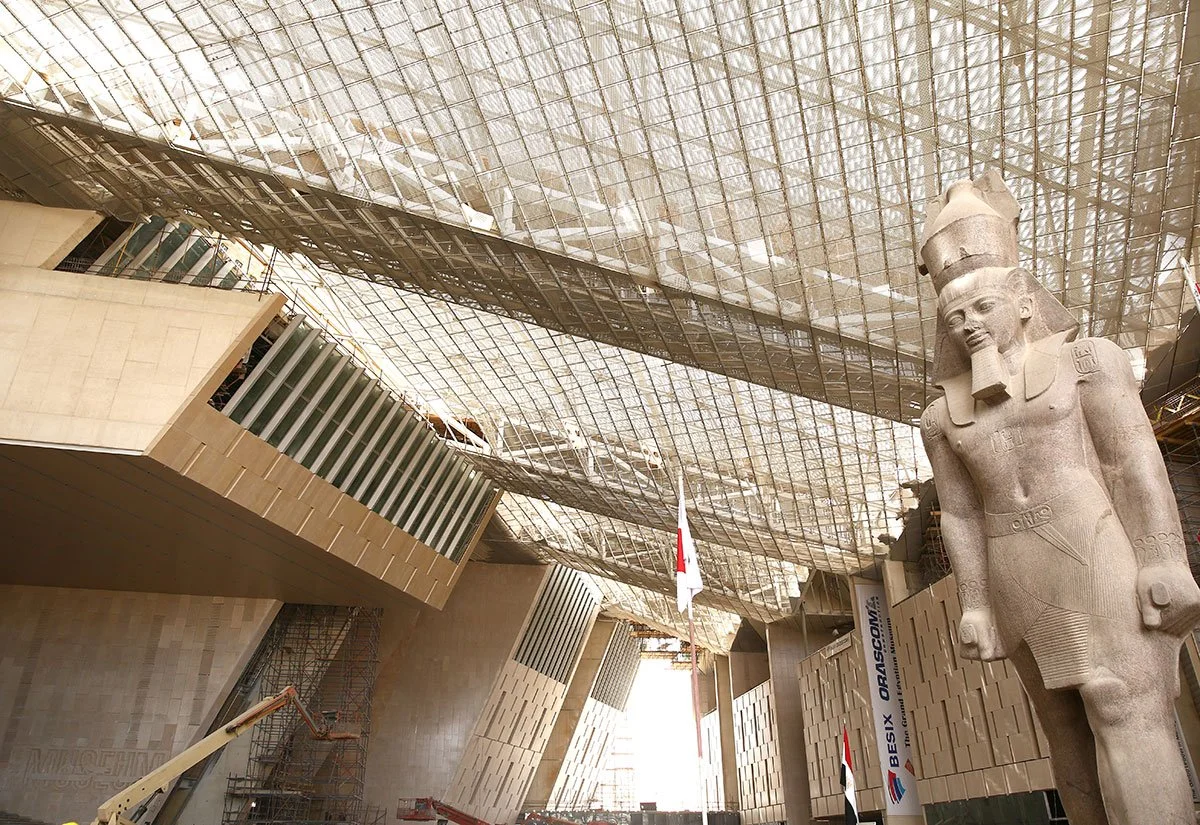
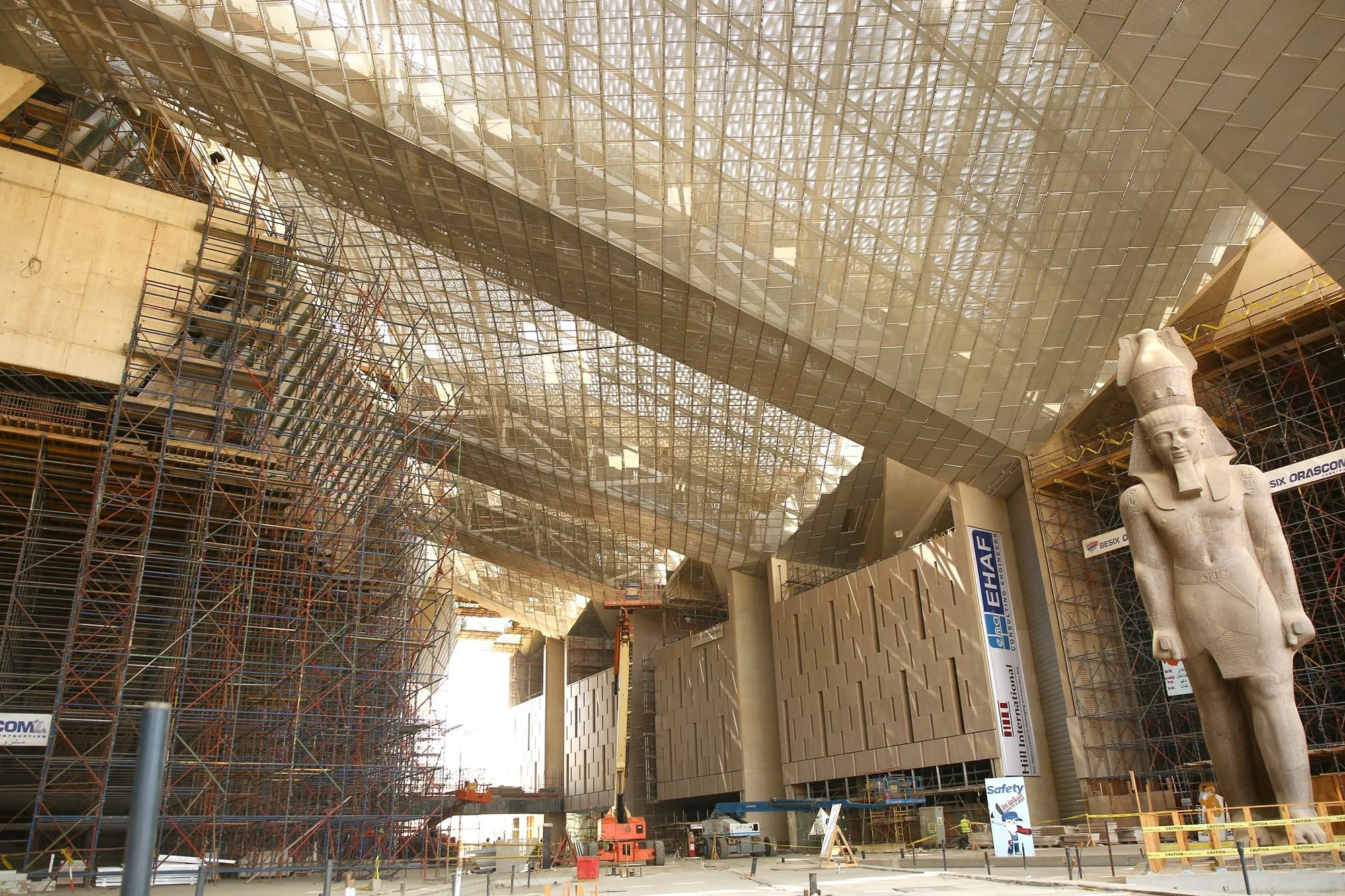
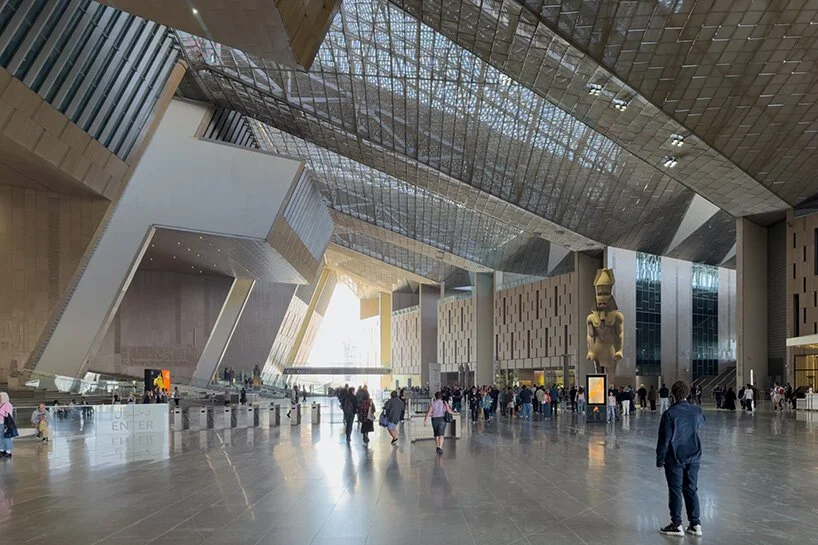
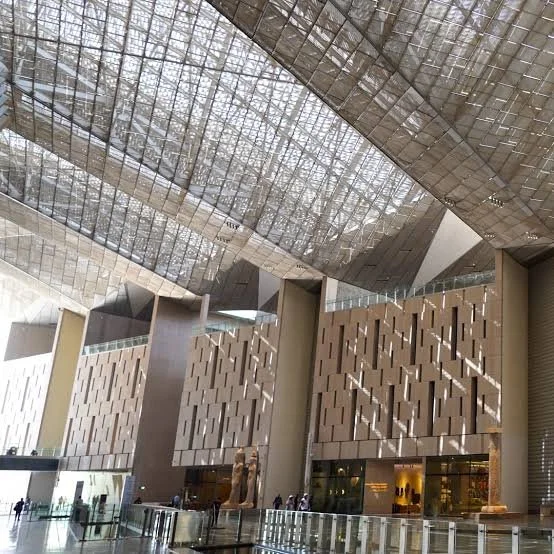
Located adjacent to the Giza Plateau, the Grand Egyptian Museum is one of the most significant cultural projects undertaken in recent decades. Designed by Heneghan Peng Architects, the museum establishes a contemporary architectural presence while maintaining a powerful relationship with one of the world's most important archaeological landscapes.
Newtecnic provided façade engineering for the project, developing envelope systems capable of reconciling heritage, environmental performance and long-term durability within the demanding climatic conditions of Cairo.
The significance of the project extends beyond the housing of archaeological collections. The museum demonstrates how contemporary architecture can engage with history without relying upon imitation. Rather than reproducing historic forms, the project identifies and reinterprets the underlying architectural principles that have allowed Egyptian architecture to endure for millennia.
In this sense the museum is not only a container for history. It is an investigation into permanence itself.
Architecture and Landscape
The relationship between architecture and landscape has always been fundamental to Egyptian civilisation.
The pyramids, temples and ceremonial complexes of ancient Egypt derive much of their power from their relationship to the desert plateau, the horizon and the movement of light across vast geological landscapes. Their significance emerges not only from form but from their integration with place.
The Grand Egyptian Museum continues this tradition.
The building's monumental stone surfaces establish visual continuity with the surrounding desert terrain. Rather than appearing as an isolated object, the museum reads as an extension of the landscape itself. Its scale, materiality and geometry create a dialogue with the plateau and the pyramids beyond while maintaining a clearly contemporary architectural language.
This relationship is important because it positions the building within a much longer cultural and environmental narrative.
The architecture derives meaning from its setting rather than from symbolic replication.
Beyond Historical Imitation
Many cultural buildings seek legitimacy through direct references to historical forms.
The Grand Egyptian Museum adopts a different approach.
Rather than reproducing columns, temples or decorative motifs, the project draws upon more fundamental architectural qualities. Mass, shadow, permanence, geometry and environmental control become the primary means through which continuity is established.
This distinction is significant.
Architecture remains alive when it adapts principles rather than copies forms.
The museum therefore demonstrates how heritage can inform contemporary architecture without constraining innovation. Historical continuity emerges through shared concerns rather than visual resemblance.
The result is an architecture that acknowledges the past while remaining rooted firmly in the present.
Monumentality and Civic Presence
Monumentality is one of the defining characteristics of civic architecture.
Yet monumentality is frequently misunderstood as a matter of scale alone. Large buildings are often assumed to be monumental simply because they are large.
The Grand Egyptian Museum demonstrates a more sophisticated understanding.
Its monumentality emerges through proportion, material consistency, geometric clarity and the careful control of light. These qualities establish a sense of permanence and civic significance without requiring excessive formal complexity.
This places the project within a lineage that includes Louis Kahn's National Assembly Building in Dhaka and Oscar Niemeyer's civic architecture in Brasília.
In each case, monumentality emerges through architectural order rather than decorative elaboration.
The museum therefore continues a long tradition of architecture that seeks dignity through restraint.
The Façade as Environmental Mediator
The façade is central to the performance of the building.
Cairo's climate presents significant environmental challenges. High temperatures, intense solar radiation, airborne dust and substantial daily temperature variations all place demands upon the building envelope.
The museum responds through a layered environmental strategy.
Large stone surfaces provide thermal mass, moderating temperature fluctuations and reducing heat transfer into occupied spaces. Deeply recessed openings minimise direct solar penetration while generating shaded zones that improve environmental performance.
The façade therefore functions as an environmental mediator between climate and occupation.
This role is particularly important within a museum environment, where the protection of artefacts must be balanced with visitor comfort and energy performance.
Environmental control becomes inseparable from architectural expression.
Light as Architectural Material
Few architectural elements possess greater significance within Egyptian architecture than light.
From the temples of Luxor to contemporary cultural buildings, the controlled admission of light has played a central role in shaping spatial experience.
The Grand Egyptian Museum continues this tradition through the careful calibration of openings, glazing and solar protection systems.
Daylight is introduced selectively rather than uniformly. Public spaces benefit from generous natural illumination, while galleries receive carefully moderated light levels appropriate for conservation requirements.
The resulting spaces demonstrate that environmental performance need not conflict with architectural quality.
Light becomes both a technical resource and a cultural medium.
Its movement throughout the day establishes a changing relationship between building, landscape and occupation.
Material and Time
Stone remains one of the most enduring architectural materials.
Its use within the museum establishes both practical and symbolic continuity with the wider landscape. The material possesses the durability required for long-term performance while simultaneously reinforcing the building's connection to Egyptian geology and construction traditions.
Yet the significance of the stone lies not only in its appearance.
Material selection influences maintenance, ageing, environmental performance and lifecycle durability. The museum therefore demonstrates an understanding of architecture as a long-term undertaking rather than a short-term visual exercise.
This perspective aligns closely with one of the central themes of contemporary construction.
Buildings must be understood not only at the moment of completion but throughout their operational life.
The architecture is designed to endure physically, environmentally and culturally.
Structure and Enclosure
The relationship between structure and façade is carefully coordinated throughout the project.
The stone cladding is supported by a secondary steel framework attached to the primary reinforced concrete structure. This arrangement allows the architectural surfaces to achieve their required scale and continuity while accommodating movement, maintenance and construction tolerances.
The strategy reflects a broader principle of contemporary façade engineering.
Architecture increasingly depends upon layered systems in which structural support, environmental control and architectural expression are developed simultaneously rather than sequentially.
The museum demonstrates how these relationships can be resolved without compromising either performance or architectural clarity.
The visible simplicity of the building is therefore supported by considerable technical sophistication.
Environmental Responsibility and Cultural Stewardship
Museums occupy a unique position within society.
They are responsible not only for housing collections but also for preserving cultural memory. This responsibility extends to the architecture itself.
The Grand Egyptian Museum acknowledges this through an environmental strategy designed to support long-term stewardship.
Reducing energy consumption, improving thermal stability and enhancing durability are not simply technical objectives. They contribute directly to the preservation of collections and the sustainable operation of the institution.
The façade therefore performs a dual role.
It protects the artefacts within while embodying the values of continuity and conservation that the museum exists to promote.
Environmental responsibility becomes a form of cultural responsibility.
Architecture as Continuity
Perhaps the most important lesson offered by the project concerns continuity.
The museum demonstrates that continuity does not depend upon reproducing historical forms. Instead, it emerges through the sustained adaptation of architectural principles across time.
Ancient Egyptian architecture responded to climate, landscape, material and civic identity. The Grand Egyptian Museum responds to the same conditions using contemporary technologies, construction methods and environmental knowledge.
The result is neither historical reconstruction nor architectural spectacle.
It is an architecture that participates in an ongoing cultural conversation extending across thousands of years.
Project Significance
The Grand Egyptian Museum demonstrates how contemporary façade engineering can support architecture that is simultaneously cultural, environmental and technological.
By integrating climatic performance, material durability, structural coordination and historical continuity within a coherent envelope system, the project establishes a model for large-scale cultural architecture in demanding environments.
The project illustrates Newtecnic's approach to façade engineering, where environmental performance and architectural expression are developed together rather than treated as separate concerns.
More broadly, the museum demonstrates that permanence is not achieved through resistance to change but through adaptation. By reinterpreting enduring architectural principles within contemporary construction systems, the building creates a meaningful connection between past and present.
The result is an institution whose performance, identity and cultural significance emerge from the same architectural idea: a contemporary architecture grounded in landscape, climate, material and civilisation.