
Holland Park School, London, UK
Further information and case study for this project can be found at the De Gruyter Birkhäuser Modern Construction Online database
The following text is not available at Modern Construction Online
The Façade as Environmental Mediator
Holland Park School is a major educational building located in West London, combining teaching spaces, communal facilities and circulation areas within a contemporary architectural framework designed to support learning while responding to a sensitive urban setting.
Newtecnic provided façade engineering for the project, developing an envelope system that integrates environmental performance, solar control and architectural identity.
The significance of the project lies not in formal complexity or technological novelty alone, but in its demonstration of a fundamental architectural principle: the façade as a mediator between environment and occupation. Rather than acting simply as a boundary between inside and outside, the envelope regulates light, privacy, comfort and visual connection, creating the environmental conditions necessary for effective learning.
The project illustrates how architecture can shape experience not through dramatic form but through the careful calibration of environmental relationships.
Learning and Environment
Educational buildings place particular demands upon architecture.
Students spend extended periods within classrooms, studios and communal spaces where environmental conditions directly influence concentration, wellbeing and learning performance. Access to daylight, visual comfort, acoustic control and thermal stability all contribute to the quality of the educational environment.
The design of a school therefore extends beyond the provision of accommodation.
Architecture becomes a tool for creating conditions that support learning.
The façade plays a central role in this process because it is the point at which external environmental conditions are transformed into internal experiences. Sunlight becomes daylight. Noise becomes background sound. Urban activity becomes visual connection. Climate becomes comfort.
The building envelope is therefore an active participant in education rather than merely a protective enclosure.
The Problem of the Urban School
Unlike many educational campuses located in open landscapes, Holland Park School occupies a constrained urban site surrounded by residential buildings and public streets.
This context creates competing requirements.
Teaching spaces require generous daylight, outward views and a sense of openness. At the same time, neighbouring properties require privacy and careful control of overlooking. Solar exposure must be managed without creating dark interiors. External noise must be moderated without isolating the building from its surroundings.
These competing conditions cannot be resolved through a single architectural gesture.
Instead, they require a layered approach in which the façade operates as a carefully calibrated environmental filter.
From Barrier to Filter
Conventional building envelopes often establish a clear distinction between inside and outside. Walls separate environments. Windows provide controlled openings within those boundaries.
The façade at Holland Park adopts a different strategy.
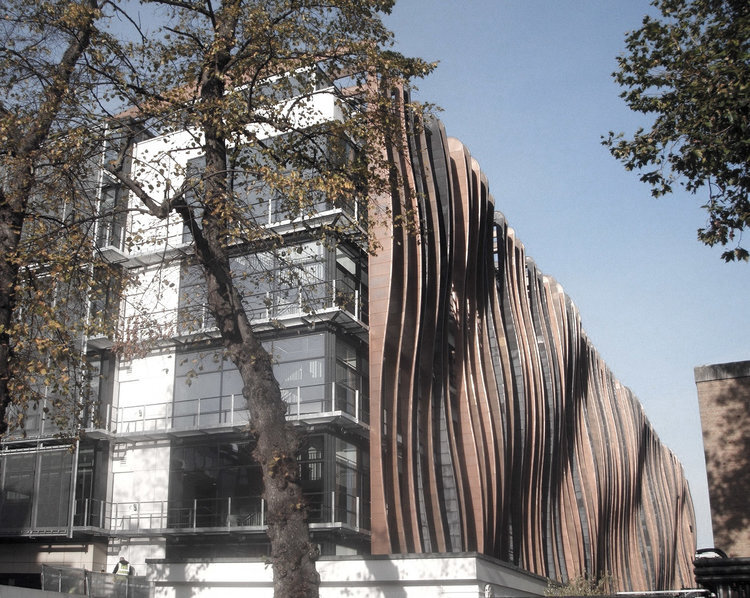
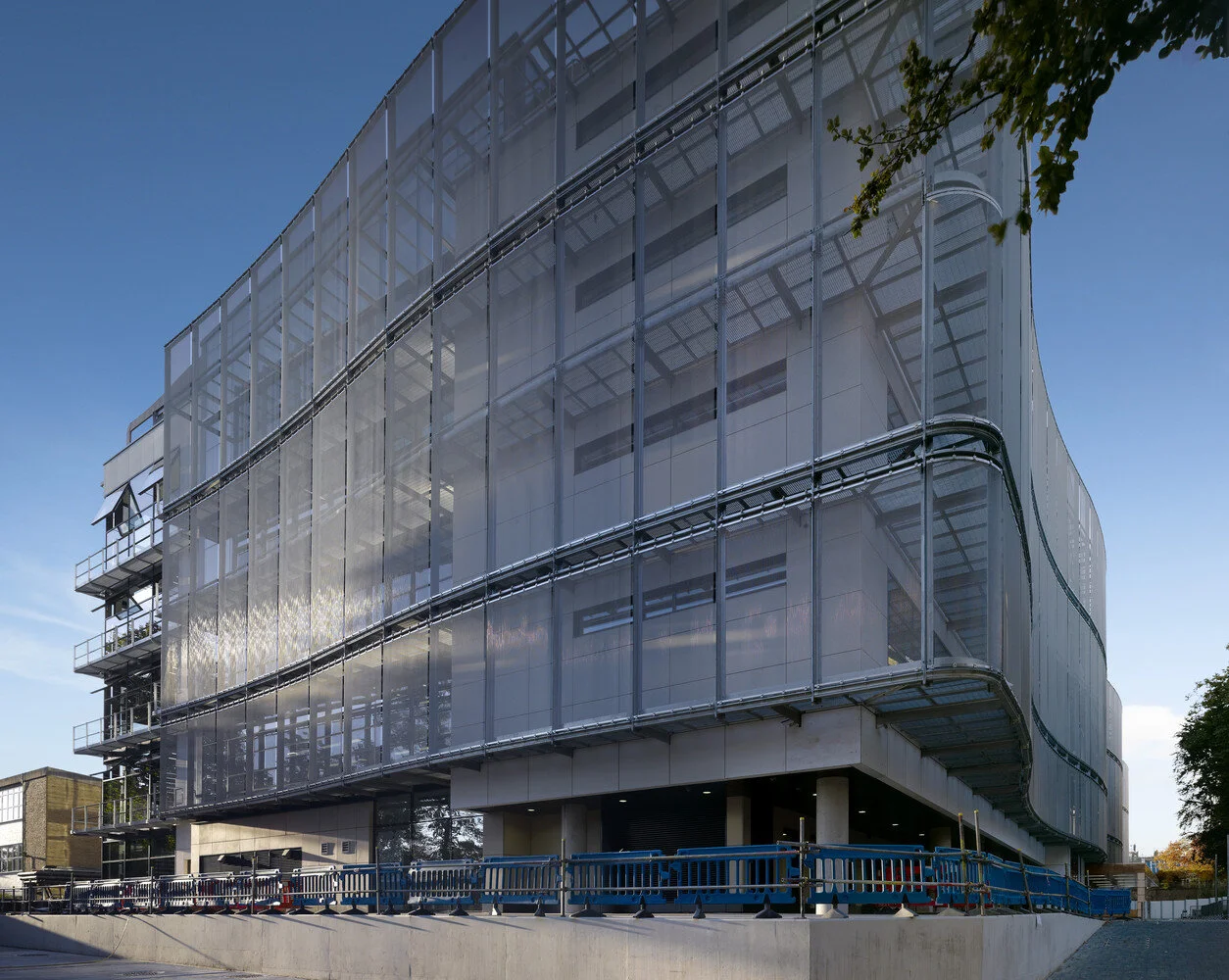
Rather than functioning primarily as a barrier, it operates as a filter. Layers of glazing and external shading elements mediate environmental conditions before they reach the occupied spaces behind.
This distinction is important.
A barrier excludes. A filter transforms.
The building therefore does not seek to eliminate environmental influences. Instead, it modifies them to create conditions appropriate for learning.
The façade becomes a device for environmental moderation rather than environmental separation.
The Logic of Layering
A defining characteristic of the project is its layered envelope system.
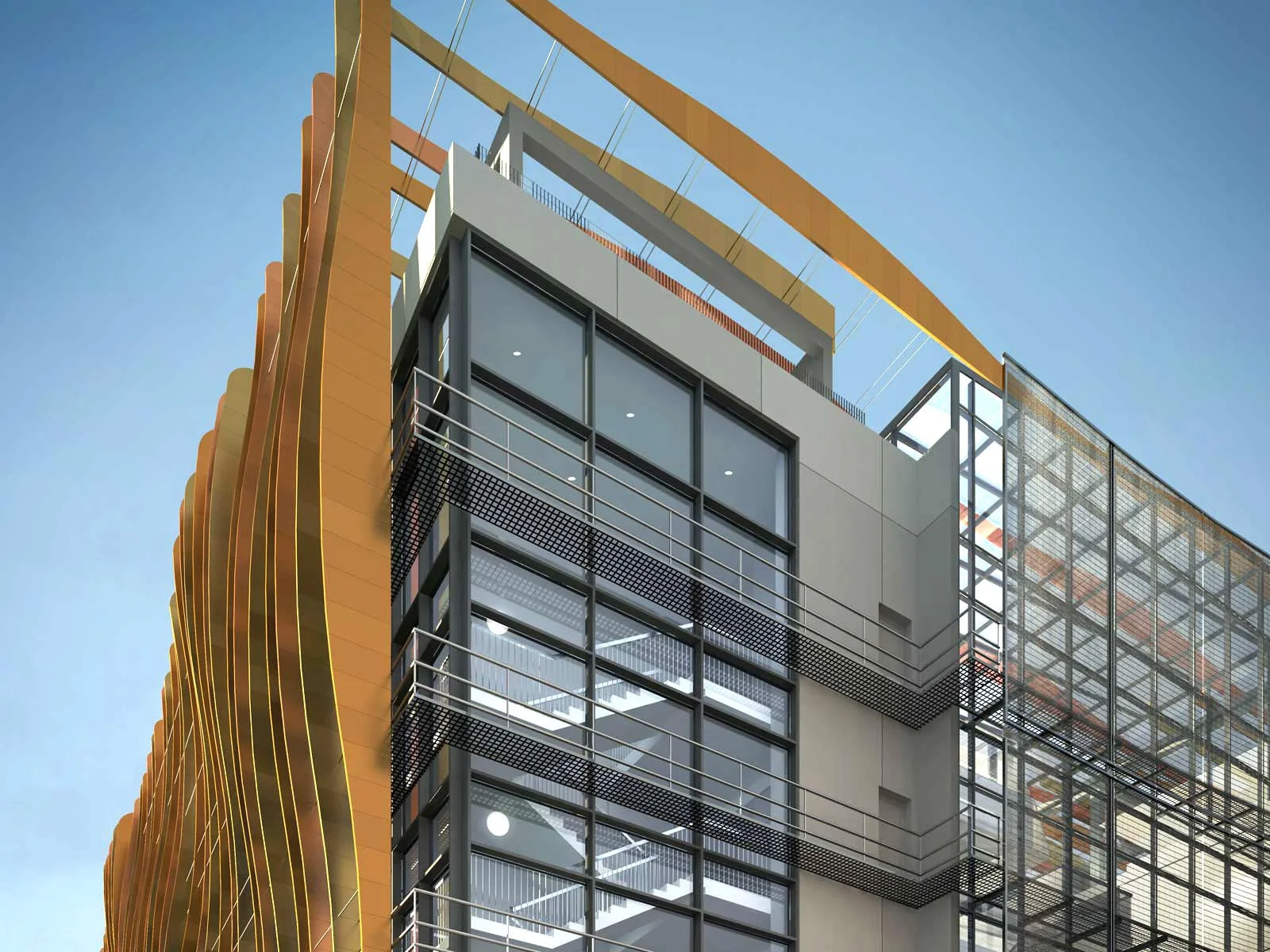
The inner layer provides environmental enclosure through insulated glazing, maintaining thermal performance and weather protection. A secondary layer of external louvres introduces an additional level of environmental control.
The space between these layers allows sunlight, views, privacy and environmental performance to be adjusted independently.
This arrangement demonstrates one of the most important principles of contemporary façade design: complex environmental requirements are often addressed more effectively through multiple coordinated layers rather than through a single multifunctional surface.
The envelope achieves performance through organisation.
Daylight as a Design Material
Light is one of the most significant architectural materials within educational environments.
Natural daylight improves visual comfort, supports wellbeing and contributes to orientation and spatial awareness. Yet daylight must be controlled carefully. Excessive sunlight can create glare, overheating and discomfort, particularly within classrooms where visual concentration is important.
The external louvre systems allow daylight to be shaped rather than simply admitted or excluded.
Their orientation, spacing and depth regulate the amount and character of light entering the building throughout the day. The result is an environment that remains bright and visually connected while avoiding the environmental penalties associated with unrestricted solar exposure.
The project demonstrates that successful daylighting depends not on maximising light levels but on achieving balance.
Privacy and Visual Connection
Schools occupy a unique position within the city.
They must remain connected to their surroundings while providing secure and protected environments for students and staff. This creates a continual tension between openness and privacy.
The façade addresses this condition through carefully calibrated screening systems.
The external louvres reduce direct overlooking from neighbouring properties while preserving outward views from within the building. Occupants remain visually connected to the wider urban environment without becoming visually exposed to it.
This balance is particularly important within dense urban contexts where educational facilities coexist closely with residential communities.
The façade therefore contributes not only to environmental performance but also to social and spatial relationships within the city.
Orientation and Environmental Response
No building façade experiences identical environmental conditions across all elevations.
Solar exposure varies according to orientation, season and time of day. Wind conditions differ between façades. Visual relationships change according to surrounding context.
The envelope at Holland Park responds to these differences rather than imposing a uniform solution.
On the western elevations, where low-angle afternoon sunlight presents particular challenges, vertical louvres provide increased solar protection. Elsewhere, shading systems are adjusted to reflect differing environmental requirements.
The building therefore demonstrates an important principle of environmental design: performance emerges from responsiveness rather than repetition.
The façade changes because the environmental conditions change.
Constructing Environmental Performance
The success of the façade depends upon the integration of architectural design, structural support and construction methodology.
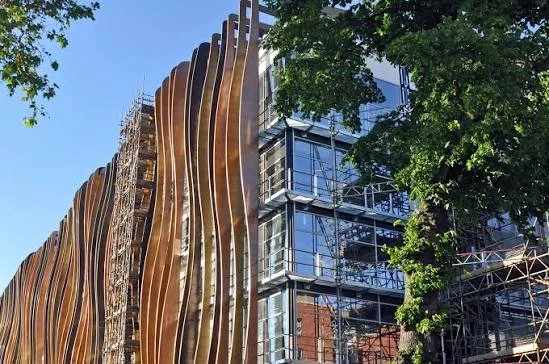
The external louvre systems required careful coordination with the primary structure, glazing systems and maintenance strategies. Their performance relies not only upon their geometry but also upon their accurate installation and long-term durability.
Prefabrication played an important role in achieving these objectives.
Manufacturing components under controlled factory conditions improved quality, reduced site complexity and ensured consistency across the building. The resulting system combines environmental precision with construction efficiency.
The project therefore demonstrates how environmental performance is inseparable from fabrication and assembly.
Good environmental design must also be buildable.
Architecture Through Environmental Control
The visual identity of Holland Park School emerges directly from its environmental strategy.
The external louvres create depth, shadow and rhythm across the façade while simultaneously providing solar control and privacy. Architectural character results from environmental performance rather than from applied decoration.
This relationship reflects a long architectural tradition in which form emerges from the organisation of environmental and structural systems.
The façade becomes expressive because it performs.
The project therefore illustrates how technical requirements can contribute positively to architectural identity rather than limiting design possibilities.
Project Significance
Holland Park School demonstrates how façade design can shape environmental quality, educational experience and architectural identity simultaneously. Through the integration of glazing, shading and environmental control systems, the building establishes a carefully calibrated relationship between the learning environment and the surrounding city.
More broadly, the project illustrates the role of the façade as an environmental mediator. Rather than acting simply as a protective boundary, the envelope filters light, moderates climate, manages privacy and supports wellbeing. The resulting architecture demonstrates that successful educational environments emerge not only from spatial organisation but also from the quality of the environmental conditions that architecture creates.
In this sense, Holland Park School provides an important lesson for architectural practice. The most effective façades are not those that separate buildings from their surroundings, but those that intelligently mediate between them.