King Abdullah Financial District (KAFD) Metro Station, Riyadh, Kingdom of Saudi Arabia
Further information and case study for this project can be found at the De Gruyter Birkhäuser Modern Construction Online database
The following architectural theory-based case study is not available at Modern Construction Online
Façade Technology and Architectural Integration of the KAFD Metro Station, Riyadh
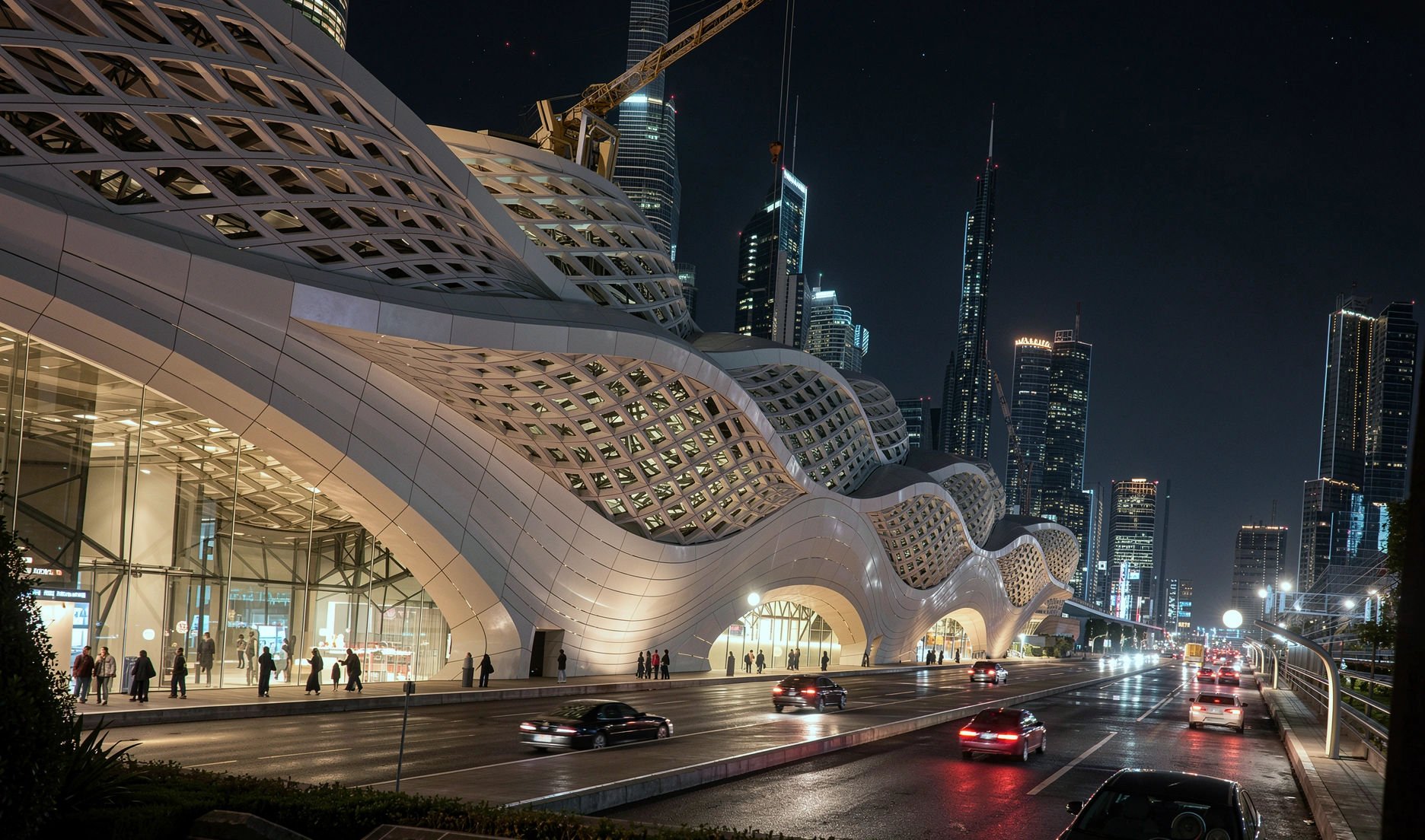
The King Abdullah Financial District (KAFD) Metro Station in Riyadh represents a technologically advanced response to the dual demands of a hyper-arid climate and a complex, expressive architectural form. Façade engineering was undertaken by Newtecnic, who developed a high-performance, prefabricated system that unifies environmental control, structural adaptability, and manufacturing precision. The architectural design, by Zaha Hadid Architects, provides a distinctive spatial and formal identity, while the envelope responds to the city’s extreme conditions with rationalised, modular efficiency.
Rather than functioning as a simple cladding layer, the façade operates as a performative skin—integrating geometric control, climatic resistance, and digital fabrication strategies. Its design reflects both a continuity of and departure from High Modernist precedents. Projects such as the Pompidou Centre, John Hancock Center, and Sydney Opera House laid the groundwork for modular rationalisation, prefabrication, and expressive structure. These architectural forebears continue to inform the envelope’s logics, alongside contemporary techniques of parametric modelling, finite element analysis, and environmental benchmarking.
This case study focuses on the development and implementation of the KAFD façade system, tracing its technological lineage and highlighting its role as a critical interface between climatic context, architectural expression, and industrialised construction. The project aligns with themes explored in Modern Construction Handbook (Watts, A., 2007), Modern Construction Envelopes (Watts, A., 2013; 2019), and Modern Construction Case Studies (Watts, A., 2016), where prefabrication, digital control, and material adaptability are positioned as central strategies in contemporary envelope design. The façade system developed for this project served as a conceptual and technical precedent for the system implemented in Project 02, featured in the second edition of Modern Construction Case Studies.
Modernist Influences and Precedents
The KAFD façade system evolves from key architectural precedents that demonstrated early innovations in modular construction, prefabricated logic, and structural expression:
The Pompidou Centre (Rogers & Piano, 1977) pioneered an exposed, prefabricated façade strategy that clearly separated structure from enclosure. At KAFD, this is reinterpreted through cassette panels suspended from a curved steel shell, fabricated in controlled factory conditions for precision and durability.
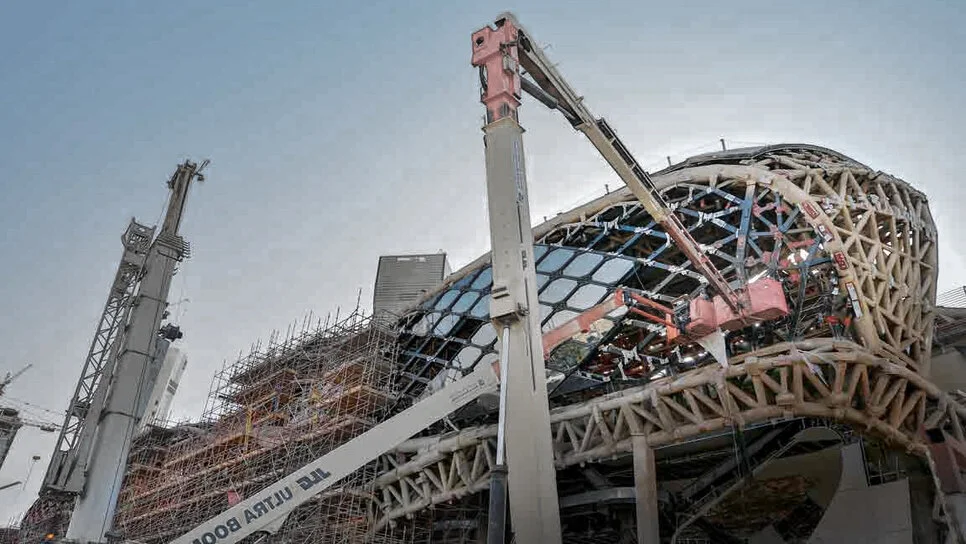
The John Hancock Center (Graham & Khan, 1969) offered an early model of structural exoskeletons. Similarly, KAFD’s envelope is supported by a diagrid steel shell, which eliminates the need for secondary grids and aligns directly with the geometry of the façade.
The Met Life Building (1963) was one of the first to deploy unitised curtain wall construction, a concept extended at KAFD through large, prefabricated steel cassettes integrating insulation, glazing, and rainscreen cladding.
The Sydney Opera House (Utzon, 1973) demonstrated how double curvature could be rationalised into modular precast components. KAFD’s façade adopts this principle, transforming complex curves into planar cassette segments mounted on the steel shell.
The Kunsthaus Graz (2003) introduced early parametric panelisation techniques, which informed the computational workflow used at KAFD to manage geometry and panel junctions.
Habitat 67 (Safdie, 1967) provided a precedent for modular prefabrication in civic architecture. Its influence is reflected in the cassette-based system at KAFD, where each unit is tailored for Riyadh’s climate yet assembled within a consistent formal logic.
Together, these precedents provided a historical framework for KAFD’s façade design, where modular prefabrication, environmental control, and expressive structure are integrated into a singular system.
Envelope Design and Climatic Strategy
In the high temperatures and solar exposure of Riyadh, the façade’s primary function is to minimise thermal load while maintaining airtightness and environmental control. Newtecnic developed a shallow façade zone that encloses air-conditioned space with a high-performance rainscreen system. The assembly includes pressure-equalised outer cladding, insulated backing panels, vapour control layers, and thermal breaks, forming a compact, robust barrier against solar radiation, condensation, and wind-driven moisture (Edwards, 2011; Banham, 2015).
Prefabrication and Modular Assembly
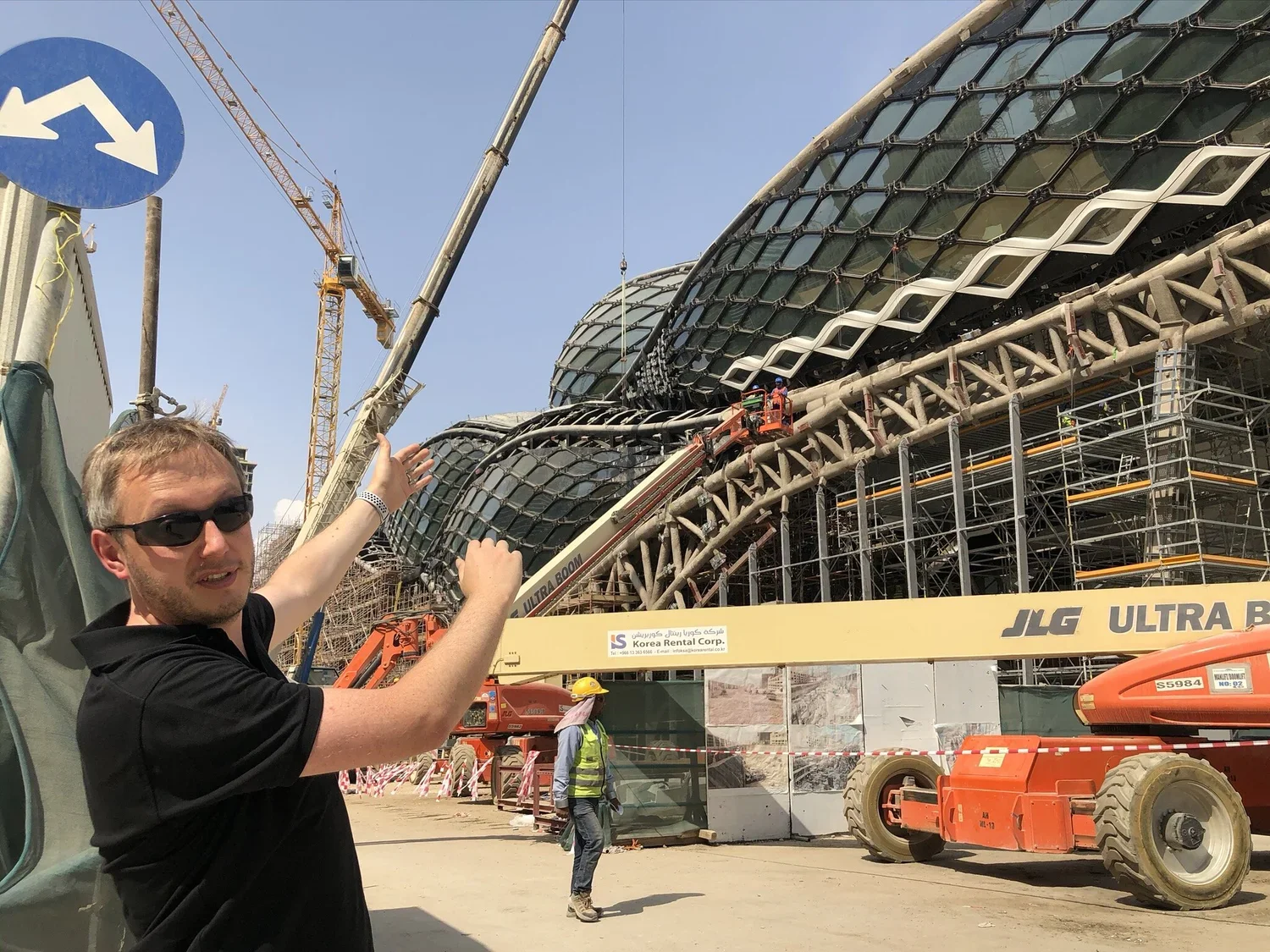
Reflecting the cassette-based strategies discussed in Modern Construction Envelopes (Watts, A., 2019), the KAFD façade employs steel-framed modular units fabricated off-site. These cassettes integrate insulation, weather membranes, perforated rainscreens, and glazing where required. Factory production ensured dimensional precision and minimised site work, enabling alignment with the tight construction schedule required by the metro’s broader infrastructure rollout.
Spider Fixings and Structural Tolerance
An innovative application of spider fixing technology—more typically associated with glazed façades—was adapted to support opaque cassettes. Using ball joint connectors, each panel is independently articulated, allowing for rotation, thermal expansion, and settlement without compromising structural or environmental integrity (Kolarevic, 2003). This adaptation ensures tolerance across the doubly curved geometry of the station envelope while maintaining continuity in thermal and weatherproofing layers.
Integration with the Primary Steel Shell
Unlike conventional façades, which rely on secondary support grids, the KAFD system attaches directly to a continuous steel exoskeleton. Finite element analysis (FEA) modelled the dynamic behaviour of the shell, informing the development of panel fixings and joint tolerances. This integration, also explored in Modern Construction Case Studies (Watts, A., 2016), enabled tighter coordination between structure and envelope, eliminating redundant framing and enhancing geometric resolution.
Computational Control and Geometry Rationalisation
Digital workflows, including parametric modelling and computational fluid dynamics (CFD), were central to the development of the façade. Subtle double curvatures were introduced in high-deflection zones to reduce steel member sizing while preserving architectural intent. Simulations informed panel placement, seam direction, and wind-load distribution, optimising both performance and aesthetics (Kolarevic, 2003; Watts, A., 2019).
Material Adaptability and Performance Benchmarking
The cassette system was designed to accept different cladding materials—including fibre-reinforced concrete and polymer composites—without changing the structural frame geometry. Newtecnic led a comprehensive evaluation of material performance under Riyadh’s extreme conditions. This included UV resistance, thermal expansion, and impact tolerance. In-situ testing at multiple fabrication sites established performance benchmarks and validated manufacturing tolerances (Edwards, 2011).
Layered Environmental Protection
The façade employs a dual-layer environmental system, comprising ventilated rainscreen panels over membrane-backed insulation and internal vapour barriers. This configuration protects against moisture ingress and solar degradation while maintaining air- and water-tightness. Aluminium flashings and compressible joints ensure long-term thermal continuity and accommodate movement, aligning with the principles outlined in Modern Construction Handbook (Watts, A., 2023) and The Architecture of the Well-Tempered Environment (Banham, 2015).
Penetrations are isolated from the waterproofing layer, reducing long-term risk associated with mechanical or thermal movement. The system reflects a broader shift in façade design: from cladding as skin to envelope as environmental mediator.
Conclusion: From Differentiation to Integration
The KAFD Metro Station façade embodies a shift from modernist modular clarity to integrated performative complexity. Newtecnic’s design methodology progressed from differentiated performance analysis—addressing structure, climate, and fabrication as separate constraints—to an integrated, modular solution responsive to Riyadh’s environmental and programmatic demands.
By aligning fabrication intelligence with digital control, the project exemplifies the next generation of façade design, where environmental resilience and architectural identity are co-produced. In doing so, KAFD continues the lineage of High Modernist innovation while demonstrating the potential of industrialised systems to meet the challenges of 21st-century public infrastructure.
References
Banham, R. (2015) The Architecture of the Well-Tempered Environment. Chicago: University of Chicago Press.
Edwards, B. (2011) Sustainable Architecture: European Directives and Building Design. London: Wiley-Blackwell.
Kolarevic, B. (2003) Architecture in the Digital Age: Design and Manufacturing. New York: Spon Press.
Silver, S. (2013) Façade Engineering. London: Wiley-Blackwell.
Watts, A. (2016) Modern Construction Case Studies. Basel: Birkhäuser.
Watts, A. (2019) Modern Construction Envelopes. 3rd ed. Basel: Birkhäuser.
Watts, A. (2023) Modern Construction Handbook. 6th ed. Basel: Birkhäuser.
Zahner, R. (2015) Fabrication and Design of Architectural Metal Façades. New York: Wiley.
Construction sequence simulation