
Küçük Çamlıca TV (KCTV) Tower, Istanbul, Turkey
Further information and case study for this project can be found at the De Gruyter Birkhäuser Modern Construction Online database
The following text is not available at Modern Construction Online
Architecture Under Conditions of Movement
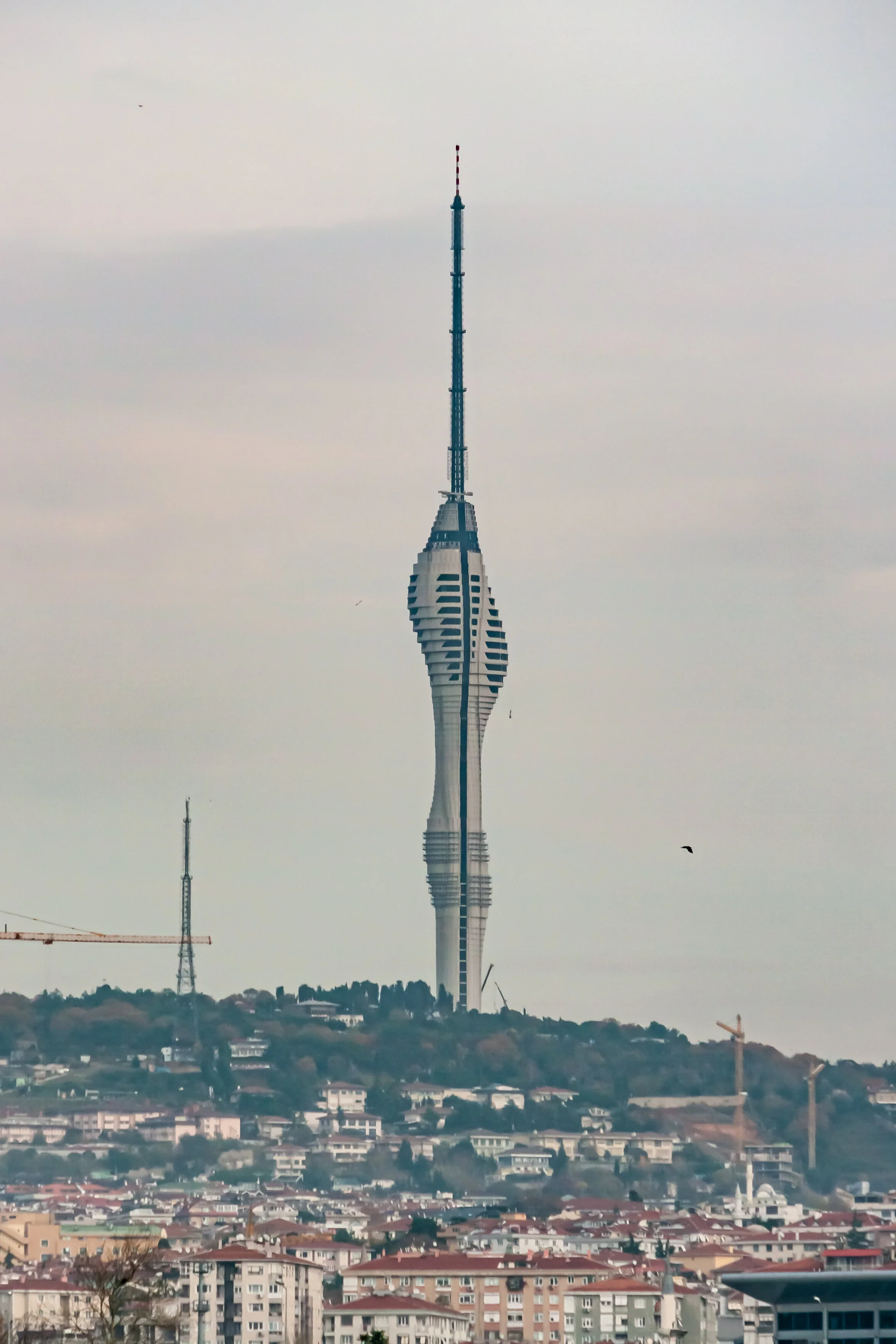
The KCTV Tower rises almost 300 metres above Istanbul, combining broadcasting facilities, public observation spaces and civic functions within a single vertical structure. Located on elevated ground overlooking the city, the tower is exposed to significant wind forces and environmental conditions that place exceptional demands on both structure and enclosure.
Newtecnic provided façade engineering for the project, developing an envelope system capable of responding to structural movement, environmental exposure and long-term operational performance.
The project demonstrates a fundamental principle of tall-building design: architecture cannot be understood as a static object. At this scale, movement becomes a permanent condition of the building's existence. The role of the façade is therefore not simply to provide enclosure but to maintain continuity, performance and architectural coherence while the structure itself responds to changing environmental forces.
Tall Buildings as Dynamic Systems
Buildings are often imagined as fixed and immovable objects. In reality, all buildings move.
Materials expand and contract as temperatures change. Structural systems deflect under load. Wind causes buildings to sway. Foundations settle. Concrete shortens as it cures and ages.
In low-rise construction these movements are often small enough to remain largely invisible. In tall structures, however, they become major design considerations.
The KCTV Tower illustrates this condition clearly. Its height, slenderness and exposed location mean that the building experiences continuous movement resulting from wind loading, thermal variation and structural behaviour.
The architectural challenge was therefore not to eliminate movement but to accommodate it.
Structure and Enclosure
The primary structure of the tower consists of a reinforced concrete core that provides overall stability while supporting observation platforms, broadcasting facilities and public spaces.
The façade is supported independently through a secondary steel framework connected to the primary structure. This arrangement allows structural and environmental systems to operate together while accommodating their different behaviours.
Rather than rigidly attaching the façade to the structure, the design establishes a controlled relationship between them. The enclosure remains aligned with the architectural geometry of the tower while allowing differential movement to occur without damaging panels, joints or weatherproofing systems.
The result is a coordinated system in which structure and façade operate as complementary but distinct elements.
Designing for Wind
Wind represents one of the most significant environmental forces acting on tall buildings.
As air flows around a tower, pressure differences develop across its surface. These pressures vary continuously according to wind speed, direction and atmospheric conditions. At greater heights the magnitude of these forces increases significantly.
The KCTV Tower's elevated site intensifies these effects.
Consequently, the façade could not be designed solely as an architectural surface. It had to function as a resilient environmental system capable of resisting highly variable wind pressures while maintaining long-term performance.
Advanced modelling techniques were used to analyse airflow around the tower and identify areas subject to particularly high pressures or suction forces. These studies informed the design of support systems, panel dimensions and fixing strategies throughout the envelope.
The façade therefore emerged from an understanding of environmental forces rather than from geometry alone.
Movement as a Design Condition
One of the most important lessons of tall-building design is that movement must be anticipated from the earliest stages of development.
When a tower moves under wind loading, different parts of the structure experience varying levels of displacement. If the façade is unable to accommodate these movements, stresses accumulate within panels, joints and connections, leading to damage or premature failure.
The KCTV façade was therefore designed around a philosophy of controlled flexibility.
Movement joints are distributed throughout the envelope, allowing components to expand, contract and adjust relative to one another. Flexible connections permit small variations in alignment without compromising structural stability or environmental performance.
Rather than resisting movement completely, the façade works with it.
This approach transforms movement from a technical problem into a fundamental aspect of the design strategy.
The Logic of the Rainscreen
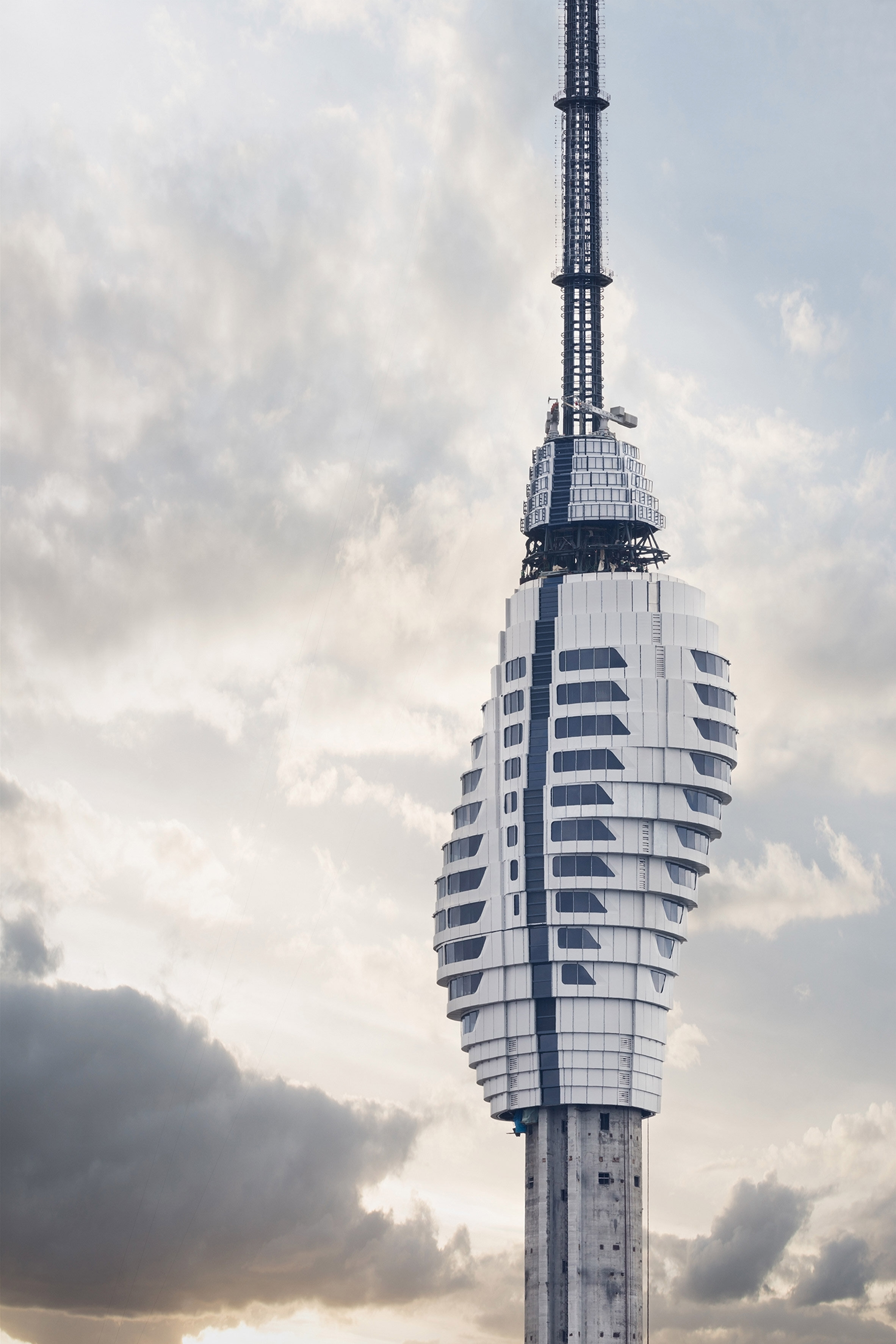
Environmental performance was achieved through an insulated rainscreen system using glass fibre reinforced concrete panels supported on a secondary steel framework.
The rainscreen principle is based upon separation.
The outer layer provides protection against rain, solar exposure and physical weathering. Behind this, a ventilated cavity and weather-resistant backing layer provide secondary protection and environmental control.
This arrangement allows water, air pressure and thermal movement to be managed independently rather than through a single barrier.
The pressure-equalised cavity plays a particularly important role in exposed conditions. By reducing pressure differences across the outer skin, the system limits the forces that drive water into the façade.
The envelope therefore achieves resilience through organisation rather than material thickness alone.
Material Selection and Performance
Glass fibre reinforced concrete was selected because it combines low weight with high durability and considerable formal flexibility.
For tall buildings, reducing the weight of cladding systems can significantly decrease demands on supporting structures and fixing systems. At the same time, materials must remain capable of resisting environmental exposure over long periods.
GRC offers an effective balance between these requirements.
Its relatively low self-weight reduces structural loading while its durability provides resistance to moisture, ultraviolet exposure and temperature variation. The material can also accommodate the sculptural forms required by the architectural design without introducing excessive fabrication complexity.
Material selection therefore became part of a broader strategy linking structure, performance and architectural expression.
Prefabrication and Quality Control
The complexity of the tower demanded a high level of precision throughout design and construction.
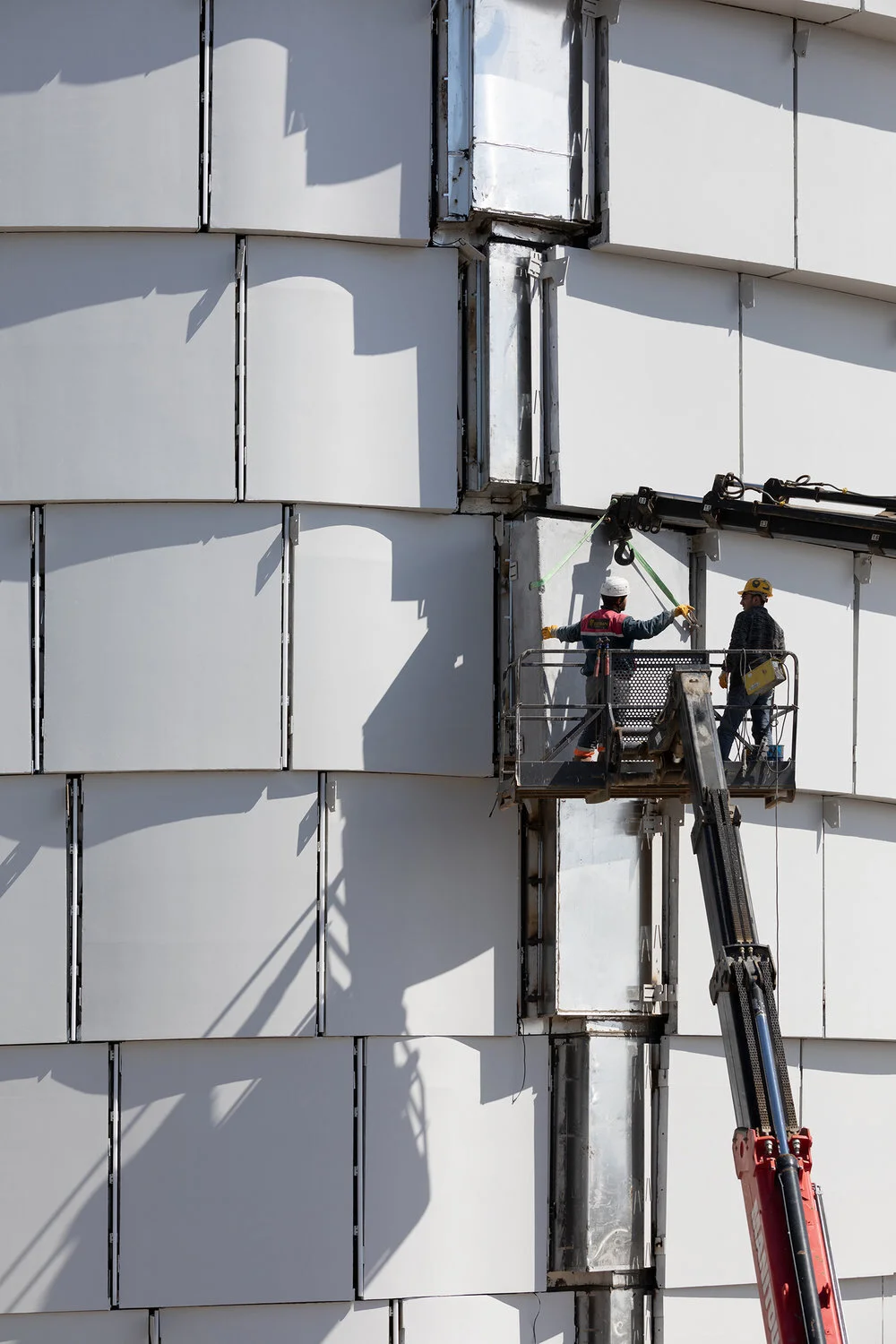
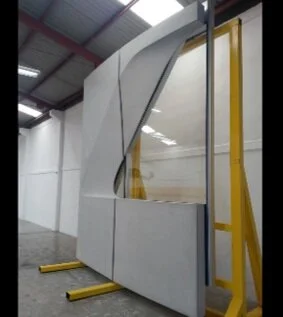
To achieve this, façade components were manufactured as prefabricated units under factory-controlled conditions. Off-site fabrication improved dimensional accuracy, reduced construction risk and ensured consistent quality across the building envelope.
The use of modular components also simplified installation at height.
Rather than constructing the façade piece by piece on site, prefabricated elements could be installed efficiently while maintaining precise alignment with the supporting structure.
This approach reflects a broader shift within contemporary construction towards greater integration between design, fabrication and assembly.
Architecture increasingly emerges through the coordination of digital modelling, manufacturing technologies and construction processes rather than through isolated stages of development.
Environmental Continuity
The success of a façade is measured not only by its appearance but by its ability to maintain environmental continuity over time.
The KCTV envelope must provide protection against rain, wind, temperature variation and solar exposure while accommodating the continual movement of the structure itself.
These requirements are interconnected.
A movement joint influences waterproofing. Structural flexibility affects weather sealing. Material selection influences thermal performance. No aspect of the façade can be considered independently.
The project therefore demonstrates how environmental performance emerges through the coordination of multiple systems rather than through any single technical solution.
Project Significance
The KCTV Tower demonstrates the importance of understanding buildings as dynamic rather than static systems. Through the integration of structural analysis, environmental design, material technology and prefabricated construction, the project establishes a coherent relationship between movement and stability.
The façade does not merely enclose the building. It accommodates structural behaviour, moderates environmental conditions and reinforces the architectural identity of the tower. In doing so, it illustrates one of the central challenges of contemporary façade engineering: maintaining continuity and performance within structures that are constantly responding to changing forces.
More broadly, the project shows how architecture, structure and environment can be understood as interdependent systems whose successful integration depends upon anticipating movement rather than resisting it. The resulting building demonstrates that resilience is achieved not through rigidity, but through carefully coordinated adaptability.