Kompleks Tabung Haji Hotel and Office Tower, Kuching, Sarawak, Malaysia
Further information and case study for this project can be found at the De Gruyter Birkhäuser Modern Construction Online database
The following text is not available at Modern Construction Online
Climate, Culture and Environmental Performance
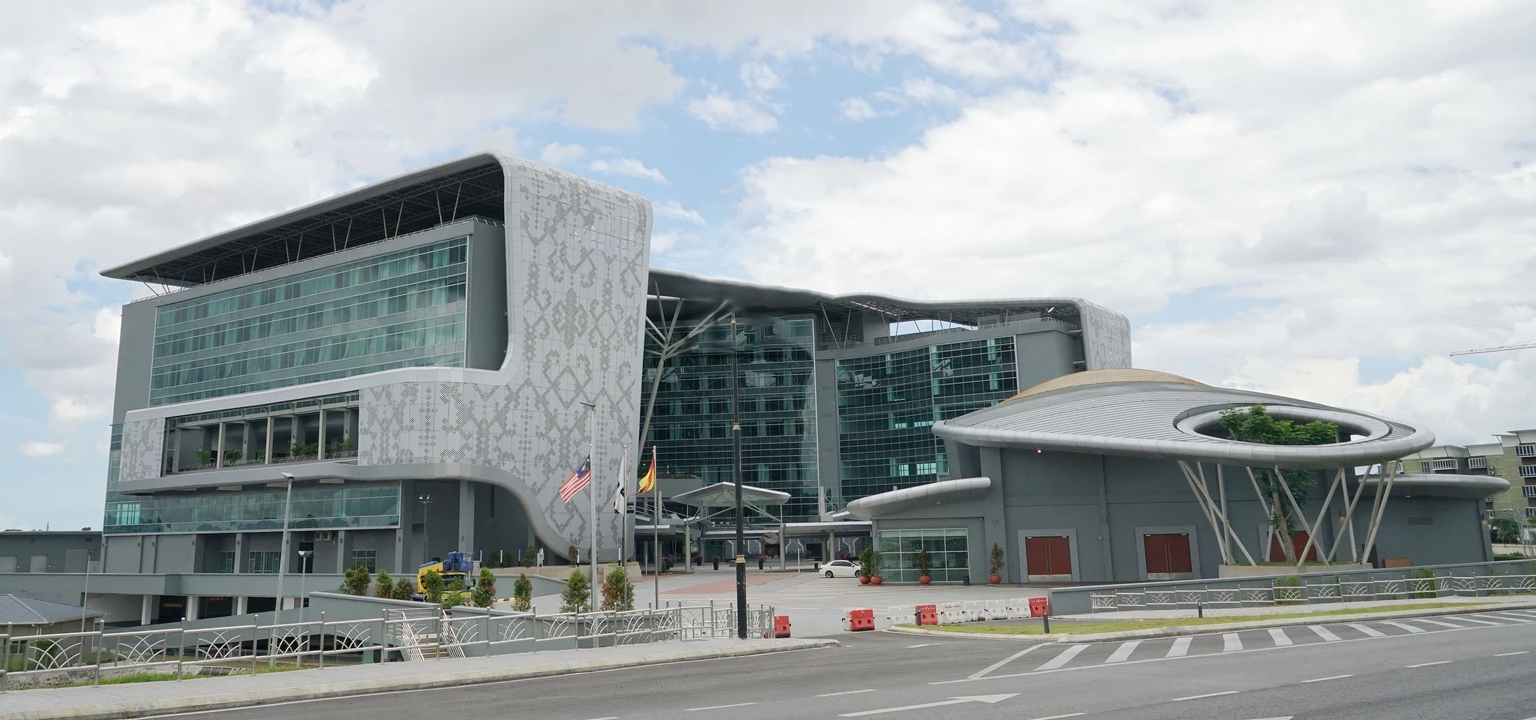
The Kompleks Tabung Haji Hotel and Office Tower demonstrates how façade design can integrate environmental performance, cultural identity and construction efficiency within a single architectural system. Developed for Malaysia's Pilgrimage Fund Board, the project combines office, hotel and institutional functions within a high-rise building designed specifically for the climatic conditions of Kuala Lumpur.
Newtecnic provided façade engineering for the project, developing an envelope strategy that responds simultaneously to solar exposure, energy performance, occupant comfort and architectural expression. The resulting façade establishes a direct relationship between environmental control and cultural representation, creating a building that is both technologically advanced and firmly rooted within its regional context.
The project is particularly significant because it demonstrates how environmental performance and architectural identity can emerge from the same design decisions. Rather than treating sustainability and cultural expression as separate objectives, the building integrates them within a single façade strategy that responds to climate, occupation and place simultaneously.
Architecture as Environmental Mediation
The building is organised around a layered façade system that separates environmental protection from the primary enclosure. Rather than relying exclusively on increasingly sophisticated glazing technologies, the design introduces an external environmental layer that intercepts solar radiation before it reaches the conditioned interior.
This strategy reflects a long architectural tradition found throughout tropical and arid regions where depth, shading and filtered light are used to moderate environmental conditions. Historically these techniques emerged from practical responses to climate. In contemporary high-rise construction they are often replaced by sealed envelopes and extensive mechanical systems.
The Tabung Haji Tower adopts a different approach.
Environmental moderation is embedded within the architecture itself. The façade becomes an active participant in the regulation of heat, light and comfort rather than a passive boundary separating interior and exterior conditions.
The building therefore demonstrates how contemporary technology can extend rather than replace established environmental principles.
Climate as Generator of Form
Kuala Lumpur's equatorial climate exerts a powerful influence upon building performance.
High levels of solar radiation, elevated humidity and relatively stable temperatures throughout the year create conditions in which cooling loads can dominate operational energy consumption. The building envelope consequently becomes one of the most important determinants of long-term performance.
In many commercial towers, environmental control is largely delegated to mechanical systems operating behind highly glazed façades. The Tabung Haji Tower instead places climatic response at the forefront of the architectural strategy.
The visible character of the building emerges directly from the environmental systems that regulate solar exposure and daylight.
Form, performance and identity are therefore closely aligned.
The appearance of the building cannot be separated from the climatic conditions that shaped it.
The Layered Façade System
The envelope is organised as a series of environmental layers working together to improve performance.
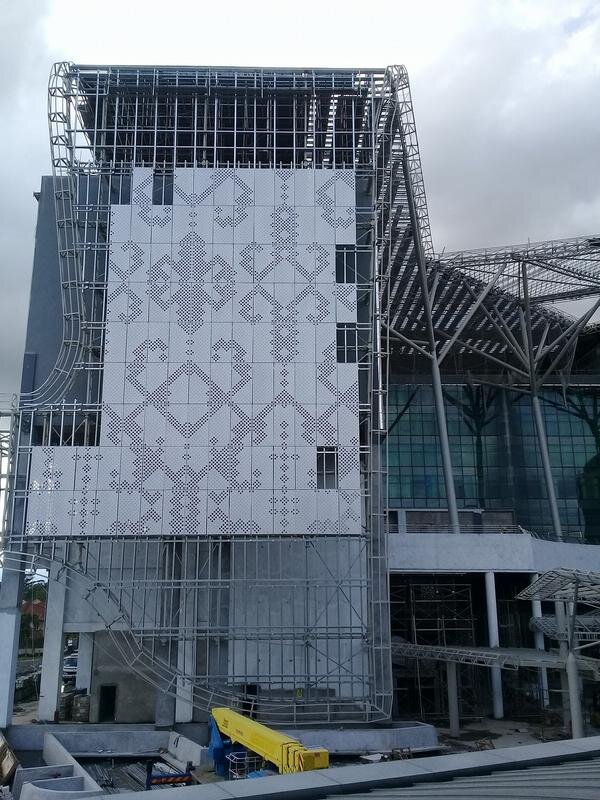
The outer screen provides the first line of solar protection. Behind this, a ventilated cavity creates a thermal buffer between external conditions and the primary enclosure. The inner curtain wall establishes environmental separation while maintaining views and daylight access.
Each layer performs a distinct role while contributing to the overall operation of the system.
This arrangement reduces thermal loads before they reach the conditioned interior, allowing the building to achieve greater efficiency than would be possible through glazing performance alone.
More importantly, it allows environmental performance to be expressed architecturally through depth, shadow and material articulation.
The façade therefore acquires both technical and spatial richness.
Solar Control and Daylight
One of the central challenges in tropical architecture is achieving a balance between daylight and solar gain.
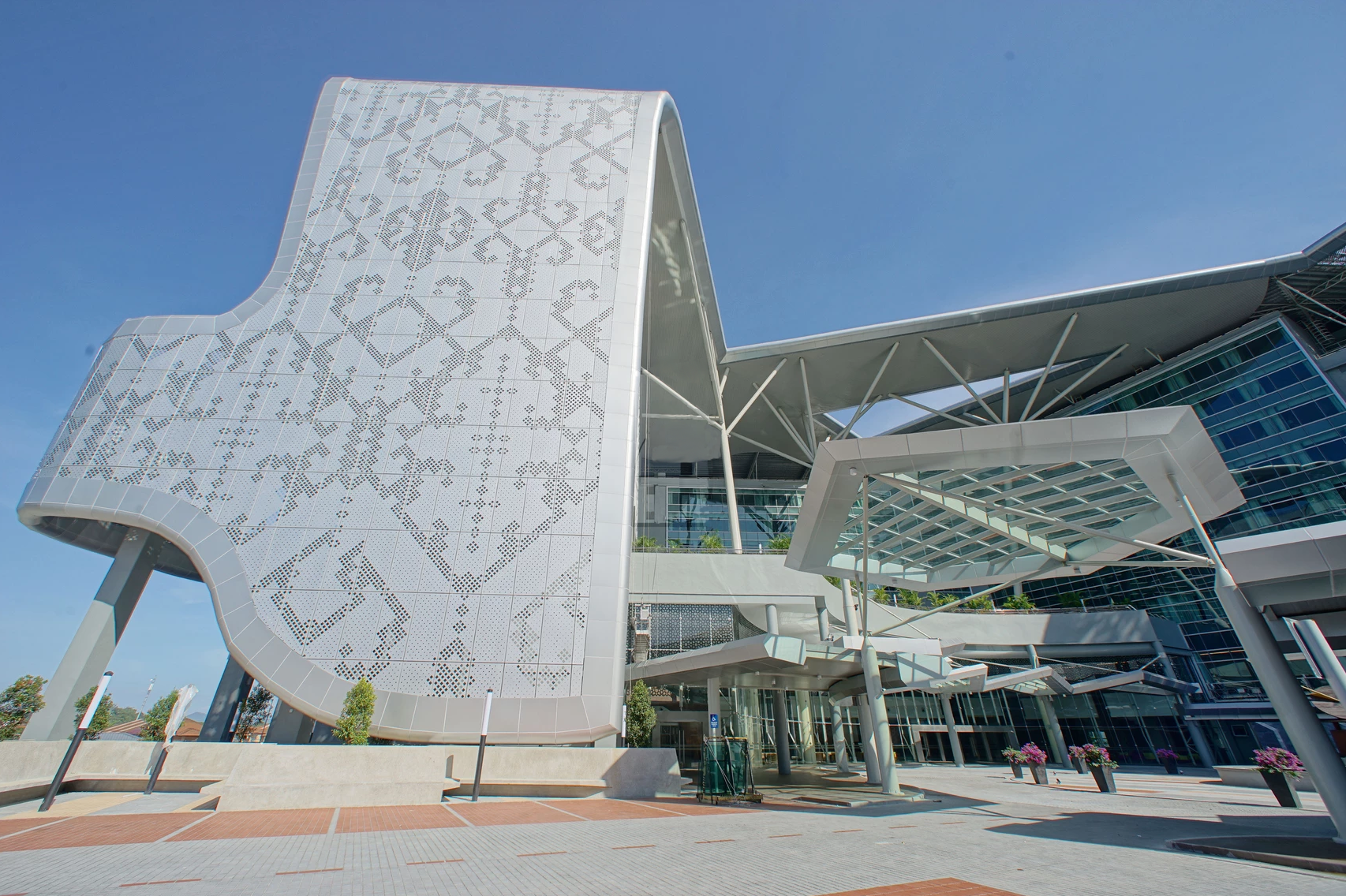
The external shading system addresses this challenge through a carefully calibrated combination of vertical fins and perforated screening elements. Direct solar radiation is filtered before it reaches the glazing while diffuse daylight is allowed to penetrate deep into the building.
This approach improves visual comfort while reducing reliance on artificial lighting.
The building remains visually connected to the city while avoiding the excessive glare and heat gain often associated with highly glazed towers in tropical climates.
The façade consequently functions as a climatic filter rather than a transparent barrier.
Light is moderated rather than excluded.
Ventilation and Thermal Buffering
The cavity between the external screen and the glazed enclosure contributes significantly to environmental performance.
Heat absorbed by the outer layer is dissipated through natural air movement before it can transfer to the occupied spaces beyond. This simple but effective strategy reduces cooling demand and improves thermal comfort.
The cavity also accommodates maintenance access and technical infrastructure, increasing the efficiency of the overall façade system.
Rather than adding complexity, the layered arrangement allows multiple requirements to be resolved within a single coordinated architectural framework.
The project therefore demonstrates the value of environmental depth as both a technical and architectural resource.
Construction and Digital Coordination
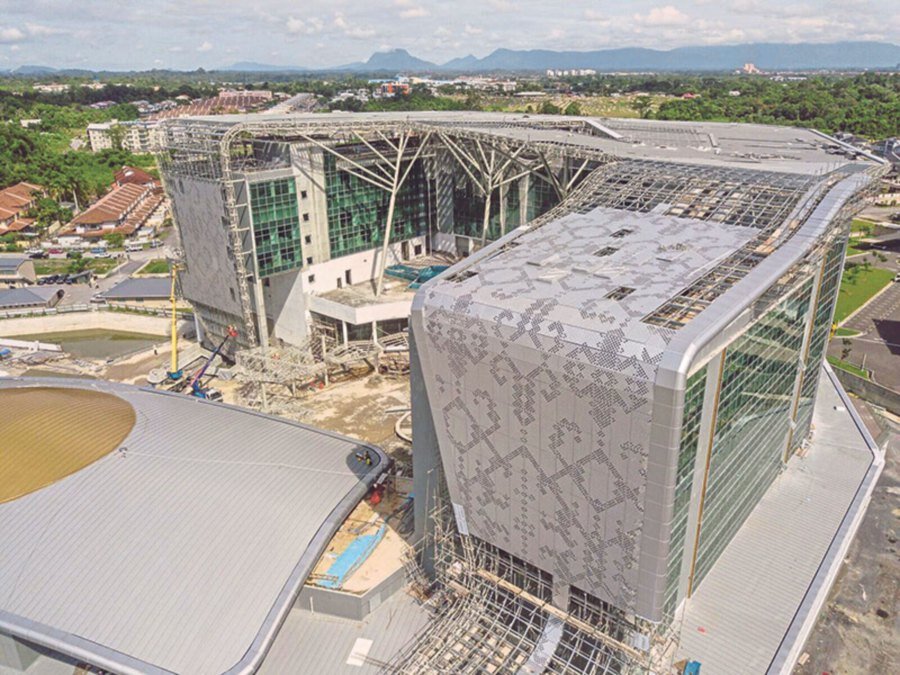
The envelope is based on a unitised curtain wall system designed for precision manufacture and efficient installation.
Prefabricated modules combine glazing, framing and environmental control components within repeatable assemblies that improve quality control and construction efficiency. Off-site manufacture reduced installation time while ensuring consistency across the tower.
A key engineering challenge involved integrating the external shading system with the building's tapering geometry. Digital modelling tools were used to coordinate façade modules, structural interfaces and environmental systems simultaneously.
This process allowed complex geometric conditions to be rationalised into manufacturable component families while preserving architectural continuity.
The project demonstrates how digital workflows can support environmental and architectural objectives rather than simply geometric complexity.
Cultural Identity Through Performance
The most distinctive aspect of the project is the relationship between environmental performance and cultural expression.
The external screen draws inspiration from Islamic geometric traditions, but its significance extends beyond visual reference. The patterning is derived from environmental requirements as much as cultural precedent.
Variations in density, porosity and depth respond to solar conditions while simultaneously generating the visual character of the building.
The screen therefore performs two roles at once.
It regulates light and heat while communicating institutional identity.
This integration allows meaning to emerge through performance rather than through applied symbolism.
The building expresses cultural continuity through environmental intelligence and constructive logic rather than through historic replication.
In this sense, the façade functions as both climate moderator and cultural artefact.
Architecture, Institution and Representation
As the headquarters of the Pilgrimage Fund Board, the building carries responsibilities beyond environmental performance.
The institution occupies a significant position within Malaysian society and requires an architecture capable of expressing permanence, trust and public presence.
The façade contributes directly to this role.
Its layered depth, disciplined geometry and controlled use of pattern establish a civic character appropriate to the institution it represents. Architectural identity emerges from the organisation of environmental systems rather than from separate representational devices.
This gives the building a consistency between appearance and performance that strengthens its architectural credibility.
Integrated Systems
The façade has been developed as a coordinated architectural system rather than a collection of independent technical components.
Structure, glazing, shading, ventilation and environmental control operate together to achieve multiple objectives simultaneously.
The external screen reduces solar gain.
The cavity improves thermal performance.
The glazing provides environmental separation and daylight.
The structural frame supports both enclosure and shading.
Together these elements form a coherent architectural response to climate, programme and context.
The project demonstrates how integration can increase both performance and architectural clarity.
Project Significance
The Kompleks Tabung Haji Hotel and Office Tower illustrates a broader evolution in contemporary high-rise architecture in which façades are expected to perform environmental, cultural and technical roles simultaneously.
By combining passive climatic strategies, prefabricated construction and culturally informed design, the project offers an alternative to the universal glass tower. Its architectural identity emerges from the interaction of climate, technology and place rather than from formal expression alone.
For Newtecnic, the project exemplifies an approach to façade engineering in which environmental performance and architectural character are developed together from the outset of the design process.
The result is a building whose cultural presence cannot be separated from its environmental performance. Climate, construction and identity operate as parts of a single architectural system, demonstrating how contemporary envelope design can contribute simultaneously to sustainability, institutional representation and architectural quality.