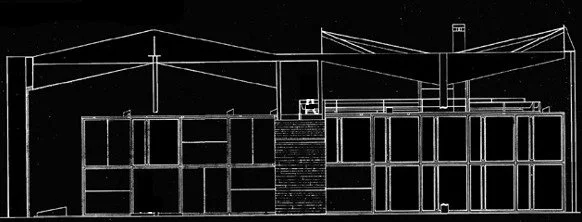
- Pavillon Le Corbusier — Zurich, 1967
Architectural Significance
The Pavillon Le Corbusier was the final building realised during Le Corbusier’s lifetime and represents the culmination of many of the ideas explored throughout his career. Conceived as a pavilion for art and public engagement, the building combines structure, enclosure, colour, furniture and landscape within a single architectural composition. It demonstrates the modernist ambition to unite architecture, engineering and the visual arts within a coherent whole.
Structure, Space and Assembly
One of the pavilion’s most significant contributions is its understanding of architecture as an assembled system. A large roof canopy extends beyond the enclosed accommodation to define a broader field of occupation, establishing relationships between interior and exterior space rather than treating them as separate conditions. Structure operates not simply as support but as a means of organising movement, gathering and spatial experience.
The building is composed from a carefully coordinated set of structural, enclosure and spatial elements whose relationships generate the architectural character of the whole. Rather than relying on monumentality or excessive scale, the pavilion achieves richness through the precise organisation of components, materials, proportion and light. Construction is therefore not merely the means of realisation but a primary source of architectural order.
Continuing Relevance
The continuing relevance of the Pavillon Le Corbusier lies in its demonstration that architecture can emerge through the integration of systems rather than through formal complexity alone. The building shows how structure can generate space, how construction can contribute directly to architectural character and how relatively simple components can be organised to produce spatial richness and civic presence.
More than half a century after its completion, the pavilion remains a powerful example of architecture understood as the coordination of relationships between structure, enclosure, material and occupation. Its lessons continue to inform contemporary approaches to design in which architectural quality emerges through constructive clarity, integration and assembly.