
Le Nouvel (formerly Menara DNP Towers), Kuala Lumpur, Malaysia
Further information and case study for this project can be found at the De Gruyter Birkhäuser Modern Construction Online database
The following text is not available at Modern Construction Online
High-Rise Living in a Tropical Climate
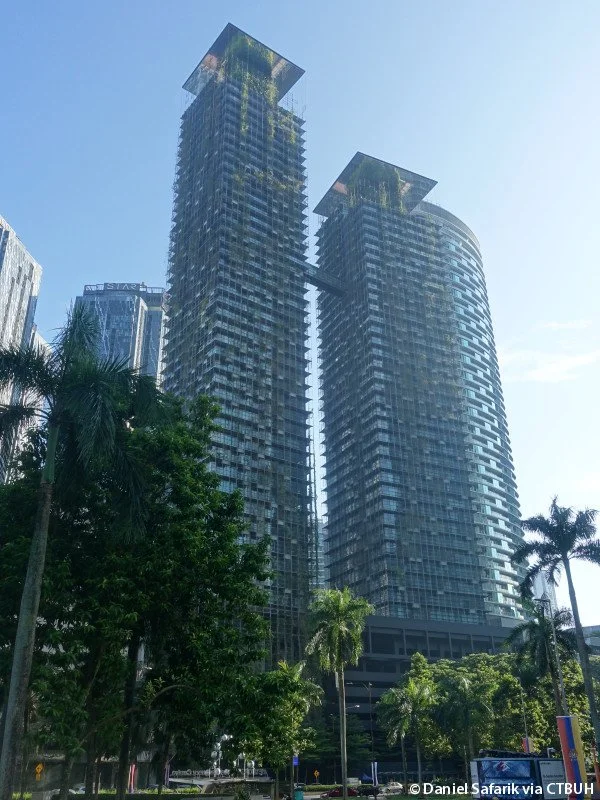
Le Nouvel is a residential development located in the centre of Kuala Lumpur and designed by Jean Nouvel in collaboration with HL Design. Comprising two residential towers connected through elevated communal spaces and shared landscape elements, the project explores how high-rise housing can respond positively to the environmental conditions of a tropical city.
Newtecnic provided façade engineering for the development, creating envelope systems that integrate solar control, natural ventilation, planting and residential amenity within a coherent architectural framework.
The significance of the project lies not simply in its architectural appearance but in its reconsideration of the relationship between climate and habitation. Rather than treating the tropical environment as a problem to be excluded through sealed construction and mechanical conditioning, the project seeks to engage directly with climatic conditions through the design of the building envelope itself.
In doing so, it proposes an alternative model for high-density urban living in the tropics.
Rethinking the Residential Tower
For much of the twentieth century, the dominant model of high-rise housing was based upon the sealed glass tower. Environmental performance depended primarily upon mechanical systems, while the façade functioned largely as a weather barrier separating interior and exterior conditions.
Le Nouvel challenges this model.
The project introduces a layered environmental envelope that creates a gradual transition between the private interior and the external climate. Rather than establishing a sharp boundary between inside and outside, the façade becomes a zone of environmental mediation.
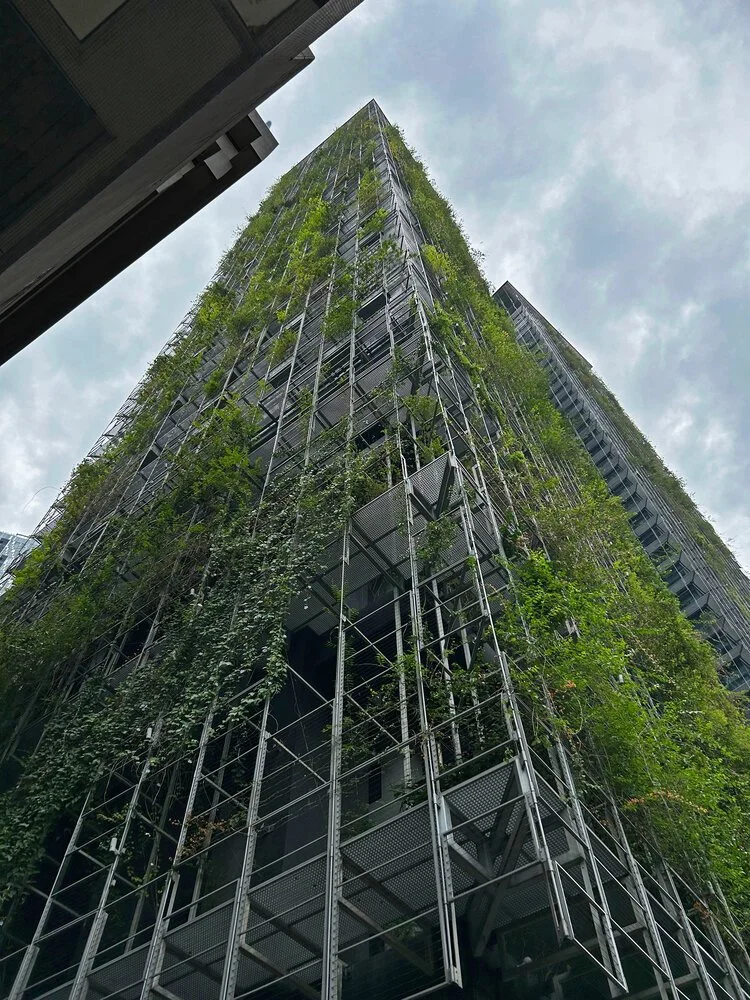
Balconies, planting, shading devices and recessed glazing create a sequence of intermediate spaces that moderate heat, light, rainfall and airflow before they reach the inhabited interior.
This approach draws upon the environmental intelligence of traditional tropical architecture while employing contemporary materials, construction systems and engineering techniques.
The Façade as Environmental Infrastructure
A central idea within the project is that the façade should perform as environmental infrastructure rather than as a decorative surface.
The envelope is organised as a series of overlapping systems that work together to regulate climate and improve residential comfort. Solar control, ventilation, planting, water management and visual screening are integrated within a single architectural framework.
Each layer contributes to environmental performance while simultaneously enhancing the quality of occupation.
The façade therefore becomes an active participant in daily life rather than a passive enclosure.
This approach is particularly important in tropical climates where solar radiation, humidity and rainfall exert continuous influence on the building environment.
Shading as Architectural Form
Solar control is one of the primary generators of the architectural expression of the towers.
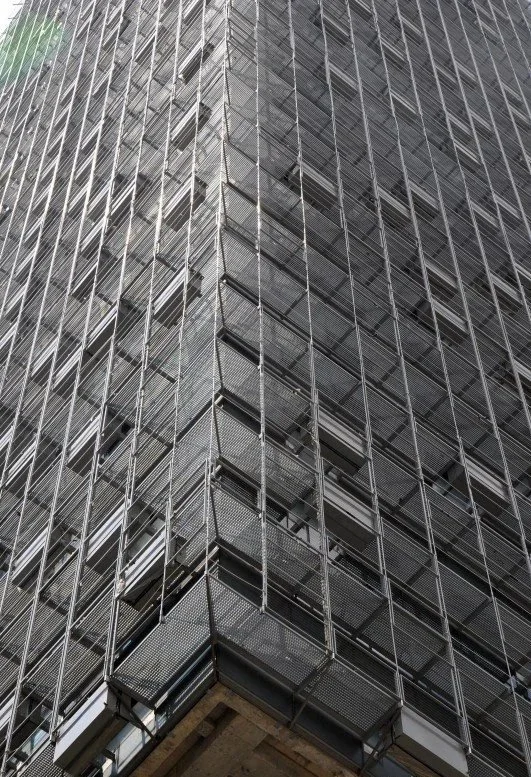
Vertical fins and horizontal shading devices reduce direct solar gain while preserving views and access to daylight. Their dimensions and arrangement vary according to orientation, allowing each façade to respond to differing environmental conditions throughout the day.
The shading systems establish depth and texture across the elevations. Rather than appearing as applied technical equipment, they form part of the architectural language of the building itself.
The resulting façade demonstrates how environmental performance can become a source of architectural character.
Light, shadow and depth emerge directly from climatic requirements.
Balconies and Transitional Space
Deep balconies play a critical role in the environmental and social performance of the project.
They provide protection from intense sunlight and tropical rainfall while extending residential living spaces beyond the conditioned interior. These spaces create opportunities for occupation, relaxation and informal interaction with the external environment.
The balcony therefore operates simultaneously as environmental buffer and inhabited space.
This dual role is important because it transforms the thickness of the façade into a zone of occupation. Residents engage directly with climate rather than experiencing it only through mechanically conditioned interiors.
The architecture consequently establishes a richer relationship between dwelling and environment.
Planting as Building System
Vegetation forms an integral part of the façade strategy.
Rather than being applied as decorative landscaping, planting is incorporated as a functional environmental system. Vegetated terraces provide additional shading, reduce reflected heat and contribute to local cooling through evapotranspiration.
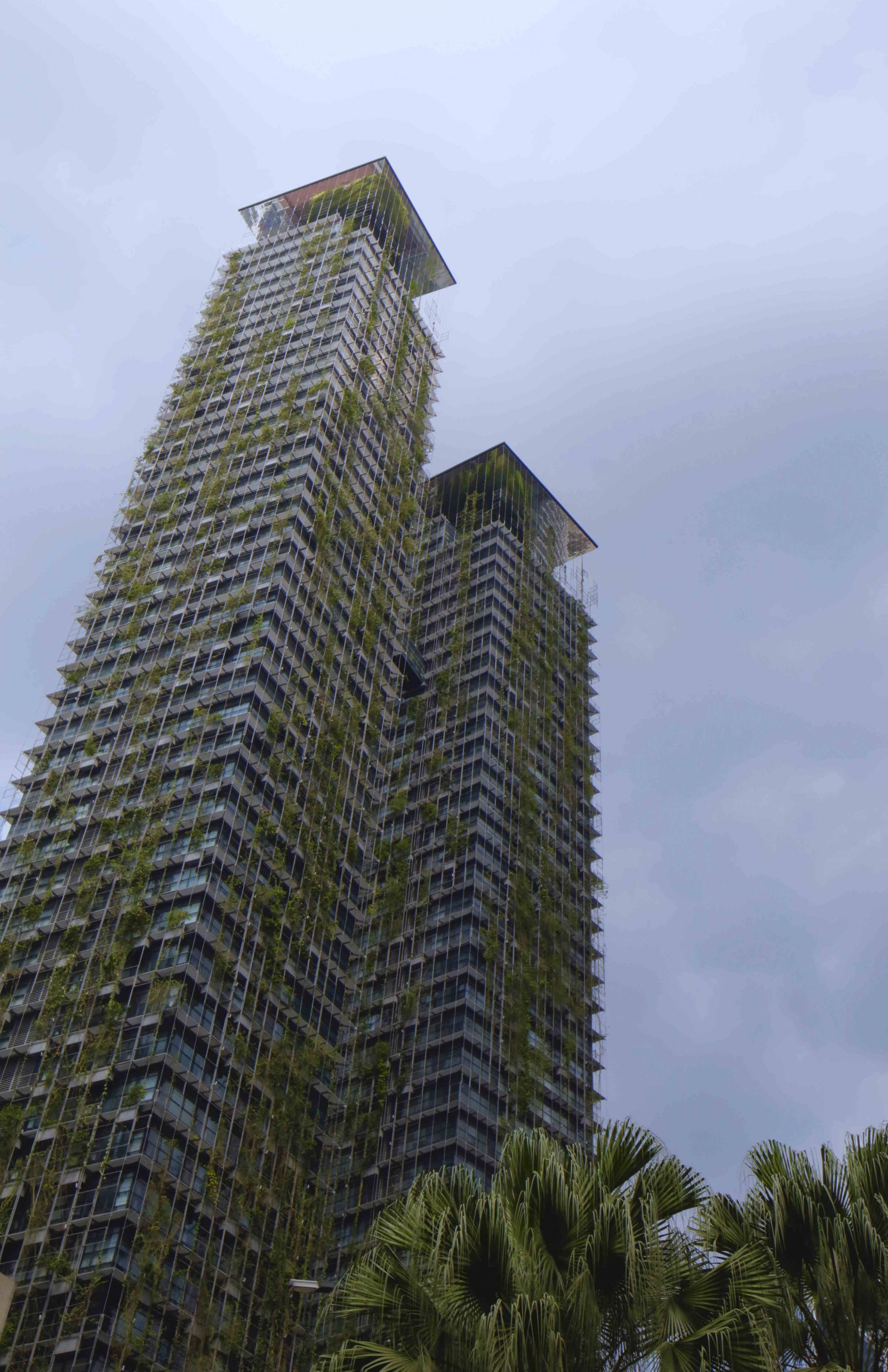
The planting also introduces seasonal variation and visual richness into the architecture. As vegetation grows and changes over time, the appearance of the towers evolves, creating a dynamic relationship between building and landscape.
This integration of architecture and planting contributes to a more humane form of high-density development.
The towers become part building and part vertical landscape.
Natural Ventilation and Environmental Moderation
The project seeks to maximise the benefits of passive environmental control wherever possible.
The layered façade allows air movement around balconies and planted terraces, reducing heat accumulation at the building perimeter. Shaded outdoor spaces create cooler microclimates that improve thermal comfort and reduce environmental stress on the façade itself.
High-performance glazing complements these passive measures by limiting solar heat gain while maintaining views and daylight.
The environmental strategy therefore combines active and passive approaches rather than relying exclusively on either.
Mechanical systems remain important, but they operate within a broader architectural framework of climatic moderation.
Material and Construction Strategy
The environmental ambitions of the project depend upon careful material selection and construction coordination.
The façade combines reinforced concrete structure, aluminium shading systems, planting infrastructure and high-performance glazing within a coordinated assembly designed for long-term durability in a humid tropical environment.
Materials were selected for resistance to corrosion, moisture and ultraviolet exposure. Their performance is critical because tropical climates subject buildings to continuous environmental stress throughout their operational life.
Modular fabrication improved quality control and installation efficiency while ensuring consistency across the towers.
The result demonstrates how construction methodology can support environmental performance rather than merely serving as a means of delivery.
Collective Identity and Urban Presence
Although the towers accommodate individual dwellings, they operate as part of a larger residential community.
Shared landscape spaces, elevated connections and common environmental strategies establish continuity between the two buildings. The development therefore functions as an integrated urban environment rather than as a collection of separate residential blocks.
The façade contributes significantly to this collective identity.
Planting, shading and layered enclosure create a visual coherence that links the towers while allowing variation in response to orientation and programme.
This balance between unity and diversity gives the development a distinctive urban presence.
Living with Climate
Perhaps the most important lesson of Le Nouvel concerns its attitude towards climate.
Many contemporary buildings seek to eliminate environmental variation through increasingly sophisticated technological systems. Le Nouvel adopts a different position.
The project acknowledges climate as a positive architectural resource rather than an external threat. Shade, airflow, planting and daylight are treated as opportunities for design rather than constraints to be overcome.
This approach creates buildings that are more environmentally responsive and more closely connected to human experience.
Architecture becomes a mediator between people and climate rather than a barrier separating them.
Project Significance
Le Nouvel demonstrates how contemporary residential towers can respond directly to climate rather than relying solely upon technology to overcome it.
By integrating planting, shading, natural ventilation and environmental control within the architecture itself, the project establishes a model for tropical high-rise living that is both environmentally responsive and architecturally distinctive.
The project illustrates Newtecnic's approach to façade engineering, where environmental performance, residential amenity and architectural expression are developed together rather than treated as separate concerns.
More broadly, it demonstrates how the façade can become inhabited environmental infrastructure: a place where climate, landscape and everyday life intersect.
The result is a development that transforms the building envelope from a simple enclosure into an active participant in comfort, sustainability and human experience, offering an alternative vision for high-density living in tropical cities.