
New Port Project Visitors Centre in Doha, Qatar
Further information and case study for this project can be found at the De Gruyter Birkhäuser Modern Construction Online database
The following text is not available at Modern Construction Online
Structure, Climate and Cultural Identity
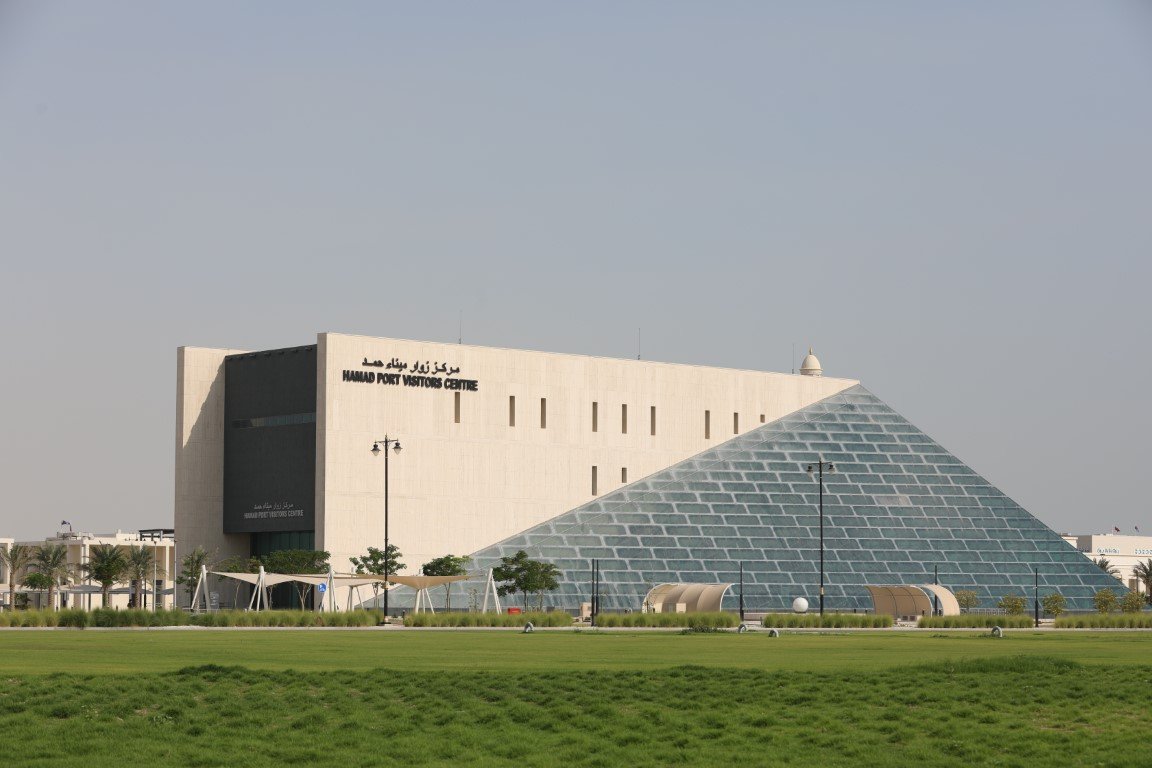
The New Doha Port Visitor Centre explores the relationship between climate, structure and cultural identity through the design of its envelope. Developed as part of Qatar's wider programme of infrastructural investment, the building demonstrates how contemporary construction technologies can be combined with environmental performance and regional architectural traditions.
Newtecnic provided façade engineering for the project, developing envelope systems that integrate environmental control, structural performance and architectural expression within a unified design strategy.
The project occupies an important position within the evolution of contemporary façade design because the envelope is not treated as a separate architectural layer applied to an otherwise complete building. Instead, the enclosure participates directly in the organisation of structure, services, environmental control and public experience.
The building therefore demonstrates how architecture can emerge from the coordination of systems rather than from the independent pursuit of form.
Architecture as Environmental Infrastructure
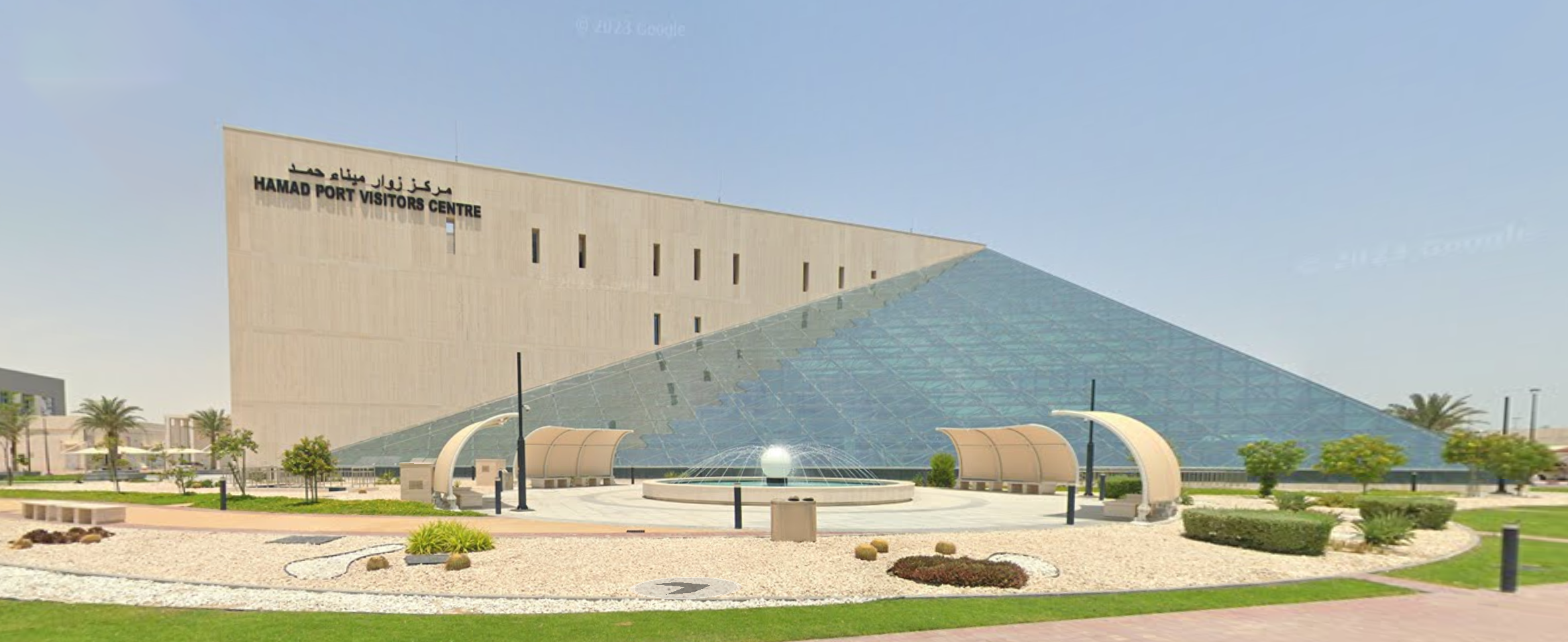
The architectural strategy is organised around the relationship between a robust perimeter enclosure and a lightweight vaulted roof structure. Together these elements create a building capable of responding to the extreme climatic conditions of the Gulf while establishing a clear civic identity.
Rather than conceiving the façade as a boundary between inside and outside, the project treats the envelope as a form of environmental infrastructure.
The enclosure moderates solar gain, manages daylight, accommodates services, supports structural systems and contributes to the building's public presence. Environmental performance is therefore embedded directly within the architecture itself.
This approach reflects a broader shift in contemporary architecture in which façades increasingly become active participants in building performance rather than passive protective layers.
Climate as Design Generator
The environmental conditions of Qatar played a fundamental role in shaping the building.
High solar radiation, elevated summer temperatures and intense daylight levels create challenges that cannot be resolved through mechanical systems alone. The architecture therefore incorporates environmental moderation within its primary spatial and constructive framework.
Solar control, daylight management and thermal performance are integrated into the geometry, materiality and organisation of the envelope. Climatic response becomes a generator of architectural form rather than a secondary technical consideration.
The resulting architecture derives much of its character from environmental necessity.
Performance and expression emerge from the same design decisions.
The Façade as a Multi-Layered System
The perimeter enclosure is conceived as a layered environmental assembly rather than a singular wall construction.
Its depth allows multiple functions to be incorporated within the façade itself. Weather protection, thermal moderation, ventilation routes and service integration operate within a coordinated architectural framework.
This layered approach improves efficiency by reducing competition for space within the building interior while simultaneously strengthening environmental performance.
The envelope consequently becomes an organising device for the project as a whole.
Rather than concealing complexity, it absorbs and coordinates it.
Ventilated Rainscreen Strategy
The vertical façades utilise a ventilated rainscreen system designed specifically for the environmental demands of the Gulf region.
The outer layer provides protection from direct solar exposure while reducing heat transfer to the occupied spaces beyond. The ventilated cavity assists environmental performance by allowing heat to dissipate before it reaches the primary enclosure.
This approach improves thermal efficiency while reducing cooling demand within the building.
The depth of the system also provides opportunities for the integration of environmental services, maintenance access and technical infrastructure.
The façade therefore functions simultaneously as climate moderator and building infrastructure.
The Roof as Environmental Instrument
A defining characteristic of the project is the vaulted roof structure.
Rather than operating solely as weather protection, the roof becomes a sophisticated environmental device capable of controlling light and thermal performance.
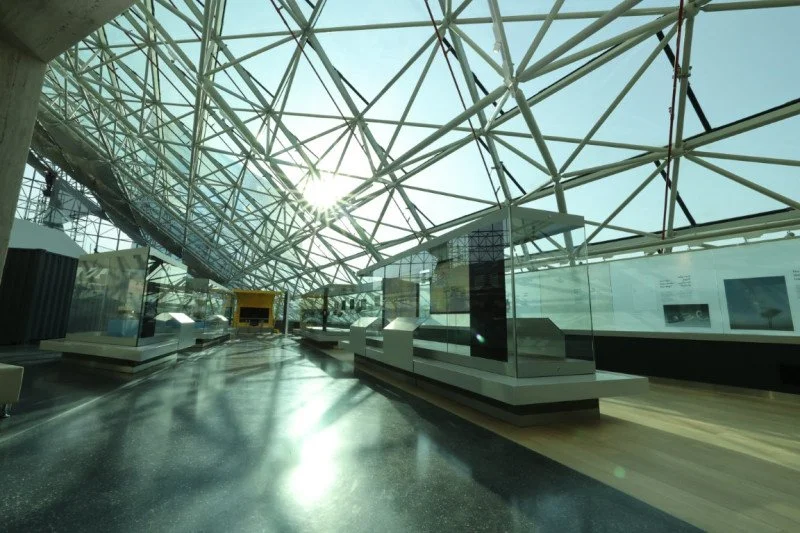
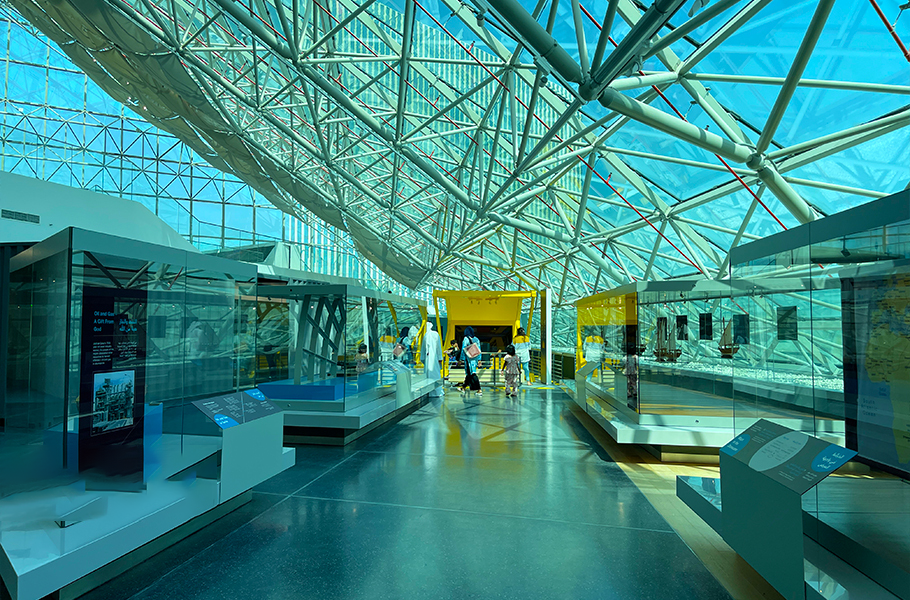
Variations in transparency, panel spacing and surface treatment allow daylight to enter the building in carefully controlled ways. Natural illumination is distributed throughout the interior while glare and unwanted solar gain are reduced.
The roof transforms changing environmental conditions into architectural experience.
Patterns of light shift throughout the day, reinforcing an awareness of time, climate and place.
Structure, enclosure and daylight operate together as parts of a single environmental system.
Daylight and Public Experience
The management of daylight is particularly important within a civic building intended to welcome visitors.
Natural light contributes to orientation, comfort and spatial quality while reinforcing connections between interior activity and the external environment. However, within a hot climate excessive daylight often carries significant thermal penalties.
The project resolves this challenge through calibration rather than exclusion.
Daylight is filtered, diffused and distributed rather than blocked entirely. The building remains visually connected to its surroundings while maintaining environmental comfort.
The resulting spaces feel open and luminous without becoming environmentally compromised.
Structure and Envelope Integration
One of the most significant aspects of the project is the close relationship between structure and enclosure.
The perimeter façade contributes to the overall stability of the building while simultaneously providing environmental protection and architectural definition. The roof structure and enclosure systems are developed as interdependent components rather than independent assemblies.
This integration reduces redundancy and strengthens the coherence of the architectural solution.
Each system performs multiple roles.
Structure contributes to environmental performance. Environmental systems contribute to architectural identity. Architectural expression emerges from the organisation of both.
The building is consequently understood as a coordinated whole rather than a collection of separate technical packages.
Digital Coordination and Construction
The complexity of the project required extensive coordination between architectural, structural and façade systems.
Digital modelling tools were used to analyse geometry, optimise structural behaviour and coordinate fabrication. Environmental analysis, structural design and construction detailing were developed simultaneously, allowing decisions to be evaluated across multiple performance criteria.
This integrated workflow reduced risk while improving consistency between design intent and construction outcome.
Prefabricated components improved manufacturing quality, accelerated installation and ensured the precision required by the geometry of the roof and façade systems.
The project demonstrates how digital workflows can support integration rather than merely geometric complexity.
Cultural Continuity Through Performance
The building draws inspiration from regional architectural traditions without resorting to direct historical imitation.
Solar screens, shading devices and layered environmental systems reinterpret long-established approaches to climatic moderation found throughout Middle Eastern architecture. Their significance lies not in visual resemblance but in the continuation of environmental principles.
These elements regulate daylight, reduce solar gain and contribute to occupant comfort while simultaneously establishing a relationship with regional culture.
The project therefore demonstrates that cultural continuity can emerge through environmental intelligence rather than through stylistic reproduction.
Tradition is understood as a body of knowledge rather than a catalogue of forms.
Civic Presence
As a public building, the Visitor Centre must communicate its role clearly to visitors while contributing positively to the wider port development.
The envelope plays a central role in establishing this civic presence. Its scale, materiality and environmental depth create an architecture that is both distinctive and purposeful.
The building appears neither purely technological nor purely symbolic.
Instead, its identity emerges from the visible integration of climate, structure and construction.
This gives the project a clarity and authenticity that reinforces its public function.
Project Significance
The New Doha Port Visitor Centre demonstrates how façade engineering can contribute directly to architectural quality. Through the integration of environmental performance, structural logic and cultural interpretation, the envelope becomes a primary generator of architectural character.
The project illustrates a broader evolution in contemporary architecture in which façades are no longer treated as external surfaces but as active systems that organise climate, light, structure and experience simultaneously.
For Newtecnic, the project exemplifies an approach to façade engineering in which environmental performance, structural coordination and architectural expression are developed together from the earliest stages of design.
The result is a building that is environmentally responsive, technologically sophisticated and culturally grounded. More importantly, it demonstrates how architecture can emerge from the integration of systems rather than their separation, establishing a model for civic architecture in arid climates where performance, identity and public experience must operate together within a single coherent framework.