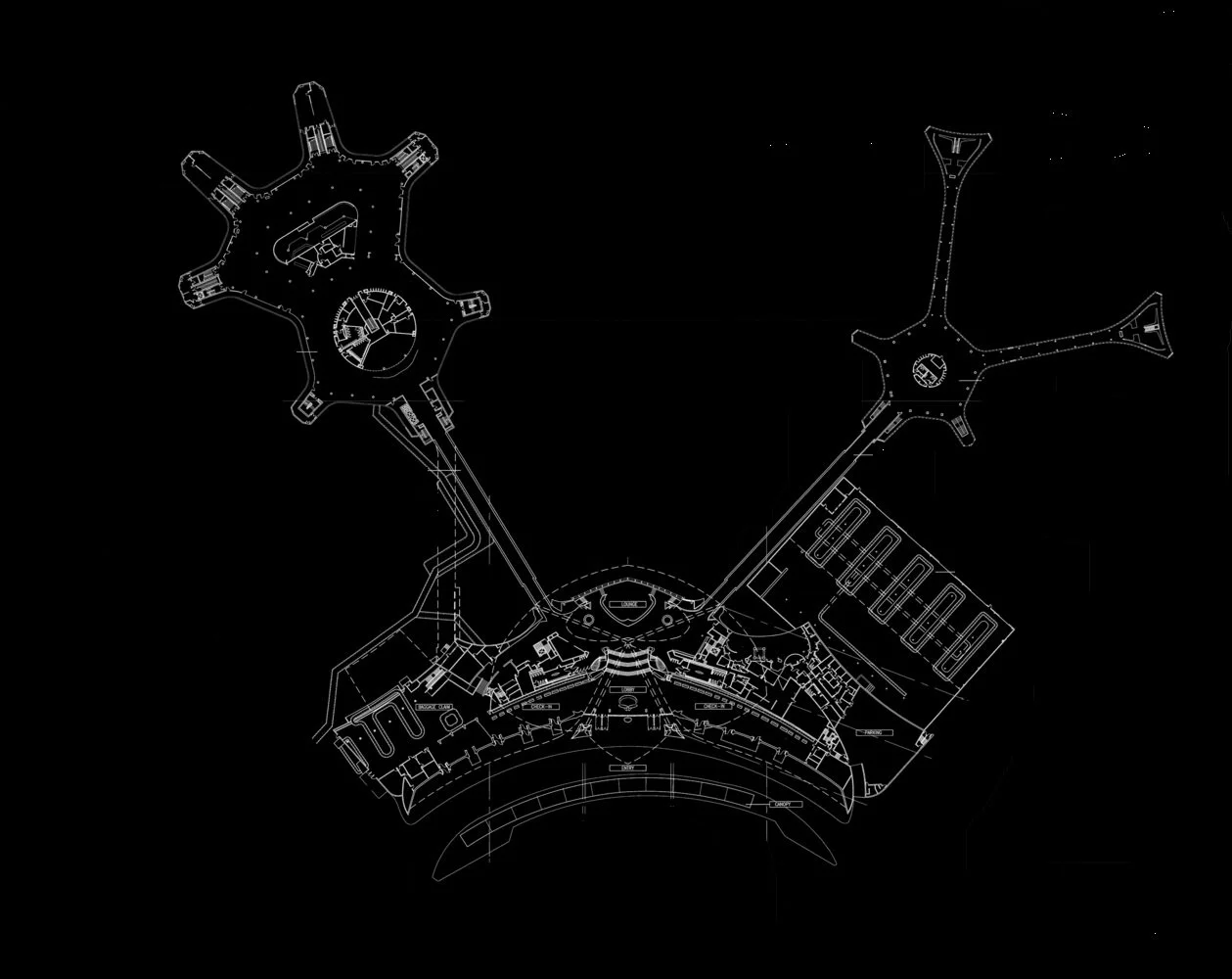
Project 01, 2nd Edition Modern Construction Case Studies - Precedent: TWA Terminal designed by Eero Saarinen, JFK Airport, NYC
Reframing the Residual: Typological Inheritance and Formal Autonomy in Project 01
Project 01, a corporate headquarters building, functions not simply as a chronological successor but as a discursive continuation of architectural ideas initiated in its precedent, as documented in Modern Construction Case Studies, Second Edition. Its relevance lies not in programmatic similarity but in its critical engagement with formal expression, residual spatiality, and the evolving relationship between interior organization and architectural envelope.
While serving the pragmatic functions of a contemporary workplace, Project 01 draws from the spatial choreography of Eero Saarinen’s TWA Terminal at JFK Airport, invoking its entrance sequence as a referential framework. In Saarinen’s terminal, figural plasticity operates as a conduit for the techno-futurist optimism of mid-century modernism, making the architecture itself a performative expression of its cultural moment. The juxtaposition of the terminal’s sculptural hub with flanking rectilinear support zones gives rise to residual spaces that exist in a liminal condition—neither fully central nor peripheral, occupying a threshold between formal exuberance and infrastructural necessity.
This reading aligns with Colin Rowe and Fred Koetter’s conception of “collage city,” wherein architectural meaning is generated through the layering of spatial and typological fragments that resist synthesis (Rowe and Koetter 1978). Project 01 critically reinterprets this strategy within the context of corporate architecture, embodying a contemporary optimism through both its deployment of advanced construction technologies and its organizational logic. While its programmatic brief and urban context diverge significantly from those of the TWA Terminal, the project retains and transforms its predecessor’s spatial ethos.
An obliquely angled internal geometry in Project 01 produces residual conditions that are deliberately externalized—displaced into the interstitial space between a technologically expressive facade and a shell-like envelope. This spatial maneuver can be understood through the lens of Stan Allen’s concept of “field conditions,” in which architecture operates not through singular gestures, but through flexible systems that accommodate complexity and indeterminacy (Allen 1999). The resulting ‘loose fit’ resists the fixity of formal determinism and instead establishes a critical relationship between envelope and interior—parallel systems that operate with formal and conceptual autonomy.
This autonomy echoes the “autonomy project” articulated by Michael Hays (1998), in which architecture resists subservience to external demands by asserting its own disciplinary language. Yet Project 01 does not pursue autonomy as isolation; rather, it posits a relational autonomy in which enclosure and occupation engage in a dialectic of differentiation. The facade and internal organization are interdependent yet not formally subordinate to one another, producing a productive ambiguity in the building’s spatial and representational legibility.
The interstitial zone generated by this strategy is not a void but a site of spatial opportunity. Drawing again on Stan Allen’s work, interstitial spaces can be understood as “loose frameworks” that allow architecture to engage contingency and accommodate multiple interpretations and uses (Allen 1997). Within this framework, the residual becomes a generative medium rather than a leftover—an enabling condition through which architectural meaning is constructed not through resolution, but through openness.
By leveraging cutting-edge construction techniques while embracing spatial discontinuity, Project 01 reframes the corporate headquarters as a site of architectural experimentation. It channels the utopian ambition of its Saarinenian predecessor, yet through a contemporary lens attuned to disciplinary critique, formal multiplicity, and technological authorship. The residual space, far from incidental, becomes the locus where architectural potential is not only sustained but expanded.
References
Allen, Stan. 1999. Points + Lines: Diagrams and Projects for the City.
Hays, K. Michael. 1998. Architecture Theory since 1968.
Rowe, Colin, and Fred Koetter. 1978. Collage City.