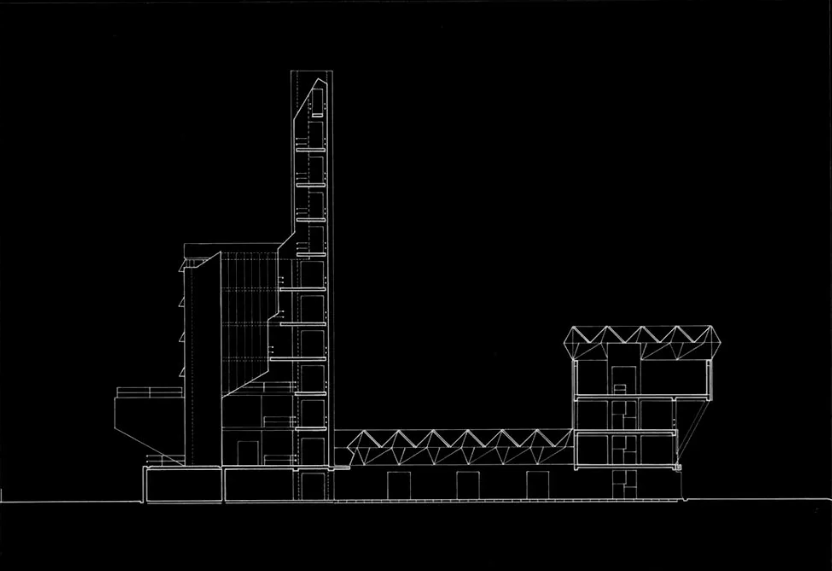
Leicester Engineering Building — James Stirling and James Gowan, 1963
Architectural Significance
The Leicester Engineering Building is widely regarded as one of the most important works of post-war British architecture. Designed for the University of Leicester by James Stirling and James Gowan, the project challenged many of the assumptions of orthodox modernism while remaining firmly committed to its social and technological ambitions.
Rather than concealing construction, servicing and programme behind uniform façades, the building makes them visible. Workshops, laboratories, towers, circulation elements and environmental systems are expressed as distinct architectural components, allowing the organisation of the institution to become legible through its form.
Structure, Programme and Making
One of the building's most significant contributions is its integration of teaching, research and production within a single architectural framework. The relationship between the tower and the lower workshop volumes establishes a clear distinction between different forms of activity while maintaining their functional connection.
The project demonstrates that architecture can emerge directly from the organisation of use, structure and construction. Laboratories, workshops and teaching spaces are treated as equally important parts of the institution, creating an environment in which learning and making are understood as complementary activities.
Its expressive use of structure, glazing and industrial materials reinforces this position. Construction is not treated as a hidden technical necessity but as a visible and meaningful part of the architectural experience. The building reveals how it is assembled, how it is used and how its different systems contribute to the whole.
Continuing Relevance
The continuing relevance of the Leicester Engineering Building lies in its demonstration that architecture can engage directly with technology, production and education without sacrificing spatial richness or architectural character.
The project remains an important precedent for buildings associated with research, innovation and fabrication because it recognises that architecture is shaped not only by occupation but also by the processes of making, experimentation and discovery that occur within it.
More than sixty years after its completion, the building continues to illustrate how programme, structure, construction and environmental systems can be organised into a coherent architectural whole. Its enduring lesson is that architectural expression can emerge from the clear coordination of relationships rather than from applied form alone.