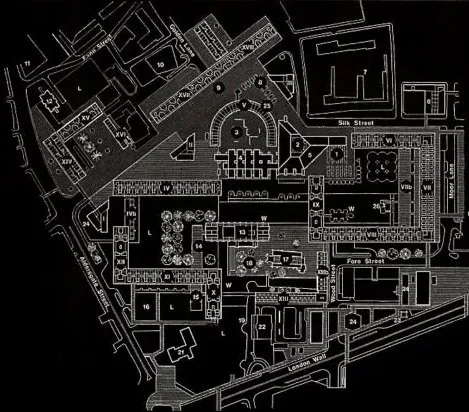
Barbican Estate — Chamberlin, Powell and Bon, London, 1982
Architectural Significance
The Barbican Estate is one of the most significant post-war urban projects in Europe. Conceived as a mixed-use development combining housing, workplaces, culture, landscape and public space, it represents an ambitious attempt to create a complete urban environment rather than a collection of individual buildings.
Developed on a site heavily damaged during the Second World War, the project demonstrates how architecture can contribute to the reconstruction of the city through the integration of living, working, learning, culture and public life within a coherent urban framework.
Architecture at the Scale of the City
One of the Barbican's most important contributions is its understanding of architecture as an organisational framework operating across multiple scales. Buildings, landscape, circulation routes and public spaces are conceived as interconnected parts of a larger civic system rather than as independent objects.
Rather than treating open space as residual land between buildings, the project organises movement, gathering and occupation through a carefully layered network of terraces, walkways, gardens, courts and cultural facilities. Pedestrian routes are integrated with the architecture itself, creating an urban environment experienced through sequence, discovery and participation.
This approach allows the estate to function simultaneously as a place of residence, employment, education, culture and public life.
Density and Collective Life
The Barbican demonstrates how density can be combined with environmental quality and social amenity. Housing, studios, offices, arts facilities, schools, gardens and public spaces are brought together within a compact urban setting while maintaining a strong sense of identity and place.
The project challenges the idea that high-density development must be anonymous or repetitive. Instead, it creates richness through the careful organisation of relationships between buildings, landscape and occupation. Its success lies not in any individual structure but in the coordination of the whole.
The estate therefore illustrates how architecture can support collective life through spatial organisation as much as through individual buildings.
Continuing Relevance
The continuing relevance of the Barbican Estate lies in its demonstration that architecture and urbanism can be conceived as a unified endeavour. The project shows how diverse programmes and forms of occupation can be organised within a coherent civic framework while maintaining a strong sense of place.
At a time when many urban developments are composed of isolated buildings connected only by infrastructure, the Barbican remains a powerful example of integrated city-making. Its enduring lesson is that architectural quality can emerge through the careful coordination of relationships between buildings, landscape, movement and public life.
More than forty years after its completion, the estate continues to demonstrate how architecture can operate simultaneously at the scale of the room, the building and the city, creating environments capable of supporting community, culture and everyday life over time.