Method
Architecture as Organised Relationships
Newtecnic approaches architecture, engineering and construction as interconnected components of a single design process.
Architecture is understood not as the creation of isolated objects but as the organisation of relationships between structure, material behaviour, environmental performance, programme, fabrication and construction. Buildings emerge through the continual coordination of these interdependent systems in response to site, climate, use and available means of construction.
Design is therefore not the application of predetermined solutions to predefined problems. It is a process of discovery through which architectural, technical and environmental requirements are developed together. Architectural form, structural behaviour, environmental response and construction logic evolve simultaneously, informing one another throughout the development of a project.
The objective is to create buildings in which architectural expression, technical performance and constructability emerge from the same organisational framework. Coherence is achieved not through the dominance of a single idea or discipline, but through the sustained alignment of relationships across the life of the project.
Construction Knowledge as Design Method
Construction is not regarded as the final stage of design. It is a source of design knowledge from the earliest stages of project development.
Fabrication methods, material behaviour, assembly sequences, tolerances, maintenance requirements and local construction capabilities are considered alongside architectural and engineering decisions from the outset. Construction knowledge therefore informs design rather than merely implementing it.
Particular emphasis is placed on modelling, analysis, prototyping, mock-ups and testing. These activities are not undertaken solely to verify compliance or reduce risk. They provide opportunities to develop understanding, refine assemblies and improve the integration of architectural, structural and environmental systems before construction begins.
Where existing solutions prove inadequate, new systems may be developed through first-principles investigation, combining architectural design, technical analysis, fabrication knowledge and physical testing. The objective is not innovation for its own sake, but the creation of solutions that are simultaneously buildable, efficient and architecturally coherent.
Architecture is consequently understood as a constructive discipline in which design knowledge develops through making as well as through drawing, modelling and analysis.
Practice as a Source of Knowledge
Newtecnic views practice, publication and education as interconnected activities.
Projects generate knowledge through real conditions of design, fabrication and construction. That knowledge is documented, tested and refined through research and publication. The resulting ideas are then returned to practice, where they are evaluated under new conditions and further developed through subsequent projects.
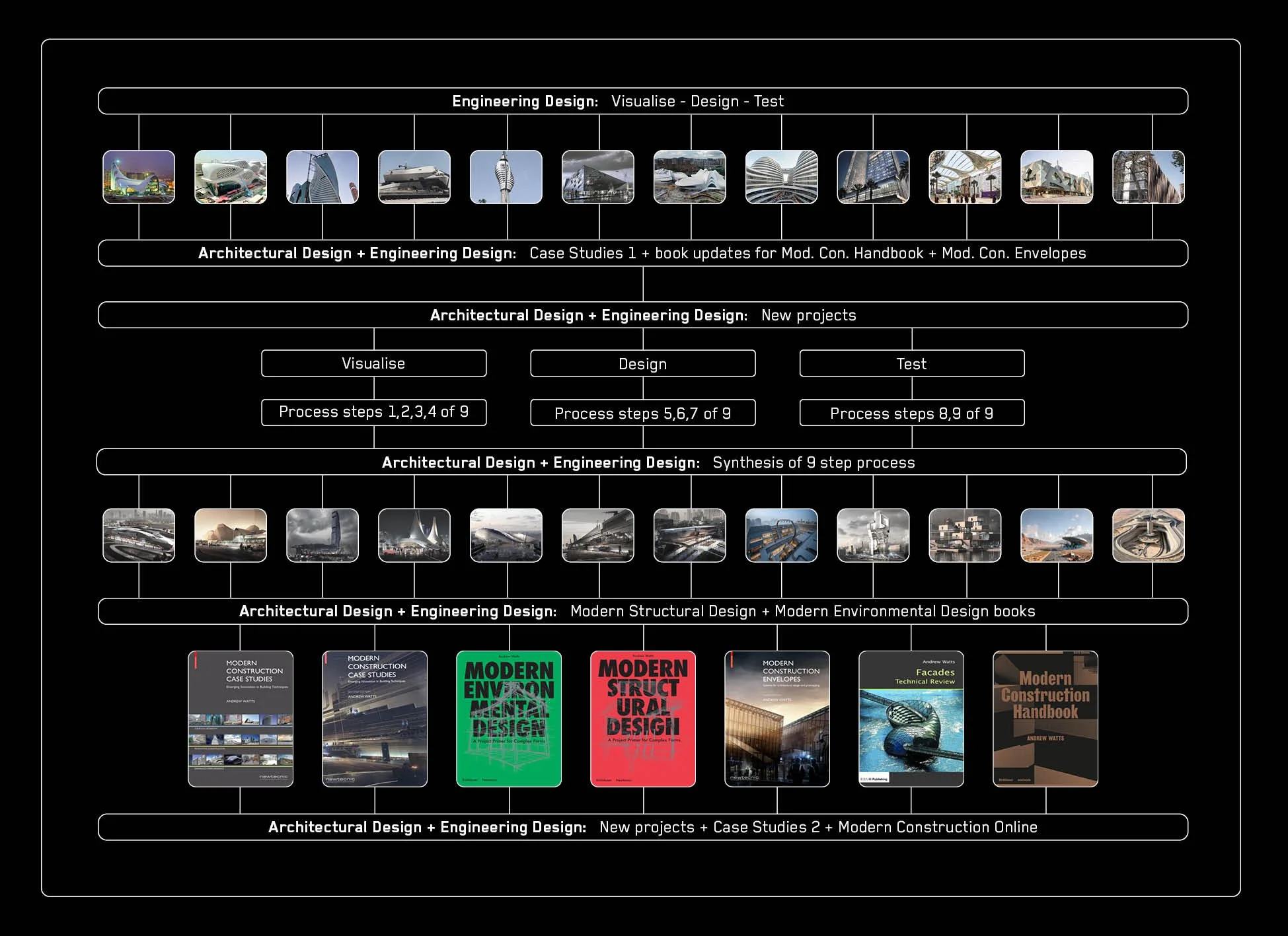
The Modern Construction series forms part of this process. The books do not sit alongside practice as separate intellectual work. They provide a framework through which lessons emerging from projects can be organised, questioned and communicated. Equally, the principles explored through publication are tested through real projects, real constraints and real construction.
This continuous exchange between practice and publication reflects a broader commitment to architecture as a knowledge-based discipline, where understanding develops through experience, testing, reflection and application.
From Method to Buildings
The projects developed by Newtecnic differ in scale, programme, climate and location, yet they are linked by a consistent approach. Their coherence derives not from a shared visual language but from a shared method in which structure, environmental performance, material behaviour, fabrication and construction are developed together. The resulting buildings are diverse because they respond to different conditions and opportunities. What remains consistent is the objective: the alignment of spatial, structural, environmental and material systems within coherent and adaptable forms.
Knowledge to Practice Framework
Architecture is developed through the continual interaction of knowledge and experience. Research, design, engineering, construction and publication each contribute to the development of the next project. The diagram below illustrates how Newtecnic integrates architectural and engineering knowledge through processes of visualisation, design and testing, allowing lessons from projects, research and publication to inform future work.