
Great Ormond Street Hospital, London, UK
Further information and case study for this project can be found at the De Gruyter Birkhäuser Modern Construction Online database
The following text is not available at Modern Construction Online
Architecture as Care
The Mittal Children's Medical Centre forms part of the continuing development of Great Ormond Street Hospital in central London. The building accommodates specialist clinical facilities within a constrained urban site while supporting the hospital's wider objective of providing high-quality environments for patients, families and staff.
Newtecnic provided façade engineering for the project, developing an envelope system that integrates environmental performance, clinical requirements and architectural expression.
The significance of the project extends beyond the technical performance of its façade. It demonstrates how architecture can contribute directly to the culture and practice of care. Within healthcare environments, environmental quality influences not only energy performance and operational efficiency but also wellbeing, recovery, stress reduction and the experience of patients, families and clinical staff.
The building therefore illustrates an important architectural principle: environmental performance is ultimately a human concern. The façade becomes part of a broader infrastructure of care.
Hospitals and Human Experience
Hospitals are among the most technically demanding building types.
They must accommodate complex servicing systems, strict environmental requirements, infection control measures and continuously changing clinical technologies. At the same time, they must provide environments capable of supporting people during some of the most difficult periods of their lives.
These requirements often appear contradictory.
Clinical efficiency demands precision and control. Human wellbeing requires comfort, orientation, connection and reassurance.
Architecture operates between these conditions.
The challenge is not simply to house healthcare functions but to create environments that support healing while maintaining the operational performance required by modern medicine.
The façade plays a central role in achieving this balance.
Beyond Shelter
Traditionally, façades have been understood as barriers separating interior and exterior environments.
Within healthcare architecture this definition is insufficient.
The building envelope influences access to daylight, views, thermal comfort, privacy, orientation and psychological wellbeing. These factors affect patients, visitors and staff throughout their daily experience of the building.
The façade therefore becomes more than an enclosure.
It acts as an environmental regulator, a source of natural light, a means of visual connection and a contributor to the overall atmosphere of care.
Its performance extends beyond energy metrics into the quality of human experience.
Daylight and Recovery
One of the most significant environmental resources available to healthcare architecture is daylight.
Research has consistently demonstrated connections between access to natural light and improved wellbeing, reduced stress and enhanced recovery environments. Daylight assists orientation, supports circadian rhythms and contributes to a sense of connection with the wider world.
Within children's healthcare environments these benefits become particularly important.
Young patients may spend extended periods within clinical spaces, separated from familiar routines and surroundings. Access to changing daylight conditions helps maintain awareness of time and place while reducing the sense of isolation often associated with hospital environments.
The façade therefore functions as a carefully calibrated instrument for the admission and control of natural light.
The objective is not simply to maximise daylight levels but to create comfortable and supportive environments for occupants.
The Logic of Differentiation
Hospitals contain a wide variety of spaces, each with different environmental requirements.
Clinical rooms require privacy and controlled conditions. Waiting areas benefit from openness and visual connection. Staff facilities require comfort and concentration. Circulation spaces assist orientation and movement.
The façade responds to these differing conditions through variation rather than uniformity.
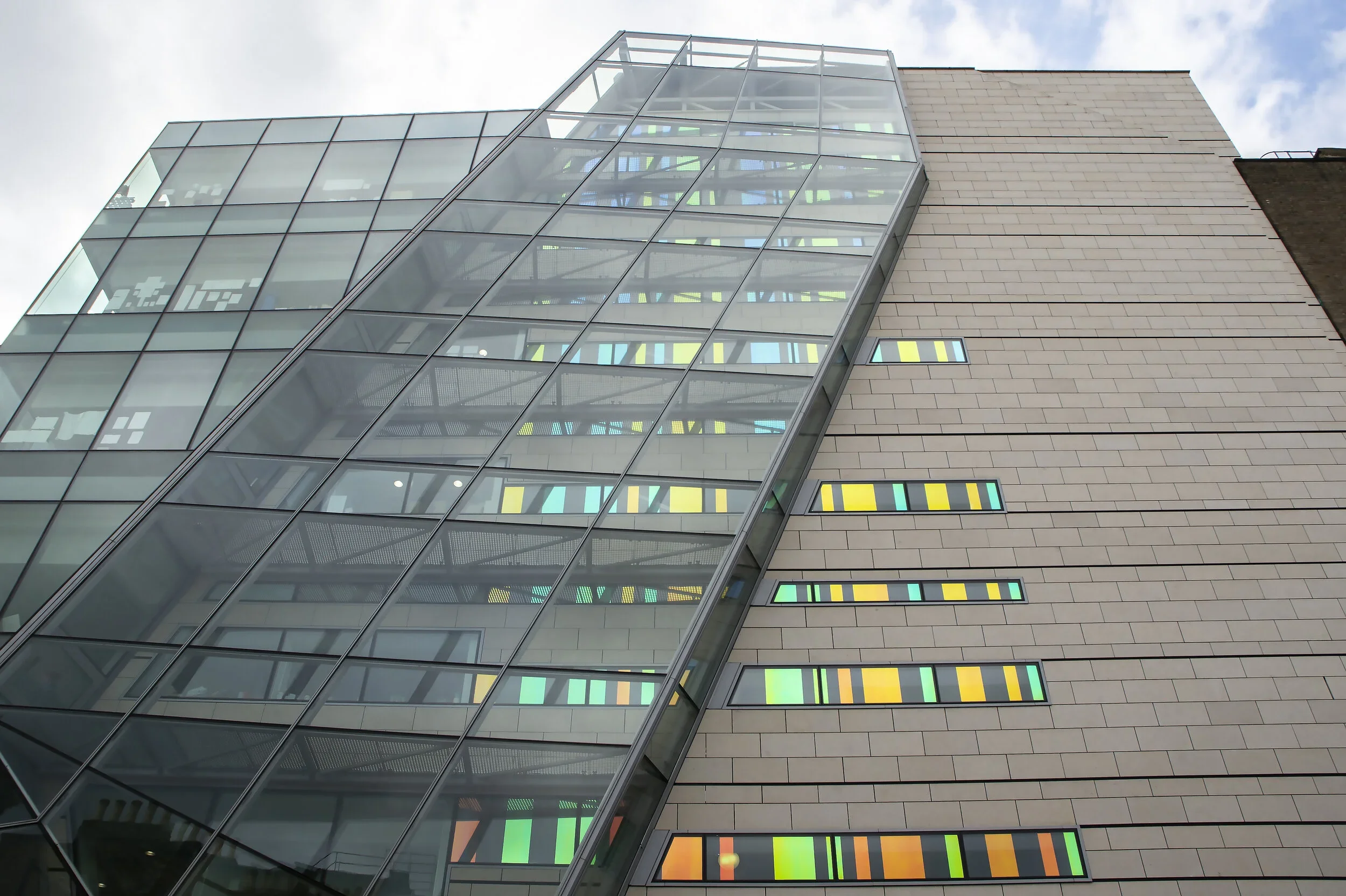
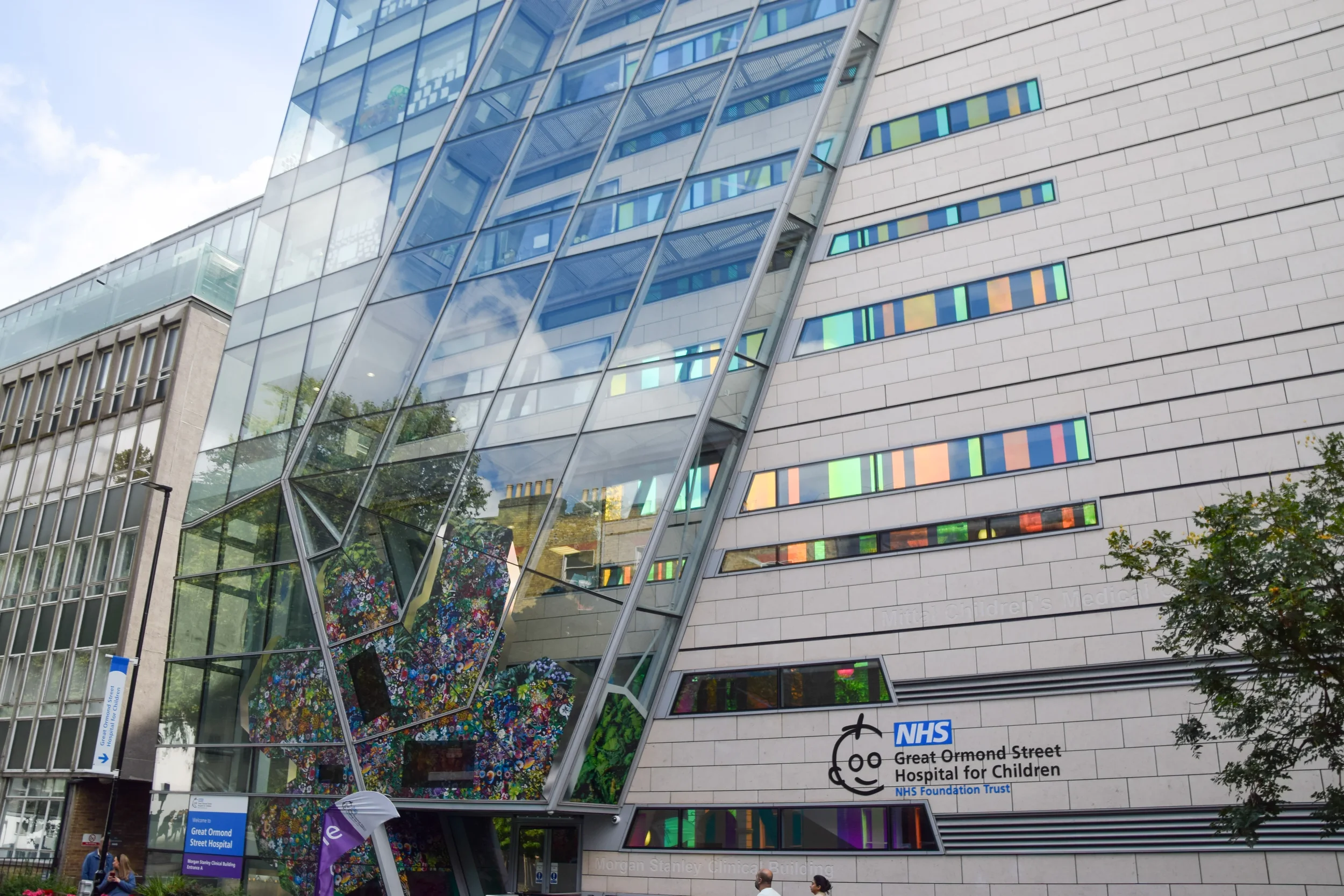
Glazed areas, solid panels and solar-control elements are organised according to the functions they support. Environmental performance is therefore aligned with clinical requirements rather than imposed independently of them.
This approach reflects a broader principle of healthcare design: different activities require different environmental conditions.
The building envelope becomes a mechanism for achieving this differentiation while maintaining overall architectural coherence.
Making Environmental Systems Visible
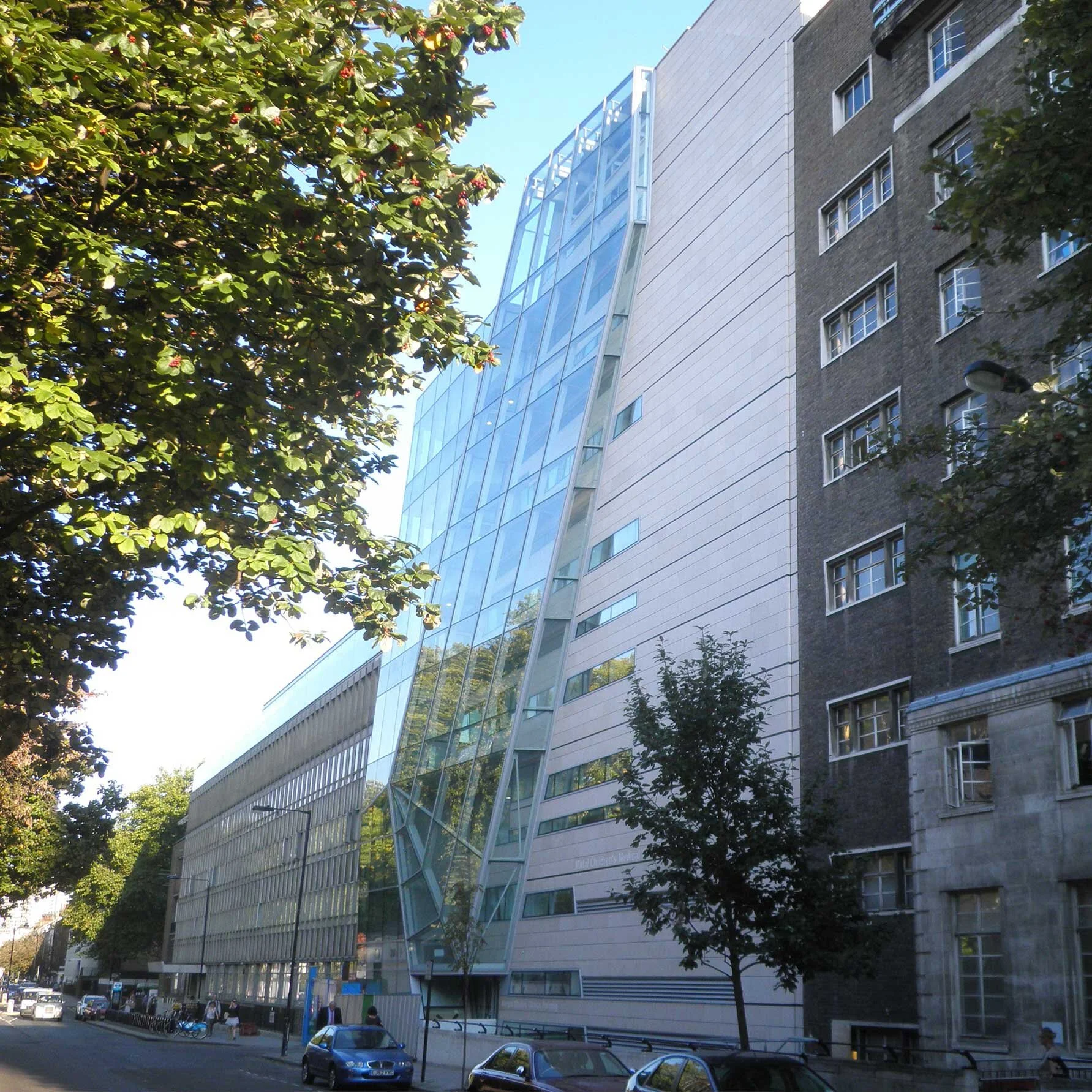
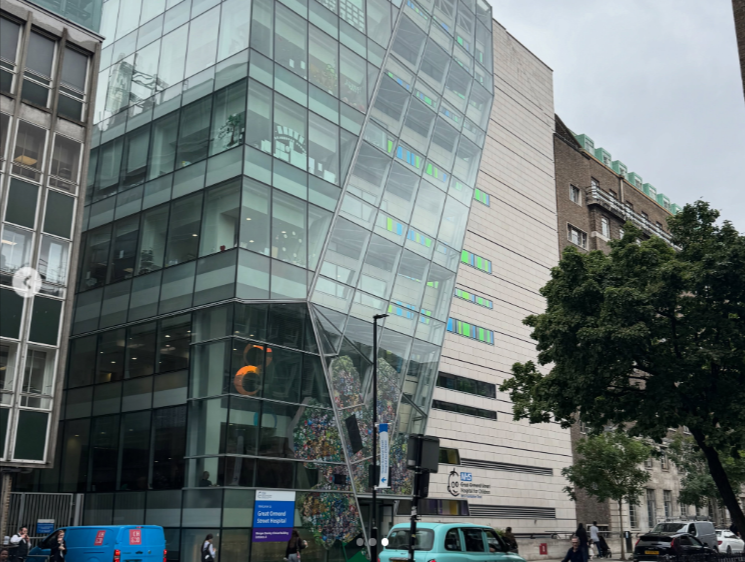
A distinctive feature of the project is the inclined glazed thermal flue located on the principal elevation.
This element performs an important environmental function within the building's ventilation strategy, assisting the movement of air through natural processes and reducing reliance upon mechanical systems under appropriate conditions.
Yet its significance extends beyond technical performance.
The flue makes part of the building's environmental operation visible within the architecture itself. Rather than concealing environmental systems entirely behind walls and ceilings, the building expresses their presence as part of its architectural language.
This approach continues a tradition in which environmental performance contributes directly to architectural expression.
The building demonstrates how technical systems can become visible participants in the identity of a project rather than remaining hidden infrastructure.
Environmental Performance and Wellbeing
Thermal comfort, air quality and environmental stability are essential within healthcare environments.
These conditions influence not only patient wellbeing but also staff performance and operational effectiveness. Hospitals operate continuously, requiring building systems capable of maintaining reliable environmental conditions throughout changing seasons and patterns of use.
The façade contributes to this objective through the integration of glazing, insulation, solar control and ventilation strategies.
Each component performs a specific role, yet their effectiveness depends upon their coordination within a larger environmental system.
The envelope therefore becomes an active participant in maintaining the internal conditions required for healthcare delivery.
Coordination and Complexity
The development of healthcare architecture requires an unusually high level of interdisciplinary collaboration.
Clinical planners, architects, structural engineers, environmental consultants, infection-control specialists and facility managers all contribute to the development of the building.
The façade sits at the intersection of many of these disciplines.
Decisions regarding glazing, shading, ventilation and maintenance affect environmental performance, clinical operation, energy consumption and long-term building management simultaneously.
The envelope therefore becomes a point of integration where multiple technical and human requirements converge.
Its successful design depends not upon individual components but upon the coordination of many interconnected systems.
Durability and Stewardship
Healthcare buildings are long-term civic investments.
Unlike many commercial developments, hospitals are expected to remain operational for decades while accommodating changing technologies and patterns of care. Durability and maintainability therefore become fundamental design considerations.
The façade was developed with particular attention to long-term performance, maintenance access and operational resilience. Materials, fixing systems and environmental assemblies were selected not only for immediate performance but also for their ability to support continuous operation over extended periods.
This perspective introduces an important lesson for architectural practice.
Care extends beyond the immediate needs of occupants. It also includes stewardship of the building itself and the resources invested within it.
Architecture and Empathy
Technical performance alone cannot create meaningful healthcare environments.
Buildings must also communicate reassurance, clarity and dignity. Patients and families often arrive at hospitals under conditions of anxiety and uncertainty. Architecture cannot eliminate these realities, but it can influence how they are experienced.
The carefully ordered façade contributes to this objective through consistency, rhythm and visual calm. The building avoids unnecessary complexity while maintaining a strong architectural identity.
This restraint is significant.
Architecture supports care not only through technical performance but also through the quality of the environments it creates.
The façade therefore becomes part of a larger framework of empathy embedded within the building.
Project Significance
The Mittal Children's Medical Centre demonstrates how façade design can contribute simultaneously to environmental performance, clinical effectiveness and human wellbeing. Through the integration of daylight, ventilation, privacy and environmental control, the envelope becomes an active participant in the delivery of care rather than merely a protective enclosure.
More broadly, the project illustrates a fundamental principle of healthcare architecture: technical systems ultimately exist to support human outcomes. Environmental performance, energy efficiency and construction quality are important not as ends in themselves, but because they contribute to healthier, more comfortable and more supportive environments.
The building therefore demonstrates how architecture can operate as part of a wider culture of care. In doing so, it shows that the most successful healthcare environments emerge when technical excellence and human experience are developed together as inseparable aspects of design.