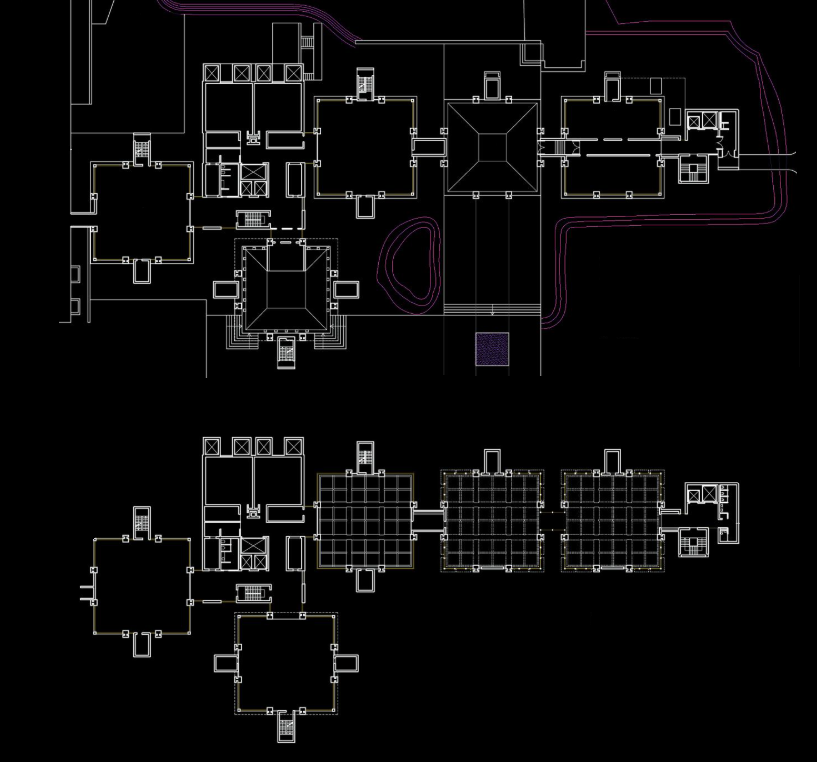
Richards Medical Research Laboratories — Louis I. Kahn, Philadelphia, 1961
Architectural Significance
The Richards Medical Research Laboratories is one of the most influential buildings of the twentieth century. Designed by Louis Kahn for the University of Pennsylvania, the project transformed architectural thinking about the relationship between structure, services and occupation.
Rather than concealing technical systems within a neutral architectural container, Kahn made them an integral part of the architectural composition. The building established a new understanding of architecture as the organisation of interdependent systems, in which structure, servicing, circulation and occupation are developed together.
Organisation of Systems
One of the building's most important contributions is its clear distinction between primary occupied spaces and supporting infrastructure. Laboratories and offices are organised as principal spaces, while stairs, mechanical systems, vertical circulation and technical services are accommodated within separate service towers.
This arrangement provides clarity to the organisation of the building while allowing technical systems to evolve independently of the principal occupied spaces. More importantly, it demonstrates that infrastructure is not secondary to architecture but an essential component of it.
The project shows how complex buildings can achieve coherence through the careful organisation of relationships between systems rather than through the simplification of programme or technology.
Structure, Services and Adaptability
The Richards Laboratories demonstrates how structure can support flexibility and long-term adaptation. Open laboratory floors accommodate changing patterns of research, equipment and occupation while maintaining a clear structural order.
Natural light is carefully integrated into the planning of the building, ensuring that working environments remain connected to daylight while supporting specialised scientific activities. Structure, services and environmental performance are therefore developed as parts of a single architectural framework rather than as separate technical layers.
This integration remains one of the building's most enduring achievements.
Continuing Relevance
The continuing relevance of the Richards Medical Research Laboratories lies in its demonstration that architecture can be understood as the coordination of interdependent systems. The project shows how technical infrastructure can contribute positively to architectural character and how servicing can become an active participant in design rather than a concealed necessity.
More than sixty years after its completion, the building remains an important precedent for research facilities, workplaces and institutions that must accommodate continual change. Its enduring lesson is that architecture achieves clarity not through the removal of complexity but through its careful organisation.
The Richards Laboratories continues to demonstrate that buildings are not simply enclosures for activity but frameworks through which structure, services, environment and occupation are brought together within a coherent architectural order.