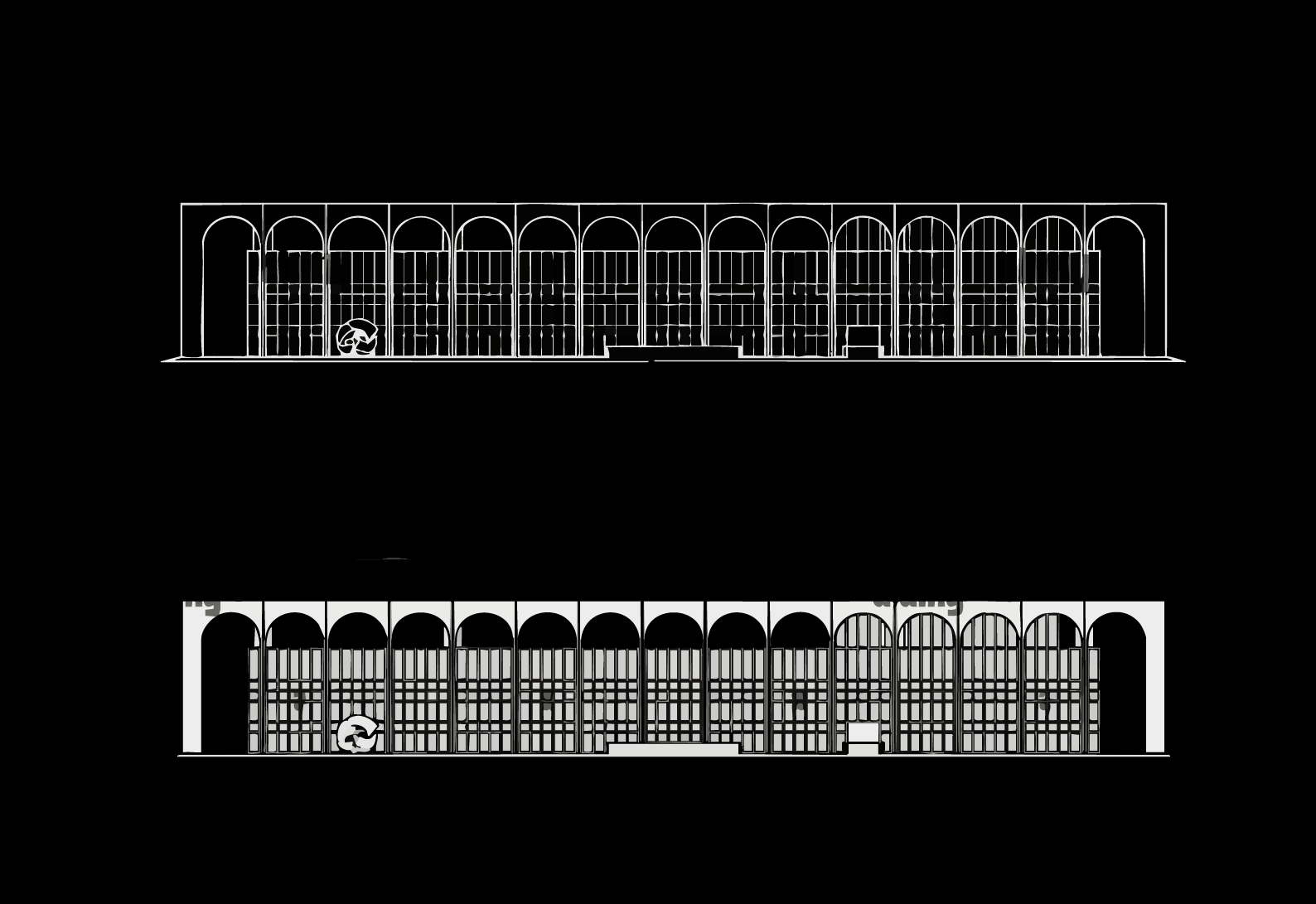
Itamaraty Palace — Oscar Niemeyer, Brasília, 1970
Architectural Significance
The Itamaraty Palace, designed by Oscar Niemeyer as the headquarters of Brazil's Ministry of Foreign Affairs, is one of the most accomplished civic buildings of the twentieth century. Combining structural clarity, spatial openness and landscape integration, the project demonstrates how architecture can represent public institutions through order, proportion and environmental presence rather than through monumentality alone.
Situated within the civic framework of Brasília, the building forms part of a larger composition in which architecture, landscape and public space are conceived as interconnected elements of a unified environment.
Structure and Architectural Order
The defining characteristic of the Itamaraty Palace is its perimeter colonnade of elegant concrete arches. These structural elements establish the building's identity while simultaneously providing enclosure, rhythm and proportion.
Structure is neither concealed nor treated as a purely technical necessity. Instead, it becomes the primary architectural language through which the building is understood. The repetition of the arches creates a clear and legible order that gives coherence to the entire composition.
The project demonstrates how structural systems can generate architectural character through simplicity, consistency and precision.
Architecture and Landscape
One of the building's most significant contributions is its integration of architecture and landscape. Water, planting and open space are developed alongside the building itself rather than being treated as separate elements.
Reflecting pools surrounding the palace extend the perceived presence of the architecture while mediating the transition between civic space and building. Landscape, climate and structure work together to create an environment in which the institution is experienced as part of a broader public setting.
The project illustrates how architecture can achieve significance through relationships between building, landscape and atmosphere rather than through formal complexity alone.
Civic Presence and Public Life
Although designed for government, the Itamaraty Palace avoids the defensive character often associated with institutional architecture. Transparency, openness and accessibility are central to its architectural expression.
The building conveys authority through clarity and confidence rather than through enclosure or intimidation. Public and ceremonial spaces are organised to support engagement while maintaining the dignity appropriate to a national institution.
This balance between representation and accessibility remains one of the project's most important achievements.
Continuing Relevance
The continuing relevance of the Itamaraty Palace lies in its demonstration that architecture can unite structure, landscape, climate and public purpose within a coherent whole. The project shows how civic buildings can achieve lasting significance through the careful coordination of environmental and spatial relationships rather than through stylistic novelty.
More than fifty years after its completion, the building remains an important precedent for institutional, cultural and educational architecture. Its enduring lesson is that architecture is most powerful when building, landscape and public life are conceived together as parts of a single architectural idea.