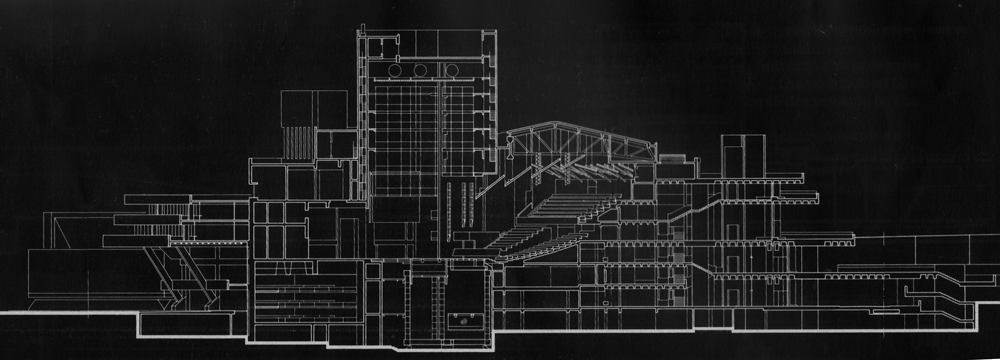
National Theatre — Denys Lasdun, London, 1976
Architectural Significance
The National Theatre is one of the most influential civic buildings of the twentieth century. Designed by Denys Lasdun and occupying a prominent position on London's South Bank, the project redefined the relationship between public space, movement and cultural activity.
Rather than conceiving the theatre as a singular object containing auditoria, Lasdun developed a complex architectural landscape composed of terraces, platforms, bridges and interconnected volumes. The building functions simultaneously as theatre, public forum and urban place, extending cultural activity beyond the performance spaces themselves.
Section, Movement and Social Space
One of the building's most significant contributions is its sectional organisation. Public spaces are layered vertically through a series of terraces and intermediate levels that create multiple routes, viewpoints and places of occupation.
Circulation is not treated merely as a means of moving between destinations but as an essential component of the architectural experience. Stairs, bridges, balconies and foyers generate opportunities for encounter, observation and participation, transforming movement into a civic activity.
This layered arrangement allows public gathering, informal occupation, performance and circulation to coexist within a single spatial framework. Architecture becomes a setting for social interaction rather than simply a container for programme.
Architecture as Civic Framework
Lasdun understood architecture as an organisational framework capable of supporting changing patterns of use over time. The National Theatre demonstrates how complex institutions can be organised through relationships between structure, programme, circulation and public space rather than through rigid hierarchies.
The building's terraces, voids and interconnected volumes create a sense of openness and adaptability while maintaining a strong architectural identity. Structure, circulation and programme are developed together, allowing the building to function as an integrated civic system rather than a collection of separate components.
The project therefore illustrates how architecture can contribute to public life not only through the activities it houses but also through the spatial relationships it creates.
Continuing Relevance
The continuing relevance of the National Theatre lies in its demonstration that public buildings can support collective life through spatial organisation as much as through programme. The project shows how architecture can encourage participation, interaction and social exchange through the careful coordination of movement, occupation and public space.
More than a cultural institution, the National Theatre remains a powerful example of architecture understood as civic infrastructure: a framework within which public life can unfold. Its enduring lesson is that architecture can create social value through the organisation of relationships, allowing buildings to support a wide range of activities while maintaining coherence, identity and public presence.