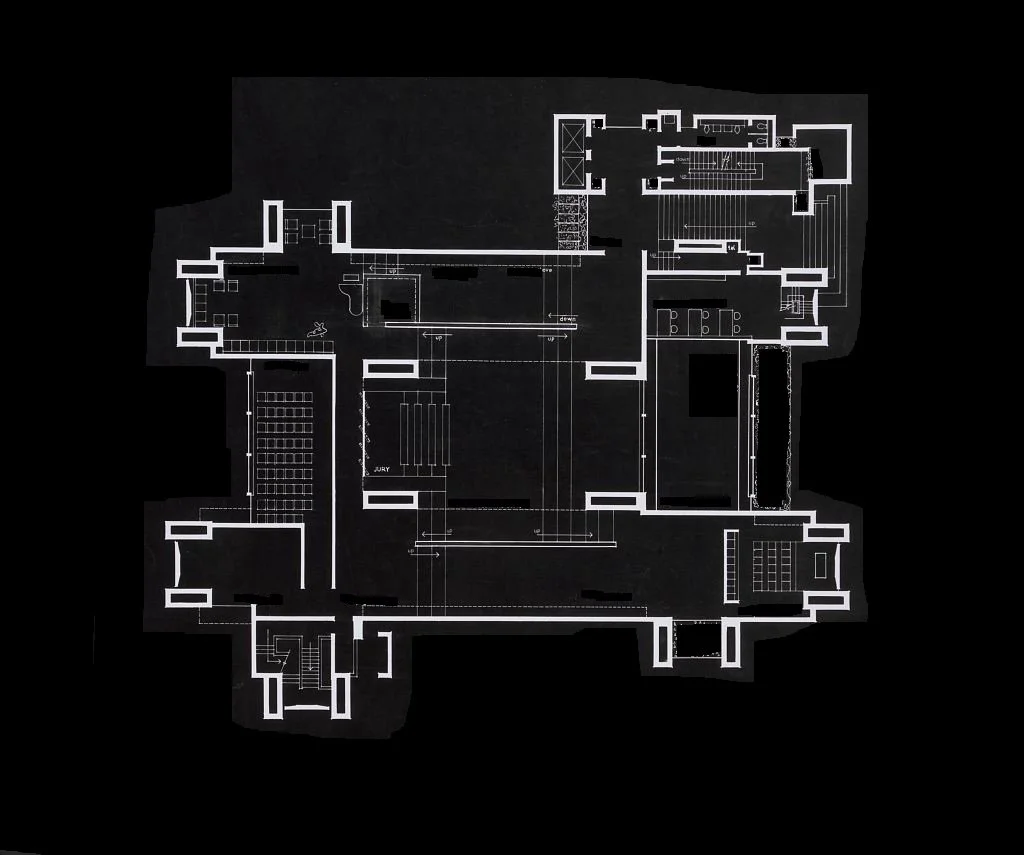
Paul Rudolph — Yale Art & Architecture Building (1963)
Architectural Significance
The Yale Art & Architecture Building is one of the most influential educational buildings of the twentieth century. Designed by Paul Rudolph for the Yale Schools of Architecture and Art, the project challenged conventional distinctions between structure, enclosure, circulation and environmental control.
Rather than treating these elements as separate technical problems, Rudolph developed them as interdependent components of a single architectural framework. The building demonstrates how architectural identity can emerge through the integration of structure, space, light, material and occupation.
Section, Structure and Space
A defining characteristic of the project is its sectional organisation. Studios, workshops, galleries, review spaces and circulation routes are arranged within a continuous spatial framework rather than on isolated floor plates. Multiple levels interconnect visually and physically, creating an environment in which movement, observation and interaction become integral components of the educational experience.
Structure contributes directly to this organisation. Columns, beams, floor plates and enclosure systems form part of a unified architectural language, supporting both spatial continuity and environmental performance. The project demonstrates how structure can participate in the generation of architectural experience rather than simply providing support.
Environmental Mediation Through Architecture
One of the building's most significant contributions is its use of architectural form as a means of environmental control. Deeply recessed glazing, substantial concrete surrounds and carefully calibrated openings moderate daylight, solar exposure and visual comfort.
Rather than relying upon technological systems alone, the building uses depth, section and materiality to mediate between climate and occupation. Environmental performance is therefore embedded within the architecture itself, allowing structure, enclosure and environmental control to operate together as parts of a single design strategy.
Continuing Relevance
The continuing relevance of the Yale Art & Architecture Building lies in its demonstration that architecture can be understood as an integrated constructive system. The project shows how structure, section, materiality, environmental performance and occupation can be developed simultaneously rather than as separate concerns.
More than sixty years after its completion, the building remains an important precedent for architects seeking to coordinate technical performance and architectural expression within a coherent whole. Its enduring lesson is that architectural quality emerges through the careful organisation of relationships between systems, spaces and people.