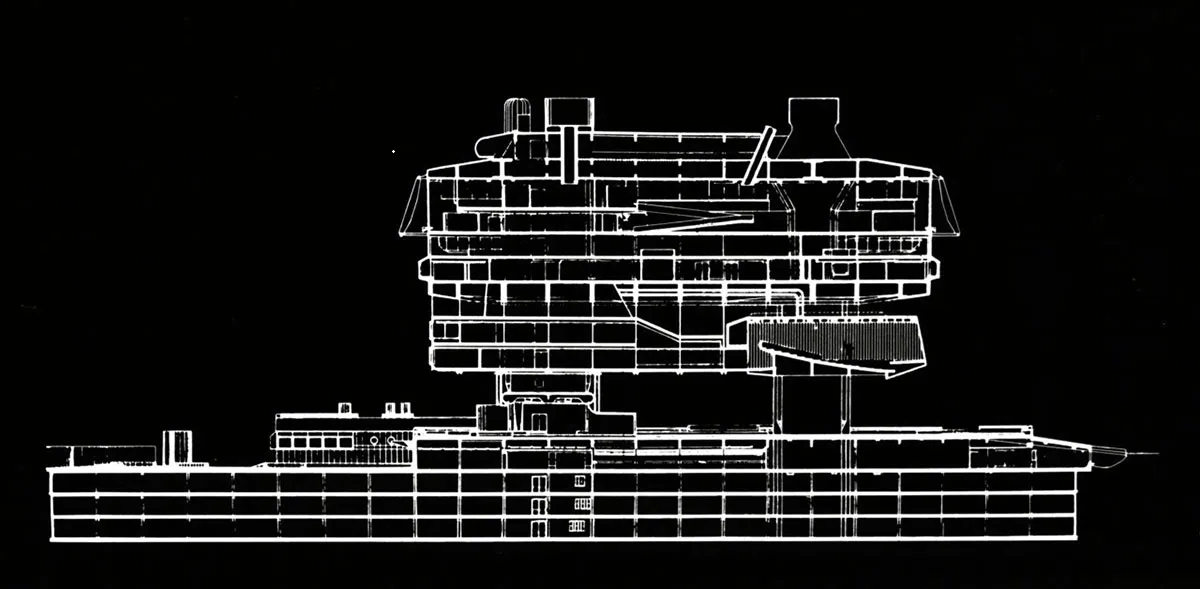
Banco de Londres y América del Sur — Clorindo Testa, Buenos Aires, 1966
Architectural Significance
The Banco de Londres y América del Sur is widely regarded as one of the most important works of twentieth-century Latin American architecture. Designed by Clorindo Testa in collaboration with SEPRA, the building challenged conventional distinctions between structure, enclosure and public space, establishing a powerful civic presence within the dense urban fabric of Buenos Aires.
Rather than treating the façade as a separate layer applied to a building, the project integrates structure, enclosure and occupation within a single architectural framework. The resulting architecture is simultaneously monumental and permeable, creating a building whose identity emerges directly from its constructive logic.
Structure, Enclosure and Public Space
One of the building's most significant contributions is its use of structure as an environmental and spatial mediator. Deep concrete elements form a layered façade that filters light, frames views and creates a transition between the public realm and the banking hall beyond.
The structural system extends beyond its conventional role as a means of support. Columns, beams and enclosure elements are organised to shape movement, occupation and environmental performance simultaneously. Structure therefore becomes an active participant in the architectural experience rather than a hidden technical framework.
The building also demonstrates how architecture can contribute to civic life. Open ground-floor spaces, visual permeability and carefully orchestrated relationships between interior and exterior create a public character that extends beyond the functional requirements of the institution itself.
Construction and Architectural Expression
The architectural character of the building emerges directly from its construction. Exposed concrete, deep structural members and carefully articulated connections generate a clear and legible architectural language without reliance on applied ornament.
This integration of construction and expression illustrates how architectural identity can arise through the organisation of structural, environmental and spatial systems. The building reveals how it is made, how it stands and how it mediates between occupation and the city.
The project therefore demonstrates that architectural richness can emerge through constructive clarity rather than formal complexity alone.
Continuing Relevance
The continuing relevance of the Banco de Londres lies in its demonstration that structure, enclosure and public space can be developed as parts of a single architectural idea. The project shows how environmental performance, civic presence and architectural expression can emerge through the careful coordination of relationships rather than through the addition of separate technical systems.
More than half a century after its completion, the building remains an important precedent for architecture that seeks to integrate structure, climate and occupation within a coherent whole. Its enduring lesson is that construction can be a generator of architectural meaning, allowing buildings to achieve both technical performance and civic significance through the same organisational framework.