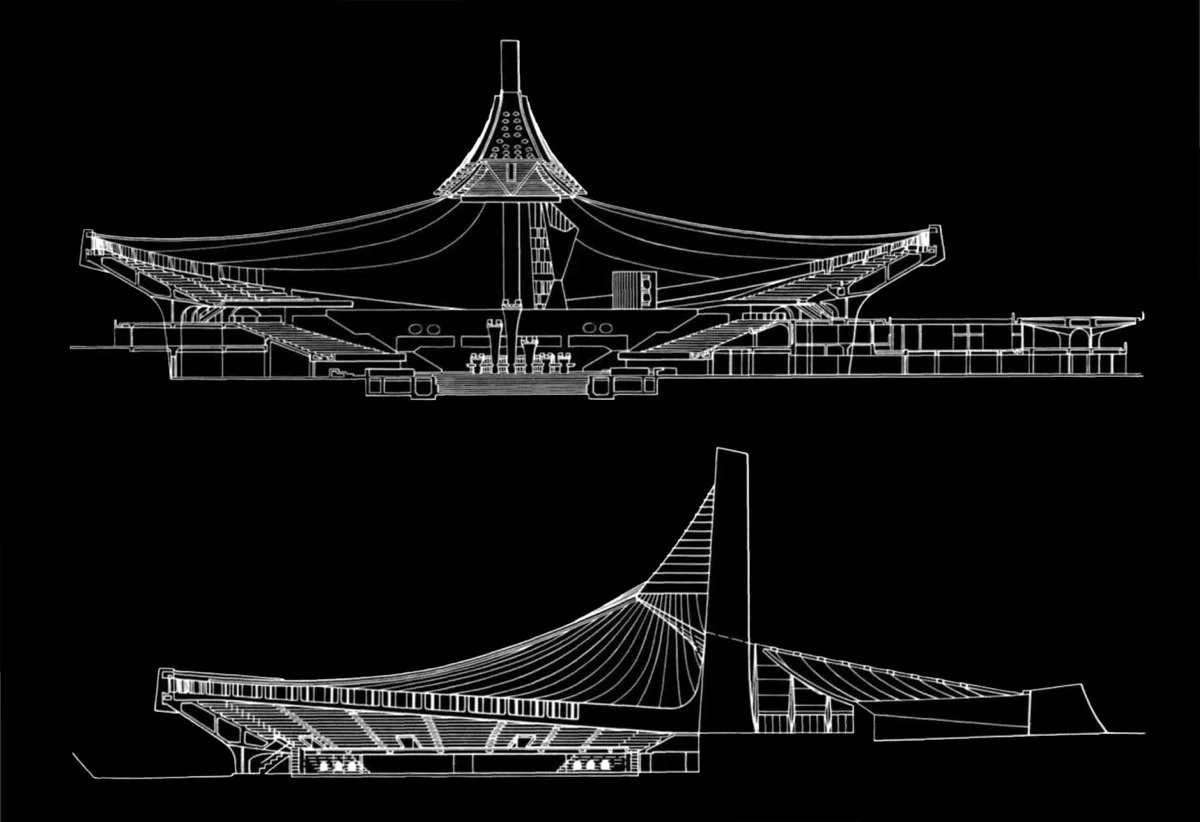
Yoyogi National Stadium — Kenzo Tange, Tokyo, 1964
Architectural Significance
Designed for the 1964 Tokyo Olympic Games, Yoyogi National Stadium remains one of the most important works of twentieth-century architecture. The project brought together structural innovation, architectural expression and civic ambition in a manner that continues to influence public buildings today.
Its suspended roof structure demonstrated how structural reasoning could become a primary generator of architectural form rather than a hidden technical system. Structure, enclosure and spatial experience are combined within a single architectural idea, creating a building whose identity emerges directly from its method of construction.
Structure and Civic Space
The most significant contribution of Yoyogi National Stadium lies in its use of long-span suspension structures to create large column-free interior spaces. The building demonstrates how structural systems can simultaneously resolve technical requirements and generate powerful architectural character.
Rather than treating structure as a separate discipline, the project integrates structural behaviour into the conception of the building itself. The sweeping roof form is both a response to forces and a defining architectural gesture, making the behaviour of the structure visible to the public.
This integration of structural reasoning and architectural form allows the building to achieve both technical efficiency and spatial drama. The interior is experienced as a continuous civic space shaped by structure, light and movement rather than by enclosure alone.
Landscape and Context
The building also demonstrates a sensitive relationship between architecture and landscape. The roof forms rise from the site as part of a larger composition of topography, open space and movement. Rather than functioning as an isolated object, the stadium contributes to a broader civic environment.
Tange combined contemporary structural innovation with an understanding of Japanese spatial traditions, creating an architecture that was technologically progressive while remaining culturally grounded. This balance between innovation and continuity remains one of the project's most enduring achievements.
Continuing Relevance
More than sixty years after its completion, Yoyogi National Stadium continues to demonstrate how architecture can unite structure, public life and civic identity within a coherent whole. It remains an important precedent because it shows that technical innovation and architectural expression need not be separate ambitions.
The project illustrates how structural systems can generate space, establish identity and contribute to collective experience. Its enduring lesson is that architecture becomes most powerful when form emerges directly from an understanding of how buildings work, stand and perform.